


Strategic Overview: The Green Industrial Framework
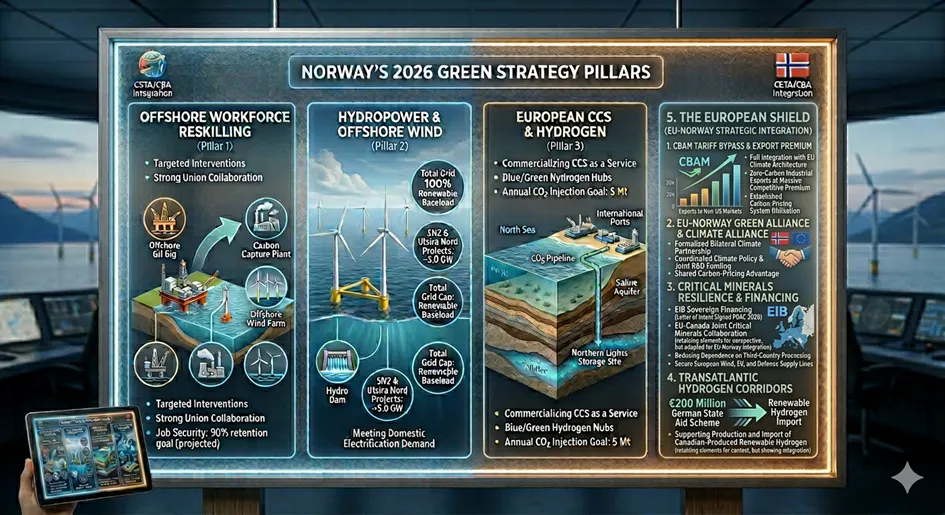
For professional networks and executive stakeholders, the strategic shift of Norway's industrial policy can be summarized through the following strategic blueprint, reflecting the structure and logic of emerging green industrial markets:
NORWAY: The 'Green Industrial Initiative' Gateway Architecting the North Sea's Transition How does a nation whose immense sovereign wealth and modern economy were built on North Sea petroleum pivot to become Europe's indispensable green energy battery and carbon sink?
Norway is executing a high-stakes, meticulously engineered strategic turn, built on its "Green Industrial Initiative" (Grønt industriløft) and undisputed dominance in offshore operations. Leveraging its massive sovereign wealth fund and deeply integrated state-capitalism model, Norway is transforming from Western Europe's premier fossil fuel exporter into an integrated hub for carbon management, marine renewables, and critical mineral supply chains.
Here are the five pillars of Norway's strategy as of 2026:
1. The Tripartite "Just Transition" and Offshore Reskilling: Phasing down peak petroleum reliance while actively repurposing the unparalleled offshore engineering expertise of its oil and gas workforce. Through targeted state interventions and strong union collaboration, Norway is funneling human capital directly into carbon capture and offshore wind sectors to maintain job security and regional economic stability. 2. Hydropower Supremacy & Offshore Wind Expansion: Capitalizing on a grid that is already nearly 100% renewable baseload (hydroelectric). To meet the soaring domestic demand from electrification and heavy industry without depleting its baseload, Norway is heavily backing commercial-scale floating and bottom-fixed offshore wind developments. 3. The European Carbon Sink (CCS) & Clean Hydrogen: Transforming the deep saline aquifers of the North Sea into Europe's premier carbon storage reservoir. Backed by the historic "Longship" project and the operational "Northern Lights" facility—which received its first international CO2 shipments in 2025—Norway is commercializing Carbon Capture and Storage (CCS) as a service alongside blue and green maritime hydrogen hubs. 4. Critical Minerals & Deep-Sea Commercialization: Pivoting aggressively to secure European supply chain independence. Bolstered by the National Battery Strategy, Norway has integrated a domestic battery manufacturing pipeline while making the highly controversial geopolitical move to open its extended continental shelf to commercial deep-sea mining exploration for rare earth metals. 5. The European Shield: EU-Norway Strategic Integration: Operating outside the EU but completely integrated into its climate architecture through the EU-Norway Green Alliance. Norway utilizes its established carbon-pricing systems and green grid to completely bypass European carbon border tariffs (CBAM), positioning its zero-carbon industrial exports at a massive competitive premium.
Norway's message is clear: The North Sea's legacy was built on extracting carbon; its future will be defined by capturing it and powering the European Green Century.
Pillar 1: Labor, Equity, and the "Just Transition" of the North Sea
Norway’s transition away from its status as a petroleum titan is governed by the principles of a "just transition," heavily mediated by the country's historic tripartite model involving the state, capital (employers), and highly organized labor unions.
The offshore oil and gas industry has traditionally offered unparalleled wages and security for Norwegian workers, accounting directly and indirectly for hundreds of thousands of jobs. However, union surveys leading into the mid-2020s indicated growing anxiety among offshore workers regarding the precariousness of long-term petroleum investments. Recognizing the structural threat of stranded human capital, the Norwegian state explicitly linked its Green Industrial Initiative to proactive labor transition.
Instead of a disruptive phase-out, the government crafted a transformation narrative: replacing oil platforms with floating wind turbines and converting oil extraction wells into CO2 injection sites. This repurposing leverages the exact maritime engineering, subsea piping, and extreme-weather operational skills possessed by current petroleum workers.
By mandating social protection, retraining subsidies, and stringent collective bargaining conditions on all new green offshore licenses, the state mitigates the friction between climate imperatives and industrial livelihood.
Legislative / Programmatic Component
Primary Objective
Funding & Structural Mechanisms
Targeted Jurisdictions
Green Industrial Initiative (Grønt industriløft)
Accelerate industrial transition and secure domestic manufacturing.
Direct subsidies, state loans, and targeted public procurement.
National focus on process industries and maritime manufacturing.
Tripartite Climate Partnerships
Enshrine worker-centered dialogue into sectoral phase-down plans.
Mandated negotiations between government, offshore industry boards, and labor unions.
Offshore workers; primarily Western and Southern coastal hubs.
HyValue & Competence Hubs
Reskill engineers for the hydrogen and CCUS economy.
Publicly funded research centers and vocational integration programs.
Bergen, Stavanger, and the broader Vestland region.
Pillar 2: Grid Expansion, Hydropower Baseload, and Offshore Wind
Norway approaches the energy transition with an enviable structural advantage: its electricity grid is virtually entirely decarbonized, powered by over 90% hydroelectric generation. However, the aggressive push to electrify transport, heavy industry, and offshore petroleum platforms to meet strict national climate targets requires an unprecedented expansion of power generation.
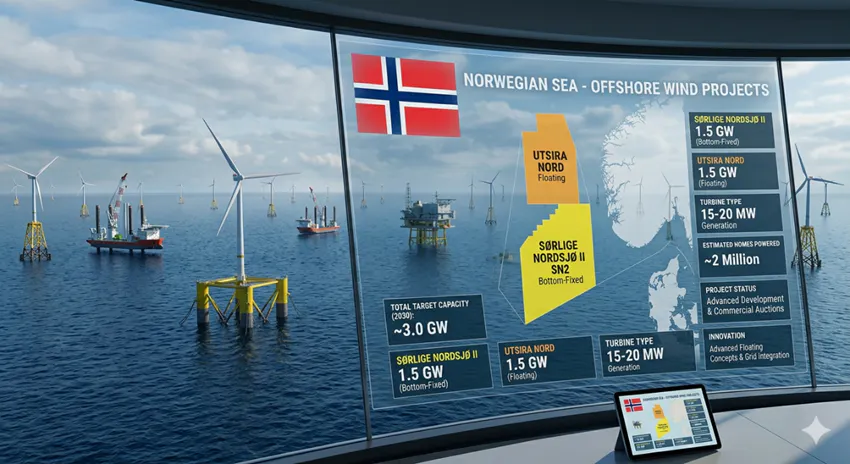
The national strategy focuses on preserving the cheap, flexible hydropower for domestic industrial baseload while rapidly scaling offshore wind in the harsh environments of the North Sea. The state has identified and auctioned massive maritime zones, specifically the Sørlige Nordsjø II (Southern North Sea II) and Utsira Nord projects, targeting a monumental build-out of bottom-fixed and advanced floating offshore wind.
This expansion is not without systemic friction. A fierce domestic debate continues over energy allocation. Exporting clean power to the European continent via interconnectors historically drives up domestic electricity prices, drawing intense political backlash from both energy-intensive process industries (like aluminum smelting) and domestic consumers. The government must continuously calibrate its offshore build-out to ensure sufficient localized power for domestic battery gigafactories rather than purely functioning as Europe's power plant.
Grid Strategy Vector
Technical & Strategic Focus
Key Regulatory Drivers
Systemic Challenges
Utsira Nord Floating Wind
Commercializing deep-water floating offshore wind technology.
Generous state aid frameworks to overcome initial technology premiums.
Extremely high capital costs and global offshore wind supply chain bottlenecks.
Onshore Grid Optimization
Expanding transmission lines to integrate new industrial loads (gigafactories).
Statnett's national grid development plans.
Deep public opposition to onshore wind and overland transmission lines.
Platform Electrification
Powering remaining offshore oil and gas rigs via renewable cables from shore.
Parliament-mandated sectoral emission reduction targets for petroleum.
Cannibalization of onshore green power for fossil fuel extraction processes.
Pillar 3: Carbon Capture (CCS), Hydrogen, and the European Carbon Sink
Norway has effectively commercialized carbon management as an industrial service. The cornerstone of this capability is the Longship (Langskip) full-scale CCS project, an end-to-end value chain designed to prove that industrial carbon can be captured, transported, and stored safely at scale.
The transportation and storage component, Northern Lights (a joint venture by Equinor, Shell, and TotalEnergies), represents the world's first open-source, cross-border CO2 transport and storage infrastructure. Following the completion of onshore facilities in Øygarden in 2024, Northern Lights achieved a historic milestone in August 2025 by successfully receiving and injecting its first commercial CO2 shipments into a reservoir 2,600 meters below the seabed. Driven by high demand from European cement and heavy industries, developers are aggressively advancing Phase 2 investments to expand injection capacity to over 5 million tonnes annually.
In parallel, Norway is cultivating a sophisticated clean hydrogen economy, focusing heavily on maritime applications. By coupling its CCS infrastructure with its natural gas reserves, Norway is producing massive quantities of blue hydrogen as a transitionary fuel for the European market, alongside electrolytic green hydrogen developments geared toward decarbonizing its domestic shipping and ferry fleets.
Regional CCS & Fuel Hub
Primary Industrial Partners
Technological Vector
Export & Strategic Market
Northern Lights (Øygarden)
Equinor, Shell, TotalEnergies, Heidelberg Materials.
Liquefied CO2 shipping, subsea pipeline transport, and saline aquifer injection.
European heavy industries requiring immediate hard-to-abate emission relief.
Vestland Hydrogen Clusters
NORCE, HyValue, local maritime operators.
Blue and green hydrogen integration into maritime fuel cells and ammonia.
Domestic zero-emission ferries, offshore supply vessels, and short-sea shipping.
Brevik CCS Facility
Heidelberg Materials, Norwegian State.
Post-combustion carbon capture retrofitted onto cement production.
Domestic blueprint for heavy industrial decarbonization.
Pillar 4: Critical Minerals, Deep-Sea Mining, and the Nordic Battery Strategy
To secure its position within the high-value downstream manufacturing sector, the government launched the National Battery Strategy in 2022. The strategy aggressively targets the electric vehicle (EV) and grid storage markets by leveraging the country’s clean energy mix to guarantee ultra-low carbon footprints for battery cells. This attracted massive investments into downstream gigafactories such as Morrow Batteries and Freyr.
However, recognizing that gigafactories remain heavily dependent on Asian supply chains for raw materials, Norway executed one of the most controversial geopolitical maneuvers of the energy transition. In early 2024, the Norwegian Parliament officially authorized the opening of its extended continental shelf in the Arctic for commercial deep-sea mining exploration.
Geologists estimate these subsea crusts contain immense reserves of copper, cobalt, zinc, and rare earth elements—materials critically necessary for the global energy transition. While this move solidifies Norway's intent to break European reliance on foreign monopolies and build a completely vertically integrated Nordic supply chain, it has sparked intense opposition from global marine biologists, environmental ESG funds, and the EU itself over the unknown ecological impacts on deep-ocean biodiversity.
Downstream Facility / Resource
Primary Proponents
Project Status & Focus
Role in Integrated Supply Chain
Morrow Batteries (Arendal)
Morrow, State loans, regional utility partners.
Active operations and scaling. Focus on LFP battery technologies.
High-volume battery cell manufacturing powered by cheap southern hydro.
Freyr Battery (Mo i Rana)
Freyr, regional industrial parks.
Pivoting strategy; scaling next-generation clean cell production.
Large-scale battery cell manufacturing with arctic cooling efficiencies.
Arctic Deep-Sea Exploration
Norwegian Offshore Directorate, specialized subsea mining firms.
Parliament-approved exploration phase (2024-ongoing).
Upstream extraction of cobalt, copper, and rare earths to bypass foreign chokepoints.
Pillar 5: The European Shield: EU-Norway Strategic Integration
Norway is not a member of the European Union, yet its economic survival depends entirely on frictionless trade with the European single market. To insulate its economy from geopolitical volatility and align with the European Green Deal, the two entities formalized the EU-Norway Green Alliance in 2023.
This alliance coordinates strategic action across climate policy, critical raw materials, and clean energy financing. Most importantly, it serves as a protective shield for Norwegian exports against the EU’s Carbon Border Adjustment Mechanism (CBAM), which went into effect in 2026. Because Norway already enforces one of the world’s highest domestic carbon taxes and possesses a near-zero emission power grid, embedded emissions in Norwegian aluminum, battery cells, and fertilizers are negligible.
As the CBAM forces tariffs on carbon-intensive imports from Asia and the Americas, Norwegian industrial products are granted a massive structural pricing advantage in the European market. Norway thus positions itself not merely as a trade partner, but as Europe's primary strategic asset for energy security—supplying transitional natural gas in the short term, while seamlessly substituting it with clean power, hydrogen, and critical minerals in the long term.
Strategic Inquiries: Practical Questions for Norway's Transition Path
As Norway moves beyond the foundational phases of its Green Industrial Initiative, policymakers, and financial institutions face several critical, unresolved challenges that will dictate the ultimate success of the transition:
1. The Deep-Sea ESG Paradox
The Question: Will Norway's unilateral push into commercial deep-sea mining secure Europe’s critical mineral supply chain, or will the international environmental backlash cause global EV manufacturers to boycott Norwegian minerals due to strict corporate ESG commitments?
The Context: Automakers are increasingly prioritizing supply chain transparency and biodiversity protection. If European OEMs refuse to purchase deep-sea extracted minerals due to reputational risk, Norway's multi-billion krone subsea gamble could result in a commercially stranded asset.
2. CCS Economics vs. Genuine Decarbonization
The Question: Can the Northern Lights project and the broader "Longship" strategy achieve true commercial profitability without perpetual state subsidies, and does offering "carbon storage as a service" inadvertently prolong the lifespan of fossil-fuel infrastructure in Europe?
The Context: While CCS is technologically proven, the capital expenditures are astronomical. If carbon pricing under the EU ETS does not remain consistently high enough to incentivize heavy industries to pay for shipping their CO2 to Norway, the business model will collapse back onto the Norwegian taxpayer.
3. The Grid Allocation Dilemma
The Question: As onshore wind faces extreme local opposition and offshore wind experiences delayed deployment timelines, how will the Norwegian state prioritize its finite clean baseload power?
The Context: The simultaneous demand to electrify remaining offshore oil platforms, establish energy-intensive battery gigafactories, and honor European export interconnectors is pushing the domestic grid to its limits. Norway must soon make a definitive political choice between exporting clean electrons or reserving them exclusively for domestic green industrial growth.
Comprehensive Summary
Norway’s green industrial transition represents a meticulously engineered, state-backed strategy leveraging the nation’s extensive offshore engineering expertise and immense financial resources. Under the "Grønt industriløft" (Green Industrial Initiative), the country is structurally reshaping its economy across five core pillars: securing a worker-centered "just transition" for the petroleum workforce, expanding its hydro-dominated grid with massive offshore wind developments (such as Utsira Nord), commercializing carbon capture and storage (CCS) through the landmark Northern Lights project, scaling battery manufacturing alongside pioneering deep-sea mining for critical minerals, and integrating deeply with the European market via the EU-Norway Green Alliance. This strategic positioning allows Norwegian exports to completely bypass CBAM tariffs, cementing the nation as Europe’s indispensable clean energy shield, even as it navigates intense domestic friction over electricity allocation, rising energy prices, and environmental trade-offs.
Critical Vulnerabilities & Friction Points
The ESG & Market Alignment Dilemma: How will Norway reconcile the geopolitical necessity and environmental risks of Arctic deep-sea mining with the strict sustainability mandates of European automotive OEMs to prevent these critical minerals from becoming reputationally stranded assets?
The Grid Capacity & Allocation Choice: Can the Norwegian grid simultaneously absorb the massive loads of onshore battery gigafactories, fulfill offshore platform electrification mandates, and maintain European export interconnectors without triggering unsustainable domestic electricity price inflation?
The Commercial Viability of CCS: Will the pricing of carbon allowances under the EU ETS remain high enough to incentivize European heavy industries to pay for cross-border carbon shipping, ensuring the financial self-sufficiency of the Northern Lights project without permanent state subsidies?