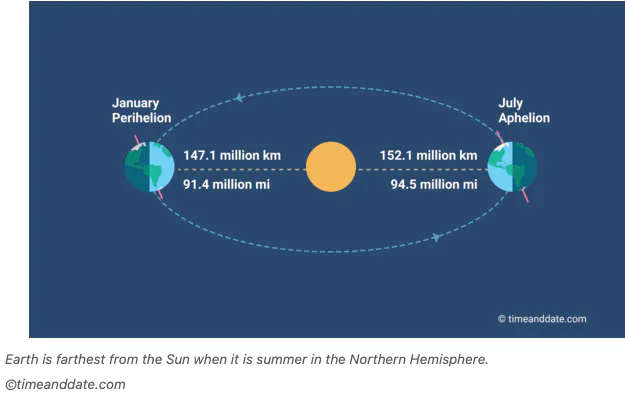
Timeanddate.com: “Perihelion and Aphelion.”
My reason for posting this will become clear shortly. The exaggerated ellipse in the figure emphasizes that the orbit of our planet is not a perfect circle, but rather varies over the course of each year. “The Earth is closest to the Sun, at its perihelion, about two weeks after the December solstice and farthest from the Sun, or at its aphelion, about two weeks after the June solstice.”
The root of both words goes back to Helios, the Titan god of the Sun in ancient Greek mythology, often depicted with a radiant crown, driving his four-horse chariot across the sky each day, bringing light to gods + mortals. “This path’s shape varies due to the gravitational influences of other planetary objects, particularly the Moon.” But also Saturn + Jupiter.
This variation over 100,000 years is called ellipticity, + is one of the famous 3 Milankovitch celestial cycles, about which nothing more will be said today. Another more subtle point is that the Earth doesn’t actually rotate around the Sun, rather both rotate about their joint center of mass—which lies within the star given its huge mass compared to any of the planets.
“In 1246, the December Solstice was on the same day as the Earth reached its perihelion.” Since then, the perihelion and aphelion dates have drifted by a day every 58 years. “In the short-term, the dates can vary up to two days from one year to another.”
And as it turns out, this year it exactly corresponds to my younger + better looking brother Jonathan’s birthday today. As if that’s not enough, he is taller + a black belt in karate + has 3 gorgeous daughters. So, here’s looking at you, kid.
BTW, this is the only present you’re getting.