


Are Indian DISCOMs ready for "big AI", or should we start with disciplined "small ML" at the grid edge? New article explores why TinyML on poles, DTRs and AMI analytics may be the fastest route to reliable, trusted AI in distribution networks.
Agenda
· How India's DISCOMs are already laying the groundwork for AI
· Why "small ML first" accelerates, not delays, advanced AI
· Tiny ML at the grid edge: poles, DTRs, and LV networks
· Strengthening reliability indices and data foundations
· A phased, opportunity-driven roadmap for Indian utilities
1. India's DISCOMs: From Pilots to Platforms
Over the last few years, India's distribution utilities have made a quiet but significant shift from manual operations to data-enabled decision-making. Large AMI programmes, GIS rollouts, control centres and IT–OT integration initiatives are creating the digital fabric on which future AI applications will run[1][2][3]. Policymakers have also clearly signalled that AI/ML will play a pivotal role in improving efficiency, integrating renewables and delivering high-quality supply to consumers
1. Moving Beyond AI Slogans in Distribution
Over the last few years, AI and ML have moved from conference buzzwords into policy speeches and programme roadmaps for India's power sector[1]. At the same time, utilities have been investing heavily in smart meters, GIS, SCADA, control centres and IT–OT integration under various central schemes and their own digitalisation plans[2][3].
What this creates is an interesting moment for Indian DISCOMs: there is both top-down pressure to "do AI" and bottom-up growth in operational data streams. The challenge is to connect the two in a way that works with the realities of 11 kV and LT networks, not just with idealised diagrams in a slide deck.
2. The Real Starting Point: Edge Visibility and Consistent Data
From an engineering perspective, "AI readiness" for a DISCOM is less about installing a new platform and more about three hard prerequisites: a coherent network model (topology plus assets) that systems can agree on, time-synchronised event and measurement streams, and a repeatable path from detection to field action to closure.
In many Indian utilities, the topology lives primarily in GIS and design drawings, while real-time states sit in SCADA (for primary network), with AMI/MDMS handling meter data and OMS/DMS recording outages[2][3]. Several independent assessments show that DISCOMs are at different stages of maturity in SAIDI/SAIFI reporting, feeder-wise interruption data and historical record-keeping[4]. In parallel, IT–OT studies point out that these systems often evolved as separate islands and are now being stitched together into more integrated architectures[2][5].
For robust AI/ML, these layers must be reconciled along three axes:
· Keys: consistent asset IDs (feeder, DTR, pole, meter), unique consumer IDs, and stable mapping tables
· Time: clocks aligned within seconds across OT and IT systems to make sequence-of-events meaningful
· Semantics: harmonised event types and cause codes so that "DT overload" or "conductor fault" mean the same thing across SCADA, OMS, and field reports
This is exactly where TinyML and focused AMI analytics can be designed not just as solutions, but as data structure enforcers: each deployment tests and hardens these keys, time alignment, and semantics for a targeted part of the network.
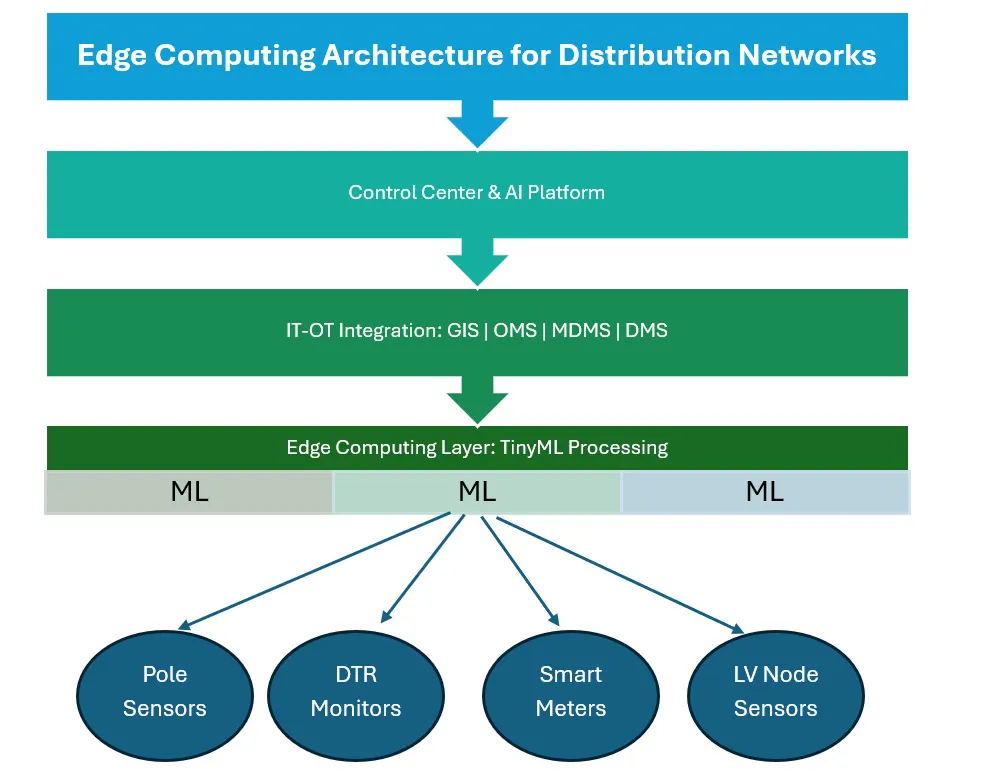
Figure 1: TinyML sensor node mounted on distribution pole for structural health monitoring
3. TinyML: Putting Intelligence Where Problems Actually Occur
From a hardware and firmware standpoint, a practical TinyML node for an Indian distribution environment typically comprises:
· MCU/SoC: Low-power microcontroller (Cortex-M4/M33 class or ESP32) with enough RAM/flash to hold a small model (tens of KB), sampling routines, and communication stack
· Sensors: MEMS accelerometer/inclinometer (pole tilt, vibration), temperature sensor (DTR thermal monitoring), optional strain or Hall sensors
· Power: Small solar panel plus Li-ion battery, or tap off LV line via suitably designed auxiliary supply
· Communications: RF mesh (sub-GHz), NB-IoT, or LoRaWAN depending on coverage and existing utility telecom infrastructure
· Protection: IP-rated enclosure, surge/lightning protection, EMI/EMC-robust design
A realistic TinyML approach uses lightweight time-series features (RMS, variance, dominant frequency peaks, kurtosis) computed over short windows from accelerometer data, combined with very compact models such as one-class SVM, tiny boosted trees, or small fully connected networks with 8-bit quantization using frameworks like TensorFlow Lite Micro[6].
Example concept for pole tilt/vibration monitoring:
· Sampling accelerometer at 50–100 Hz during short listening intervals
· Computing feature vectors over sliding windows (1–2 seconds)
· Comparing features against a learned envelope of normal behavior
· Escalating to network (event uplink) only when multiple consecutive windows are out-of-band in a pattern consistent with structural change rather than a single gust
For DTR thermal/overload monitoring:
· Sampling temperature and load proxy every few minutes
· Building a local model of normal cooling and heating curves vs. ambient and time-of-day
· Raising graded alerts: "drift from baseline" → "abnormal persistence" → "pre-fault risk" before a Buchholz or fuse operation happens
Because most sampling and classification load is on the MCU, network traffic is limited to concise events (JSON payloads of a few dozen bytes), making large-scale deployment feasible under constrained backhaul.
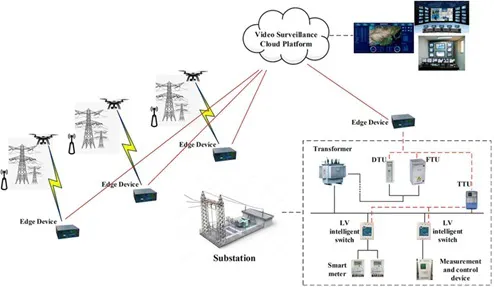
Figure 2: Edge computing architecture in smart grid: from poles and distribution transformers to substation and cloud platform
4. AMI Analytics: Data Engineering for Revenue Protection
Smart meter rollouts under recent schemes have opened another rich area for "small ML": targeted AMI analytics for revenue and loss control[7]. A robust technical approach includes:
Data engineering layer:
· Stream ingestion from HES/MDMS into a time-series store or data lake, with partitioning by utility, region, feeder, and time
· Standardised schema: Meter ID, consumer ID, asset mapping keys (feeder/DTR), timestamp (UTC plus offset), channel type (kWh, kW, voltage), quality flags
· Reference data: Tariff tables, sanctioned load, consumer category, connection type, location tags, historical disconnection status
· Alignment to network: Periodic reconciliation of meter-to-DTR mapping via engineering records plus consumption-based validation
Feature engineering for ML:
For tamper/theft detection at meter or small group level:
· Load shape features: weekday/weekend profiles, peak/off-peak ratios, typical daily energy, seasonal variations
· Event features: frequency of outages, voltage sags, tamper events, terminal cover open, neutral disturbance
· Behavioural changes: percentage drop in consumption after specific dates, or unusual alignment with tariff changes
· Peer comparison: deviation from peer group of similar category/sanctioned load in the same climatic/feeder area
For DTR-level energy balance and loss analysis:
· Aggregated consumption (sum of mapped meters) vs. DTR input energy (from SCADA/DTR meters), normalised by estimated technical losses
· Temporal patterns in the gap: systematic night-time gap suggests theft; time-of-day variation may indicate agricultural/unmetered loads
· Stability/instability indices over weeks/months to identify persistent vs. transient anomalies
For customer segmentation and DSM:
· Clustering features derived from typical 24-hour load shapes, volatility, response to outages, and seasonality
· Classification into "flat", "peaky", "nocturnal", "weekend heavy", etc., to inform time-of-use tariffs and targeted DSM programmes
Model deployment and integration:
Operationally, ML outputs feed into processes: integration with CRM/field force tools for automatic case creation (site visit, remote check, customer engagement), prioritisation logic combining ML score with revenue at risk, and feedback loops where investigation outcomes re-train or recalibrate models periodically[7].
5. Building the Digital Twin Through Edge Deployments
Technical teams often talk about "digital twins" and "common data models", but these remain abstract until linked to actual event flows. In a concrete implementation, each TinyML node and AMI analytic case becomes a data contract between systems.
Every edge or AMI event carries:
· Asset and topological identifiers (feeder, DTR, pole, LV segment, meter)
· Geo-coordinates (from GIS) where applicable
· Time-stamps in a unified time base (UTC with zone offset)
· Event taxonomy (for example, STRUCTURAL_DRIFT, THERMAL_DRIFT, LV_IMBALANCE, AMI_TAMPER_SUSPECTED, DTR_LOSS_ANOMALY)
· Severity, confidence score, and recommended action type
This is then persisted in an event store that acts as a backbone for reliability metrics (SAIDI/SAIFI computed not only from OMS tickets but enriched with early warning and near-miss events), asset health indices (composite scores per pole, DTR, and LV section based on counts and recency of edge-ML alerts), and model supervision (tracking how often ML alerts are confirmed, leading to quantifiable precision/recall and regulatory-grade documentation)[2][4].
In practice, the "digital twin" is not a single monolithic model but the emergent result of up-to-date GIS topology, consistent asset IDs across GIS/SCADA/AMI/OMS, and time-series and event streams that are asset-centric rather than system-centric. TinyML and AMI analytics, if designed with this in mind, become the fastest way to stress-test and refine this twin in live operation.
6. A Staged Technical Roadmap
A more technical formulation of the three-step roadmap:
Step 1 – Baseline data and integration
· Establish a canonical asset registry and connectivity model in GIS, with APIs that other systems must use
· Implement a time synchronisation policy: NTP/PTP or equivalent across OT and IT, with monitoring of clock drift
· Create a unified event bus or integration layer (Kafka topics, MQTT brokers, or ESB) where SCADA, AMI, OMS, TinyML nodes and enterprise systems publish structured events
Step 2 – Targeted edge-ML and AMI deployments
Design 2–3 anchor use cases with clear KPIs:
· Example 1: 11 kV line segment with chronic wind/vegetation faults → deploy pole TinyML plus vegetation management analytics
· Example 2: High-loss DTR cluster → AMI-based loss and theft analytics plus DTR thermal TinyML
· Example 3: Urban LV network with voltage complaints → LV node sensors plus AMI voltage analytics
For each use case, define sensor/AMI data requirements, model type and training data needs, integration points (OMS ticketing, DMS switching suggestions, maintenance planning, revenue protection workflows), and feedback metrics (reduced interruptions, reduced AT&C loss, fewer truck rolls, detection lead time).
Step 3 – System-level AI
Once confidence is established, introduce feeder/DTR-level forecasting models using historical load (from AMI/SCADA), weather data, outage/derating history, and customer mix. Build predictive maintenance libraries with feature sets combining SCADA alarms, OMS events, TinyML alerts, and asset metadata. Pilot AI-assisted optimisation in constrained areas: reconfiguration suggestions under N-1 scenarios, Volt/VAR and tap settings recommendations, and scheduled outage planning that minimises customer impact by leveraging demand forecasts[8][9].
In all steps, the underlying principle remains: each new AI/ML capability must be grounded in the cleaned keys, time, and semantics that TinyML and AMI analytics helped to establish.
7. Conclusion
India's distribution sector is already doing the hard work of digitalisation—rolling out AMI, building GIS models, modernising control rooms and improving outage reporting[3][7][9]. AI and ML can accelerate this journey, but only if introduced in a way that respects where data is born: at the pole, at the transformer, and at the consumer's meter.
A "small ML first" approach, especially through TinyML and targeted AMI analytics, allows the grid itself to become a training ground for future AI. Edge intelligence improves reliability and loss control today, while generating the structured, asset-centric datasets that tomorrow's larger AI systems will need[2][6][7]. For Indian DISCOMs, that may be the most realistic—and ultimately the fastest—way to turn AI from a headline into a dependable tool in everyday operations.
References
[1] Press Information Bureau. (2025). AI and machine learning based applications to play pivotal role in transforming India's power sector. Government of India. https://www.pib.gov.in/PressReleasePage.aspx?PRID=2199988
[2] GIZ & Accenture. (2023). IT-OT Integration for Indian DISCOMs. Indo-German Energy Program. https://energyforum.in/fileadmin/india/media_elements/publications/20230413_DISCOM_REPORTS/GIZ-Accenture_IT-OT_Integration_for_Indian_DISCOMs.pdf
[3] GIZ & Accenture. (2023). Smart Meter Interoperability and Data Management for Indian DISCOMs. Indo-German Energy Program.
[4] The Leap Journal. (2025). A review of outage reporting by Indian DISCOMs. The Leap Blog. https://blog.theleapjournal.org/2025/09/a-review-of-outage-reporting-by-indian.html
[5] Powerline. (2022). Integrated approach: IT-OT convergence a key imperative for power utilities. https://powerline.net.in/2022/04/28/integrated-approach-2/
[6] Nature Scientific Reports. (2025). TinyML with CTGAN based smart industry power load usage prediction. Scientific Reports, 15. https://www.nature.com/articles/s41598-025-25678-x
[7] Critical River. (2025). AI in energy sector: Smart meter QC, energy auditing & revenue protection under RDSS and IPDS. https://www.criticalriver.com/ai-power-distribution-india-rdss-ipds/
[8] 360info. (2025). AI-ML models can help India's discoms be sustainable in scorching summer. https://360info.org/ai-ml-models-can-help-indias-discoms-be-sustainable-in-scorching-summer/
[9] Powerline. (2026). Discom digitalisation: Moving to data-led planning and predictive operations. https://powerline.net.in/2026/02/23/discom-digitalisation-moving-to-data-led-planning-and-predictive-operations/