


The Grid Is More Constrained Than Ever — and That’s Not All Bad
Every utility leader today is grappling with the same reality: the grid is constrained in more places, more often, and for more reasons than ever before. Load growth (accelerated by data centers and other large loads), electrification, DER integration, and extreme weather are converging to stress infrastructure that was never designed for this level of complexity or rapid change. Planning cycles are moving from 15-20 timeframes to 3-5 years.
Yet the very pressures that strain the grid are also clarifying where it’s ready to advance. Constraints don’t just expose vulnerabilities. They also highlight increased potential for investment options, new and innovative operating models, and advanced technologies that will deliver the greatest impact. For utilities that have invested in creating a modernization journey map, reading those signals and signposts makes the path forward sharper, more actionable, and more strategically aligned. Lastly, with the right focus, it also makes the utility nimbler and better able to change direction quickly.
Transmission Bottlenecks Are Driving Smarter Solutions
Historically, transmission congestion was viewed as a problem to be solved with more steel in the ground – more capacity, more lines, expanded substations, and so on. Today, congestion is prompting utilities to deploy a broader suite of grid‑enhancing technologies (GETs) that increase transfer capability, redirect flows, provide localized congestion relief, and optimize the network in real time. These solutions fall into three complementary categories:
Flow‑redirecting technologies, including advanced power flow controllers, phase‑shifting transformers, and FACTS devices that push power off overloaded lines and towards their destinations over underutilized corridors.
Capacity‑increasing technologies, such as advanced (carbon-core) conductors, high‑temperature low‑sag (HTLS) reconductoring, and dynamic line ratings that safely increase the usable capacity of existing assets or increase the number of hours they can operate closer to their limits.
Real‑time optimization technologies, including topology optimization, advanced analytics, PMUs, WAMS, and enhanced state estimation, that help operators identify switching actions and run the system closer to its true limits.
Distribution Constraints Are Accelerating Innovation
Distribution‑level constraints, from hosting capacity limits to EV clustering and DER variability, are pushing utilities to adopt a new generation of distribution‑enhancing strategies that improve flexibility, visibility, and control. These include:
Targeted storage deployments, especially battery energy storage systems (BESS) – either fixed or mobile, that provide localized capacity, voltage support, and peak shaving.
Flexible load and managed charging programs, including traditional and automated Demand Response.
Non‑wires alternatives (NWAs), such as microgrids and Virtual Power Plants that aggregate DERs and other distribution-level generation into dispatchable grid assets that defer or avoid traditional upgrades.
Advanced forecasting and granular edge-visibility tools that improve situational awareness and predictability, helping the distribution operator under both normal and emergency operations.
Regulatory frameworks such as Integrated Distribution System Planning (IDSP), NWA screening, and outcome‑based incentives that encourage utilities to deploy DERs, flexible load, and advanced visibility tools as core system assets.
Together, these approaches help utilities manage uncertainty, maintain reliability, and avoid overbuilding in areas with highly dynamic load and DER growth, all with a focus on maintaining/enhancing reliability while keeping a watchful eye towards affordability.
What NERC’s 2025 LTRA Says About the US Grid: A Nation Entering a Decade of Tightening Margins
The NERC 2025 Long‑Term Reliability Assessment (LTRA) makes one point unmistakably clear: grid constraints are emerging across every region of the country, driven by rapid load growth, resource retirements, extreme weather, and transmission limitations. While the specific risks vary by region, the national pattern is consistent: reliability margins are tightening, and the grid is becoming more sensitive to stress events.
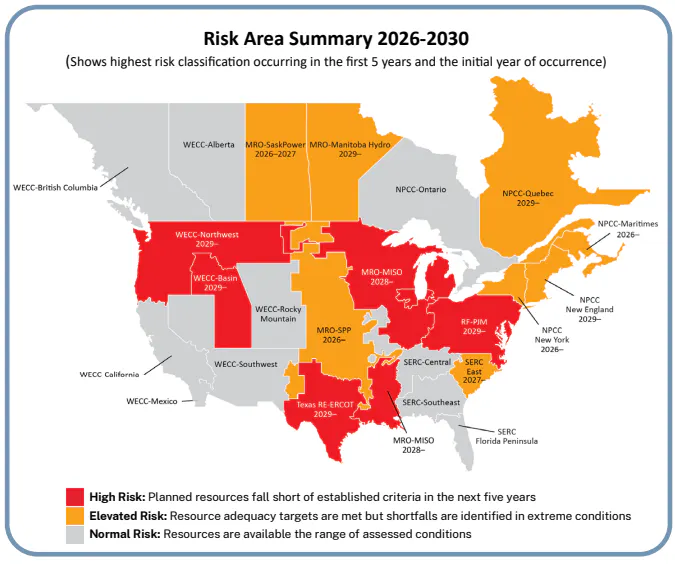
(Image source: NERC 2025 Long-Term Reliability Assessment)
Across the U.S., NERC highlights several cross‑cutting themes:
Load growth is accelerating faster than expected. Data centers, electrification, and industrial reshoring are reshaping demand curves in multiple regions.
Resource adequacy is becoming more weather‑dependent. Extreme heat and cold are increasingly determining whether regions have sufficient capacity to meet peak demand.
Transmission constraints are a national bottleneck. Limited transfer capability reduces the ability to move power where it’s needed most during emergencies.
Thermal retirements continue to outpace replacement capacity. Many regions are losing dispatchable resources faster than firm, flexible alternatives are coming online.
Interregional coordination remains insufficient. The grid’s physical and regulatory fragmentation limits the ability to share resources across regions.
Taken together, these trends don’t just highlight risk; they clarify where modernization will have the greatest impact. The constraints are real, growing, and increasingly consequential, and they demand modernization, not incremental fixes.
Innovation Begins With a Shift in Mindset
The pressures facing today’s grid aren’t just technical. They’re also organizational. Modernization requires more than new tools; it requires new ways of thinking, collaborating, and engaging, both within the utility and externally. As constraints multiply and planning horizons compress, utilities that thrive will be the ones that break old patterns, embrace cross‑functional problem‑solving, and treat innovation as a shared responsibility rather than a specialized function.
Breaking down traditional utility silos so planning, operations, engineering, customer programs, field crews, and regulatory teams work from the same assumptions, data, and modernization journey map.
Building internal fluency in emerging technologies, whether through utility‑run pilots or lessons learned from peer utilities, so teams can confidently evaluate non‑traditional solutions.
Expanding the solution set by considering NWAs—storage, flexible load, DER portfolios, microgrids, and VPPs—alongside conventional upgrades.
Exploring market‑aligned opportunities where appropriate, identifying new revenue streams or customer value propositions that benefit both shareholders and ratepayers.
Strengthening transparency with regulators, using pilots and demonstrations to build shared understanding of new approaches and the benefits they can unlock.
Creating a culture that rewards curiosity and adaptability, recognizing that innovation and modernization are as much about mindset as they are about technology.
A More Constrained Grid Can Be a More Modern Grid
The grid will always have constraints; that’s the nature of a complex, interconnected system. The utility cannot design and build a gold-plated system that accommodates all alternatives – it would be too expensive and unaffordable for most people. The question is whether we treat constraints as obstacles or as directional cues pointing toward smarter, affordable, and more resilient ways of operating.
In 2026, the utilities that lead will be the ones that recognize constraints as early indicators of where innovation can deliver the most value and who respond with urgency, clarity, and a modernization mindset. A more constrained grid isn’t a setback; it’s a moment of focus that’s revealing exactly where the system is ready to evolve next.