


The global transition toward smart, resilient and sustainable energy systems demands advanced planning and operational intelligence. One of the most promising technological enablers in this transformation is the Digital Twin.
A Digital Twin is a dynamic, virtual replica of a physical energy system that continuously integrates real-time operational data, system models and analytics to monitor, simulate and optimize system performance.
In the context of energy systems, a digital twin may represent:
• Electrical distribution networks
• Renewable energy plants (solar, wind, hybrid systems)
• Microgrids and smart grids
• Building energy systems
• Energy storage and electric mobility infrastructure
By synchronizing physical infrastructure with digital models, a digital twin allows engineers, operators and planners to analyze system behavior, predict performance and test operational strategies without disturbing the real systems.
For modern energy infrastructure, the digital twin becomes a decision-support platform for planning, design, optimization and lifecycle management.
The Need for Digital Twin in Smart Energy Systems
Energy systems worldwide are undergoing rapid structural transformation driven by:
• Integration of distributed energy resources (DERs)
• Large-scale deployment of renewable energy
• Growth of electric mobility
• Increasing demand for energy efficiency and resilience
These developments introduce high levels of complexity and uncertainty in system planning and operation.
Traditional planning methods rely largely on static models and offline simulations, which often fail to capture the dynamic behavior of modern energy systems.
Digital twin technology addresses this challenge by enabling:
I. Real-Time System Visibility
Energy assets such as transformers, feeders, solar plants, storage systems and loads can be monitored continuously through sensors and smart meters, allowing operators to track system performance in real time.
II. Predictive and Preventive Maintenance
Using historical and real-time data, digital twins can identify equipment degradation patterns and predict failures before they occur, improving system reliability.
III. Optimization of Energy Flow
Digital twin models enable advanced optimization of power flow, energy dispatch and demand management, improving overall system efficiency.
IV. Integration of Renewable Energy
With increasing variability in solar and wind generation, digital twins help simulate scenarios and determine optimal strategies for grid stability and renewable integration.
V. Risk-Free System Experimentation
Operators can test control strategies, load growth scenarios and infrastructure upgrades in the digital environment before implementing them in the physical system.
Architecture and Implementation
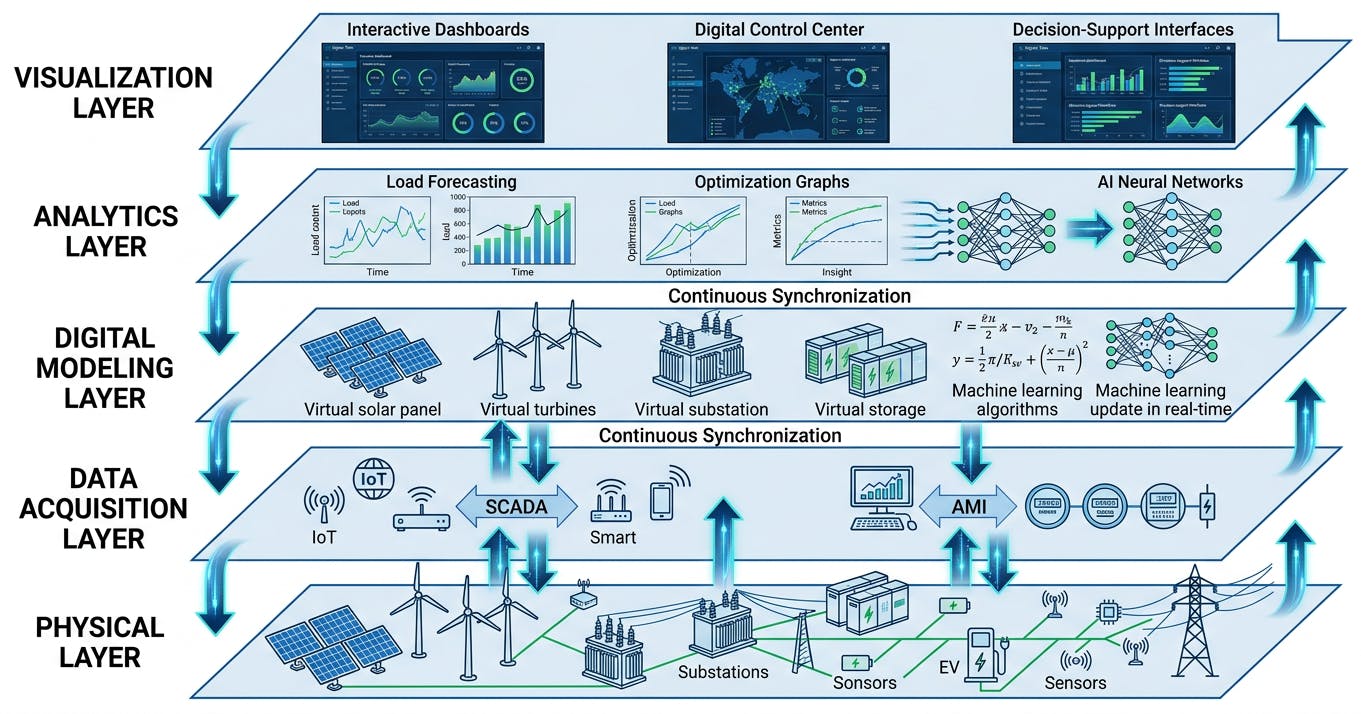
A Digital Twin Driven Energy System integrates multiple technological layers that connect the physical energy infrastructure with its digital representation.
I. Physical Layer (Energy Infrastructure)
This layer consists of the actual system components such as:
• Distributed generators (solar PV, wind, hybrid systems)
• Distribution networks and substations
• Energy storage systems
• Smart meters and sensors
• Electric vehicle charging infrastructure
These assets generate operational data that reflects real-time system behavior.
II. Data Acquisition and Communication Layer
Sensors, IoT devices and smart meters collect parameters such as:
• Voltage and current
• Power flow
• Energy consumption
• Equipment health indicators
• Environmental conditions
Communication technologies such as IoT networks, SCADA systems and advanced metering infrastructure (AMI) transmit this data to centralized or edge computing platforms.
III. Digital Modeling and Simulation Layer
At the core of the digital twin lies a physics-based and data-driven model of the energy system. These models combine:
• Power system simulation models
• Equipment performance models
• Network topology models
• Machine learning and data analytics algorithms
The digital twin continuously updates its state using real-time data, ensuring that the virtual model accurately reflects the physical system.
IV. Analytics and Optimization Layer
Advanced analytics tools process the data to perform:
• Load forecasting
• Renewable generation forecasting
• Network optimization
• Fault detection and diagnostics
• Energy management optimization
Optimization algorithms enable the system to identify the most efficient operating conditions under various scenarios.
V. Visualization and Decision Support Layer
The results are presented through interactive dashboards and digital control centers, enabling engineers and decision-makers to monitor system performance and implement data-driven strategies.
Building Intelligent Energy Infrastructure
Digital twin technology will play a crucial role in shaping the future of smart grids, microgrids and integrated energy systems.
Several developments will accelerate its adoption:
I. Integration with Artificial Intelligence
AI and machine learning will enhance digital twin capabilities for predictive analytics, anomaly detection and autonomous control.
II. Digital Twins for Cities and Campuses
Future smart cities and university campuses will use digital twins to optimize energy generation, consumption, mobility and infrastructure planning.
III. Energy System Lifecycle Management
Digital twins will support planning, design, commissioning, operation and modernization of energy systems across their entire lifecycle.
IV. Policy and Infrastructure Planning
Governments and utilities can use digital twins to evaluate grid expansion strategies, renewable energy policies and resilience planning.
V. Digital Twin Enabled Energy Markets
In the future, digital twins may enable real-time energy trading, demand response optimization and decentralized energy markets.
Conclusion
The energy sector is entering an era where data, intelligence and digital technologies are becoming as critical as physical infrastructure. Digital twin technology provides a powerful platform for planning, optimizing and managing complex energy systems in real time.
By enabling simulation-driven decision-making, predictive maintenance and system-wide optimization, digital twins can significantly enhance the efficiency, reliability and sustainability of modern energy networks.
As countries accelerate their transition toward clean and intelligent energy systems, digital twin driven approaches will become an essential tool for engineers, utilities, researchers and policymakers.
“The future of energy systems will not only be renewable and decentralized-it will also be digitally intelligent.”
Dr. Pushpendra Singh
Professor-Energy Sciences
Atria University Bengaluru