


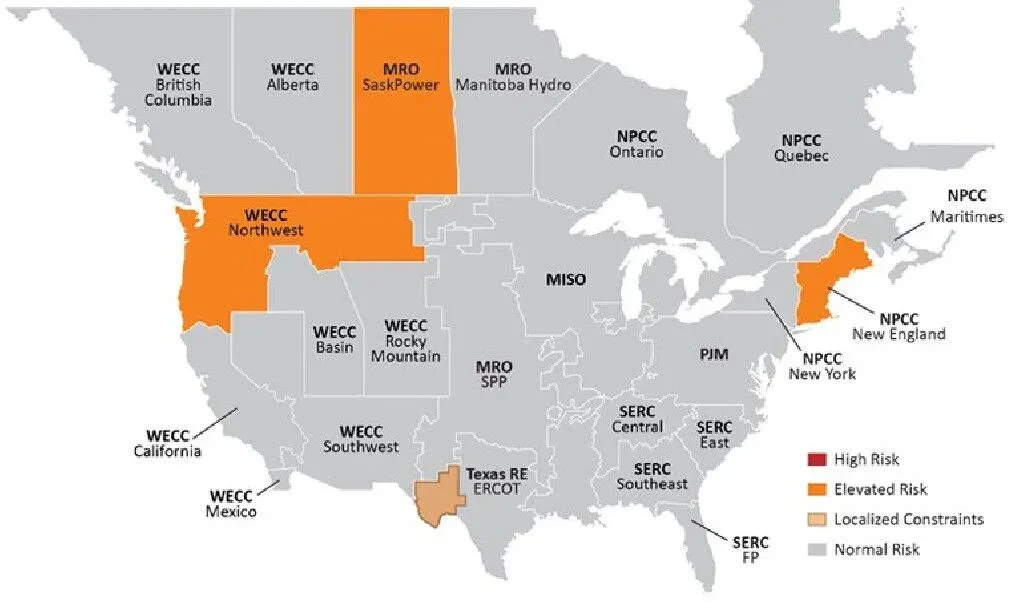
The North American Electric Reliability Corporation (NERC) concludes that all assessment areas are expected to have adequate resources to meet normal summer peak demand in 2026. Significant new generation—especially solar, battery storage, and natural‑gas capacity—has strengthened reserve margins across most regions. However, three subregions face elevated risk of supply shortfalls under above‑normal or extreme conditions: NPCC–New England, MRO–SaskPower, and WECC–Northwest.
More than 58 GW of new generation capacity has been added since Summer 2025, including 16.4 GW solar, 14.7 GW battery storage, 6.7 GW natural gas, and 1.6 GW wind, materially improving resource adequacy.
Despite these gains, extreme heat, drought‑driven hydropower reductions, rapid load growth, and variable renewable output continue to pose reliability challenges—especially during prolonged heatwaves or when early‑summer temperatures overlap with planned maintenance outages.
KEY FINDINGS
Adequate resources under normal conditions: All NERC assessment areas can meet expected peak demand with sufficient reserves.
Elevated risk in three subregions:
NPCC–New England: Reduced firm imports and tighter operating reserves.
MRO–SaskPower: Higher forecasted demand and reduced reserve margins.
WECC–Northwest: Drought, low snowpack, and heavy reliance on hydropower.
Localized constraints: Western ERCOT may face operational challenges when high demand coincides with low wind/solar output and transmission congestion.
Large resource additions: Solar, storage, and gas additions have outpaced demand growth in many regions, improving reliability compared to 2025.
Weather‑driven risks: Extreme heat, wildfires, drought, and hurricanes remain major reliability threats across the West and parts of the East.
Operational challenges from large loads: Rapid growth in data centers and industrial loads increases uncertainty and can stress local systems.
REGIONAL RISK SUMMARY
NPCC – New England (Elevated Risk)
Declining firm import commitments reduce operating reserves.
Above‑normal heat could create supply shortfalls requiring non‑firm imports or emergency actions.
MRO – SaskPower (Elevated Risk)
Higher demand forecast and reduced reserve margins.
Vulnerable during extreme heat or unexpected outages.
WECC – Northwest (Elevated Risk)
Drought and low snowpack threaten hydropower output (region relies on hydro for ~55% of generation).
Demand up nearly 5% from 2025; existing resources down ~2%.
Elevated risk during wide‑area heat events or wildfire‑related transmission constraints.
ERCOT – Far West (Localized Risk)
Rapid load and resource growth.
Risk emerges when high demand aligns with low wind/solar output and limited transmission import capability.
Other Regions (Normal Risk)
MISO, SPP, PJM, NPCC–NY, NPCC–Ontario, Québec, Maritimes, Manitoba Hydro all show adequate reserves for normal and above‑normal conditions due to strong resource additions.
CROSS‑CUTTING RELIABILITY THEMES
Extreme heat & weather volatility: Heatwaves, drought, wildfires, and hurricanes can simultaneously reduce generation and increase demand.
Hydropower uncertainty: Western drought conditions may constrain hydro output, increasing reliance on thermal generation and imports.
Rapid load growth: Data centers and electrification are driving faster‑than‑expected demand increases.
Maintenance overlap risk: Early‑summer heat may coincide with planned outages, reducing available capacity.
OVERALL OUTLOOK
The 2026 summer reliability outlook is materially improved compared to 2025, driven by unprecedented resource additions. However, reliability risks have not disappeared—they have shifted toward extreme‑condition vulnerabilities, especially in regions dependent on hydropower or imports, or those experiencing rapid load growth.
NERC emphasizes that normal conditions are manageable, but extreme heat events remain the primary threat to system reliability across North America.
Of course, NERC often talks out of both sides of its mouth, in this case, issuing a "Rare Level III Alert" and then basically telling operators, "you don't actually HAVE to do anything." It's no wonder the grid(s) are under threat to their reliability and resilience. Shameful, actually.
https://www.businessinsider.com/nerc-issues-alert-on-data-centers-threatening-grid-stability-2026-5