


Discover how Vehicle-to-Grid (V2G) technology and stationary battery energy storage systems (BESS) can enable India to achieve 20 GW of distributed energy storage capacity by 2030. Explore the regulatory framework, economic benefits, and deployment models driving India’s energy transition.
The Convergence of Two Transformative Technologies
India stands at an inflection point in its energy transition. With an ambitious target of 500 GW of non-fossil fuel capacity by 2030 and the Paris Agreement pledges driving clean energy integration, the nation faces a critical challenge: managing the intermittency of variable renewable energy sources while maintaining grid stability. The answer lies not in a single solution, but in the synergistic deployment of Vehicle-to-Grid (V2G) technology and stationary Battery Energy Storage Systems (BESS), which together could unlock up to 20 GW of distributed storage capacity by 2030 equivalent to approximately 10% of India’s peak demand.
This convergence represents more than technological innovation; it signals a fundamental re imagining of India’s power ecosystem, transforming electric vehicles and distributed assets into active grid participants rather than passive consumers.
Understanding V2G and Stationary BESS
What is Vehicle-to-Grid (V2G) Technology?
Vehicle-to-Grid (V2G) technology enables bidirectional energy flow between electric vehicles and the power grid. Unlike traditional unidirectional charging, V2G allows EVs to:
Draw power from the grid during off-peak hours when electricity is cheaper and renewable generation is abundant
Supply stored energy back to the grid during peak demand periods when renewable generation is low or grid stress is high
Serve as decentralized, mobile energy storage units that stabilize frequency and voltage
With India’s EV penetration expected to reach 40% of new vehicle sales by 2030 (and over 75% in two and three-wheeler segments), millions of vehicles could function as distributed energy resources, creating an unprecedented opportunity for grid flexibility.
Stationary BESS: The Foundation Layer
Stationary Battery Energy Storage Systems are fixed installations deployed at utility substations, alongside renewable generation facilities, or within transmission networks. Unlike mobile V2G assets, stationary BESS provides:
Renewable integration: Storing excess solar and wind generation during low-demand periods
Peak shaving: Discharging during peak hours to reduce reliance on expensive peaker plants
Grid services: Providing frequency regulation, voltage support, and black-start capability
Transmission deferral: Reducing the need for costly grid upgrades in congested corridors
Together, V2G and stationary BESS create a two-layer distributed storage architecture that addresses India’s most pressing energy challenges.
The Regulatory Breakthrough: CERC’s Integrated Energy Storage Framework
For nearly a decade, India’s energy storage sector operated in regulatory limbo. Developers faced uncertainty on tariff treatment, depreciation schedules, and operational compensation. This changed decisively on December 1, 2025, when the Central Electricity Regulatory Commission (CERC) issued a comprehensive draft framework for Integrated Energy Storage Systems (IESS).
Key Regulatory Features
The CERC framework sets normative operational benchmarks that reduce lending uncertainty and enable bankable project structures:
85% round-trip efficiency (energy retained after storage and discharge)
90% annual plant availability factor for continuous operation
5% auxiliary consumption (energy used for system operation)
12-year depreciation schedule for battery assets
50:50 gain-sharing mechanism between generators and beneficiaries post cost recovery
The framework explicitly permits storage to participate in multiple revenue-generating services simultaneously ancillary services, energy markets, peak support, and congestion relief creating commercially viable business models for developers and utilities.
Additionally, transmission licensees are now empowered to install grid-side storage for reliability enhancement and transmission deferral, with any ancillary service revenues flowing back into reduced transmission charges for consumers.
India’s Distributed Storage Landscape: Current Projects and Pipelines
Leading Stationary BESS Deployments
India’s pipeline of BESS projects reflects accelerating momentum:
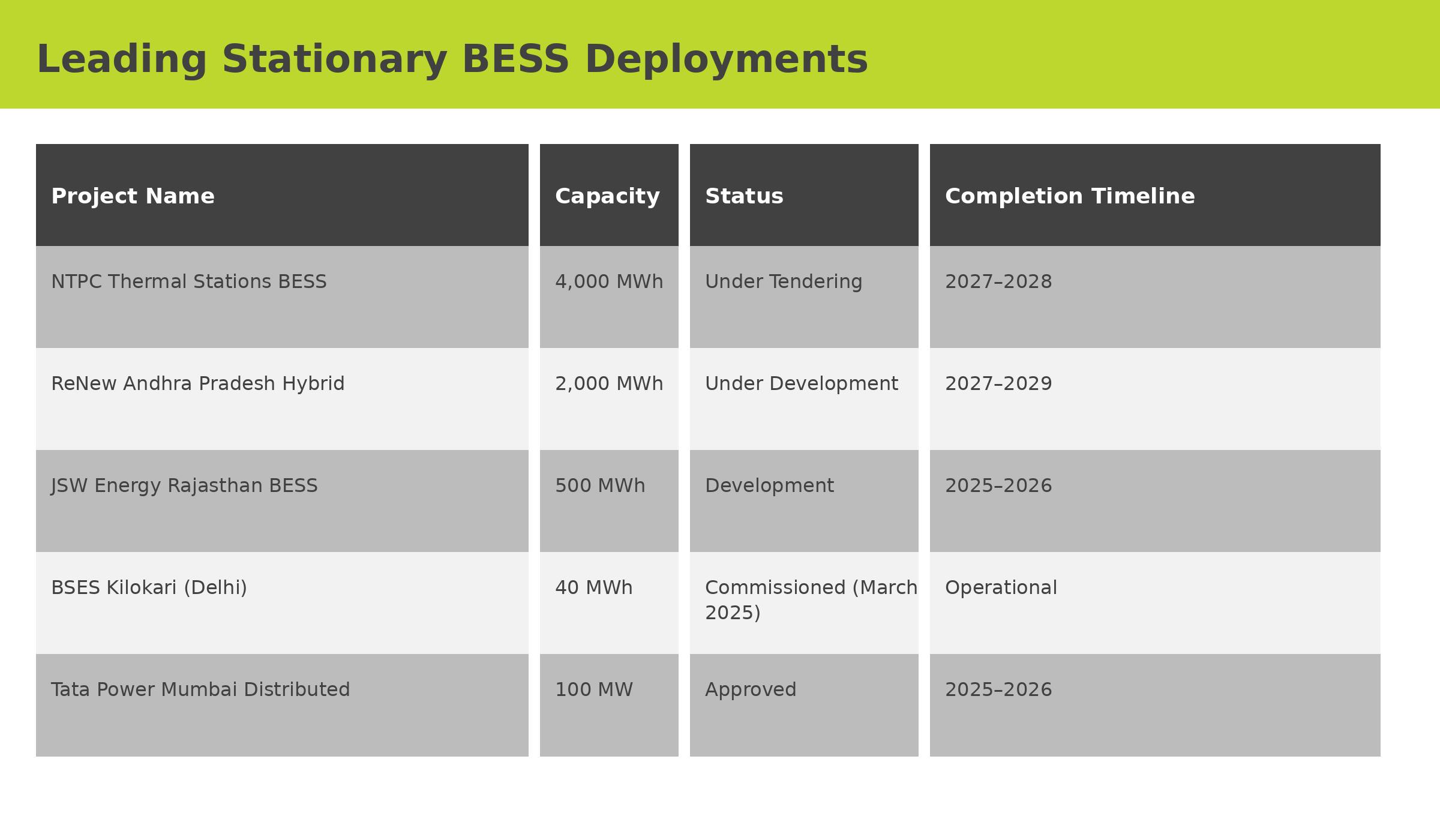
The BSES Kilokari project, commissioned in March 2025, serves as India’s first commercial standalone BESS at the distribution level, proving that utility-scale storage can be integrated into existing 33/11 kV substations with minimal infrastructure modifications. This landmark achievement has unlocked regulatory precedent for distributed deployment models across discoms nationwide.
V2G Pilot Projects and Fleet Deployment
India’s V2G journey has commenced through strategic pilot projects, particularly in fleet electrification:
Delhi BSES-Tata Power Collaboration: 500 e-buses serving as mobile storage units during off-peak hours
Bengaluru BESCOM Initiative: Integration of V2G with solar rooftop charging hubs and smart grid infrastructure
ISRO and IIT Collaborations: Indigenous development of bidirectional inverters and V2G communication protocols
These pilots are critical first steps. Fleet-based V2G (e-buses, taxis, logistics vehicles) will scale first due to concentrated asset management, centralized scheduling, and predictable operating patterns. Residential and commercial EV uptake will follow as charging standards evolve and smart grid infrastructure matures.
Economic and Environmental Benefits: The Value Proposition
For EV Fleet Operators
₹8,000–₹12,000 monthly revenue per EV through grid services and energy arbitrage
30–40% reduction in charging costs by optimizing charge timing and selling peak power
New business models: Vehicle-as-Grid-Asset, turning mobility fleets into revenue-generating grid resources
For Utilities and Discoms
Reduced infrastructure investment: Defers costly transmission and distribution upgrades
Lower peak power procurement costs: Stationary BESS and V2G reduce reliance on expensive peaker plants
Enhanced grid reliability: Frequency regulation, voltage support, and congestion relief without new generation capacity
Renewable energy absorption: Increased capacity to integrate solar and wind without curtailment losses (India lost 2–3 TWh to curtailment in 2022)
For Consumers
Improved grid stability and power quality through frequency and voltage support
Reduced wholesale electricity costs as distributed storage suppresses peak prices
Environmental benefits: 40–50 million tonnes annual CO₂ reduction potential through coal-plant displacement
Government Support: Policy Tailwinds Accelerating Deployment
India’s government has deployed a comprehensive support architecture to achieve 20 GW distributed storage:
Viability Gap Funding (VGF)
First Tranche: ₹3,760 crore ($415M) supporting 13,220 MWh of BESS capacity
Second Tranche: ₹5,400 crore backing 30 GWh announced in June 2025
Combined support targets 43+ GWh BESS deployment by 2030
Production-Linked Incentive (PLI) Scheme
Targets 50 GWh of domestic battery manufacturing by 2030
Reduces import dependency and builds indigenous technology capabilities
Incentivizes advanced chemistry cell development (LFP, sodium-ion, flow batteries)
Technical Mandates and ISTS Waivers
CEA technical advisory (February 2025) recommends 10% minimum BESS integration with solar projects (2-hour duration)
ISTS charges waived for standalone BESS and renewable-storage projects commissioned before June 30, 2025
20% local content mandate for battery storage projects, supporting domestic supply chains
These policies collectively reduce capital costs and create “first-mover” advantages for early-stage deployments.
The Path to 20 GW: Hybrid Deployment Models
Achieving 20 GW distributed storage by 2030 requires coordinated hybrid deployment across three architectural layers:
Layer 1: Fleet-Based V2G (4–6 GW by 2030)
500+ e-buses deployed across major metros (Delhi, Bengaluru, Mumbai, Hyderabad)
Commercial fleets: taxis, delivery vans, logistics vehicles
Supported by dedicated V2G charging hubs with bidirectional fast-charging infrastructure
Layer 2: Distribution-Level Stationary BESS (8–10 GW by 2030)
33/11 kV substations in dense urban areas and renewable-rich zones
Owned/operated by discoms, utilities, or private developers
Providing peak shaving, load shifting, and transmission deferral services
Layer 3: Utility and Transmission-Scale BESS (6–8 GW by 2030)
400+ kV substations in transmission corridors
Co-located with thermal plants (flexibility retrofits) and renewable hubs
Providing grid stability services and renewable firming
This stratified approach balances quick-win fleet deployments with foundational utility-scale infrastructure, ensuring distributed resilience rather than single-point-of-failure risk.
Challenges and Solutions: Bridging the Implementation Gap
India’s 20 GW ambition faces real obstacles that require targeted interventions:
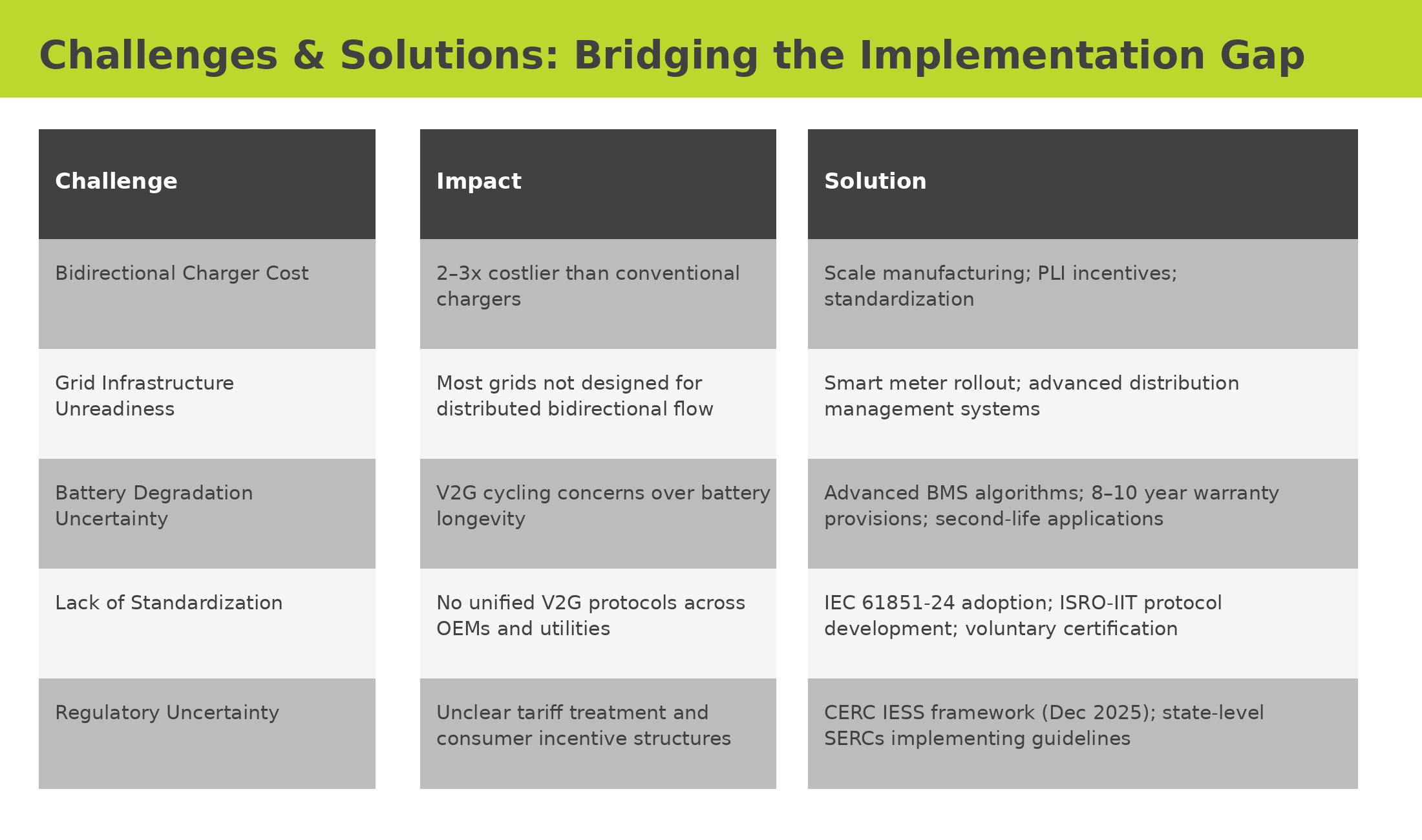
Solutions are already materializing. The CERC December 2025 framework addresses tariff uncertainty. Indigenous V2G protocol development by ISRO and IITs is reducing foreign technology dependency. Smart grid infrastructure investments are accelerating. Energy economics lithium-ion battery costs dropping from $1,200/kWh in 2010 to ~$100/kWh in 2025 provide the strongest tailwind of all.
Global Context: Learning from Leaders
China leads the world with 100+ GW of operational battery storage as of 2025, deployed across utility-scale solar farms, coal-plant retrofits, and grid-edge installations. The United States has 30+ GW operational (Q1 2025), concentrated in California, Texas, and the Carolinas. Europe operates approximately 45 GW across distributed residential and commercial deployments.
India’s 20 GW target by 2030 (representing a 40x increase from current 490 MWh) is ambitious but achievable, given the regulatory framework now in place, the economics rapidly improving, and the government policy support across multiple levers.
Conclusion: India’s Energy Future Is Distributed, Digital, and Decarbonized
The convergence of V2G technology and stationary BESS represents India’s best opportunity to reconcile three seemingly contradictory goals: achieving 500 GW of non-fossil capacity by 2030, maintaining grid reliability amid rapid renewable integration, and creating affordable, secure electricity for 1.4 billion citizens.
The 20 GW distributed storage target is not merely an engineering target it embodies a shift in how India thinks about energy. Rather than centralized generation flowing one-way to passive consumers, India is building an ecosystem where millions of EVs, thousands of distribution substations, and hundreds of transmission-scale assets actively participate in grid services, creating resilience through diversity.
The regulatory framework is in place (CERC December 2025). The government financial support is committed (₹9,160 crore VGF). The technology is proven (fleet pilots running in Delhi, Bengaluru, Mumbai). The economics are working (battery costs 80% lower than 2010). What remains is execution at scale.
Explore How Advanced BESS Solutions Power Your Storage Vision
If you’re evaluating Battery Energy Storage System (BESS) solutions for your facility, renewable integration, or fleet electrification needs, modern storage platforms now offer scalable, modular architectures purpose-built for India’s distributed energy landscape.
These systems deliver utility-grade reliability with flexible deployment models from distribution substations and industrial microgrids to EV fleet charging hubs. Designed for performance, resilience, and rapid deployment, they enable seamless integration with solar, wind, and hybrid energy infrastructure.
Across India, leading manufacturers, discoms, and utilities are leveraging distributed storage to reduce operating costs, enhance grid stability, and accelerate renewable integration at scale.