


Abstract
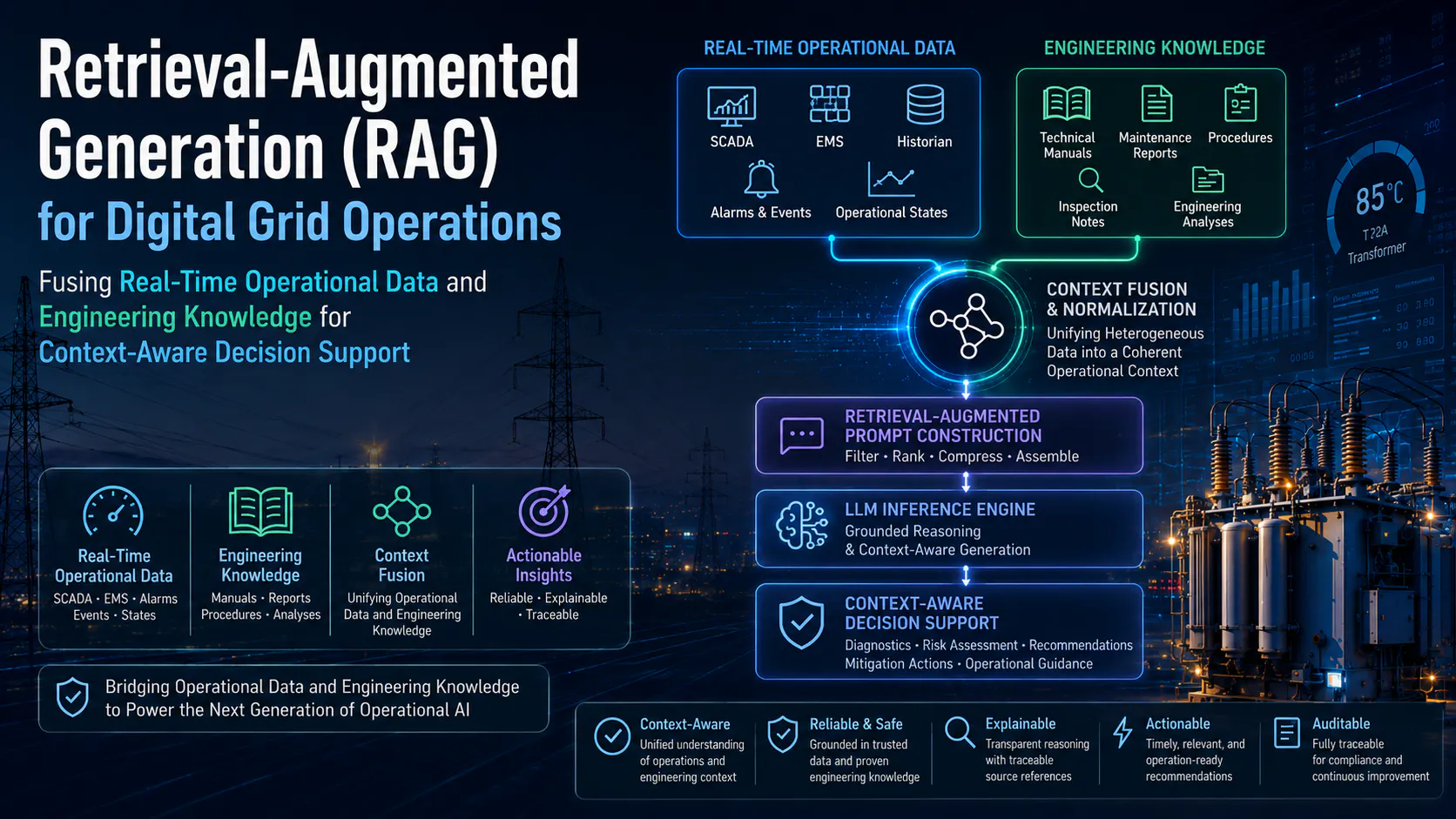
Modern digital grid infrastructures are evolving into complex cyber-physical systems-of-systems, where context-aware decision support requires real-time fusion of Operational Technology (OT) telemetry with structured asset data and unstructured engineering knowledge across OT and IT enterprise systems. However, achieving this capability using Large Language Models (LLMs) in mission-critical grid operations remains challenging due to safety and reliability constraints, hallucination risk, and the fragmentation of operational data and engineering knowledge across heterogeneous enterprise systems and representation formats.
This article presents a utility-grade Retrieval-Augmented Generation (RAG) reference architecture for digital grid operations. The proposed architecture combines deterministic retrieval of structured data from operational and asset management systems with semantic retrieval over unstructured engineering documents. A context unification layer then performs temporal and semantic alignment of heterogeneous sources into a coherent operational context representation. This operational context is consumed by a retrieval-grounded LLM reasoning layer that generates context-aware decision outputs. The architecture bridges empirical grid states with engineering knowledge, enabling auditable operational reasoning for grid operators while maintaining alignment with mission-critical safety and reliability constraints.
1. End-to-End RAG Architecture for the Digital Grid
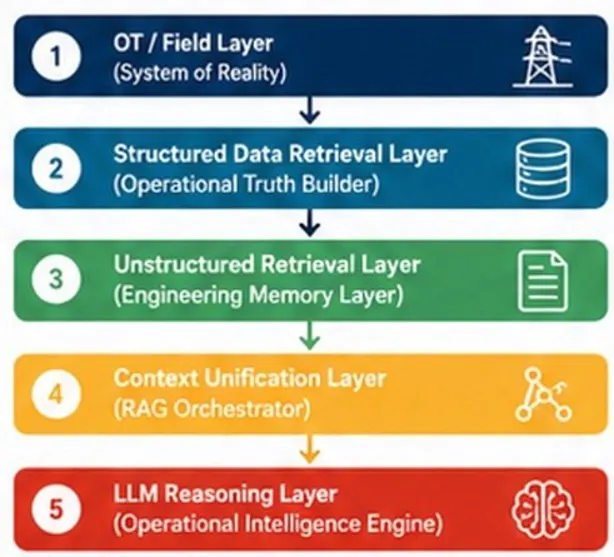
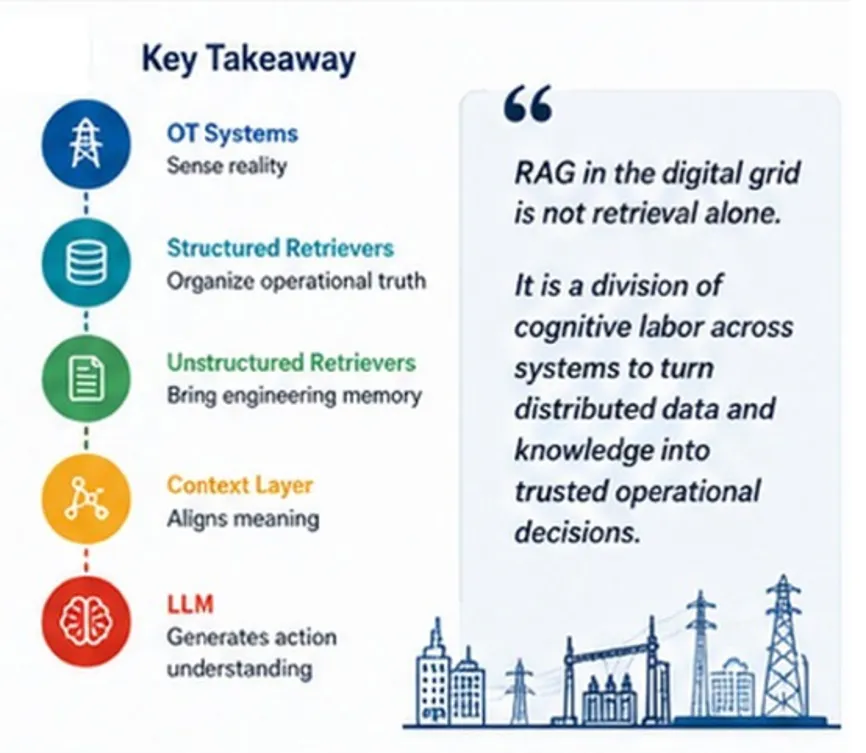
At the enterprise tier (Layers 1–3), the digital grid RAG architecture combines deterministic retrieval over operational and asset management systems with semantic retrieval over unstructured engineering documents to bridge dynamic operational conditions and static engineering knowledge repositories. A dedicated orchestration layer (Layer 4) then normalizes and aligns heterogeneous information sources into a unified operational context representation. This operational context is provided to a Large Language Model (LLM) (Layer 5), which serves as the final reasoning layer. The LLM generates context-aware decision outputs, including risk assessments, root-cause hypotheses, and mitigation recommendations, enabling auditable operational reasoning for grid operators while maintaining alignment with mission-critical safety and reliability constraints.
2. The Operational Technology Layer
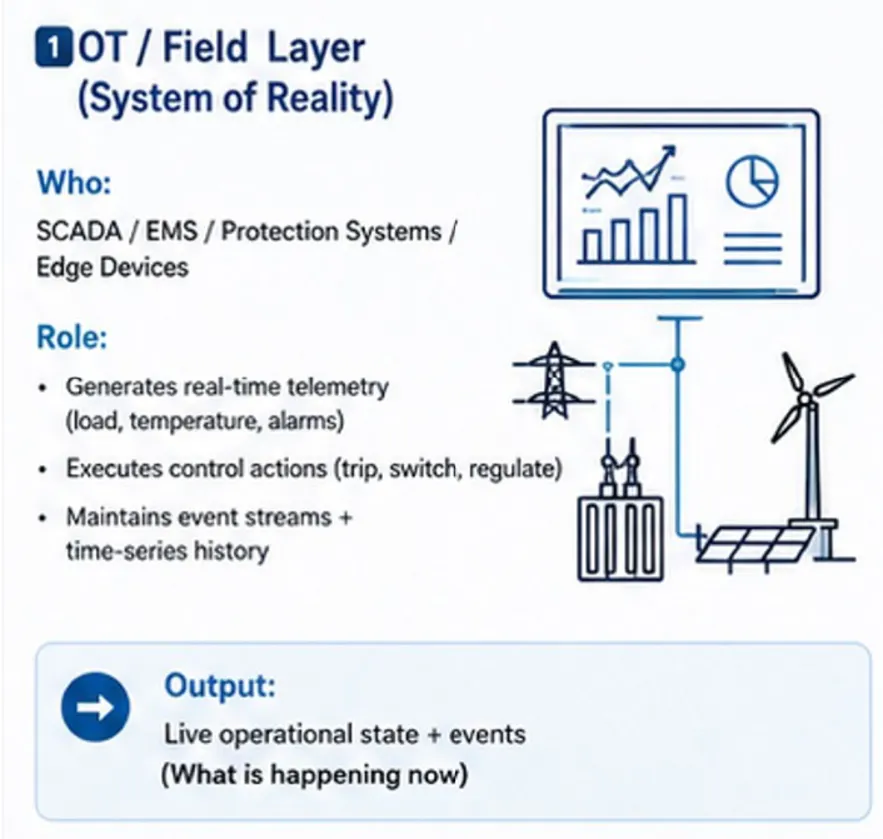
Systems operating at this layer—primarily Supervisory Control and Data Acquisition (SCADA) systems, Energy Management Systems (EMS), and operational historians—are engineered mainly for real-time monitoring and control execution. The primary output of this layer consists of discrete event streams and continuous time-series telemetry representing the instantaneous electrical states of the network. Within this architecture, this layer constitutes the empirical ground truth that anchors all downstream analytical models, interpretations, and decision-support functions.
3. The Structured Data Retrieval Layer
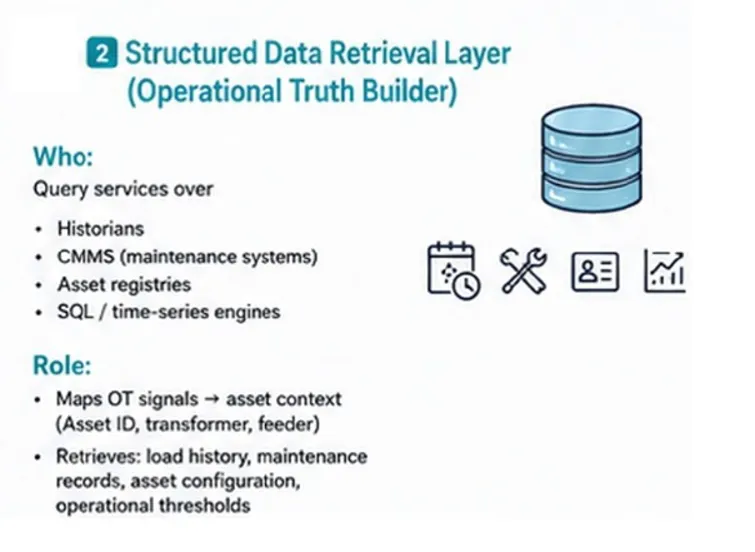
Raw edge telemetry signals lack structural and relational hierarchy; for example, a thermal excursion or current surge carries minimal diagnostic value without asset-specific context. To resolve this, incoming telemetry signals are transformed into a validated asset state representation by the Structured Data Retrieval Layer through deterministic mapping of real-time signals to unique asset identifiers (e.g., feeder IDs, transformer nodes) and cross-referencing with enterprise asset management systems and Computerized Maintenance Management Systems (CMMS). This process enriches operational signals with historical load profiles, maintenance intervals, and boundary thresholds, producing a coherent and validated asset-level context for downstream reasoning.
4. The Unstructured Data Retrieval Layer
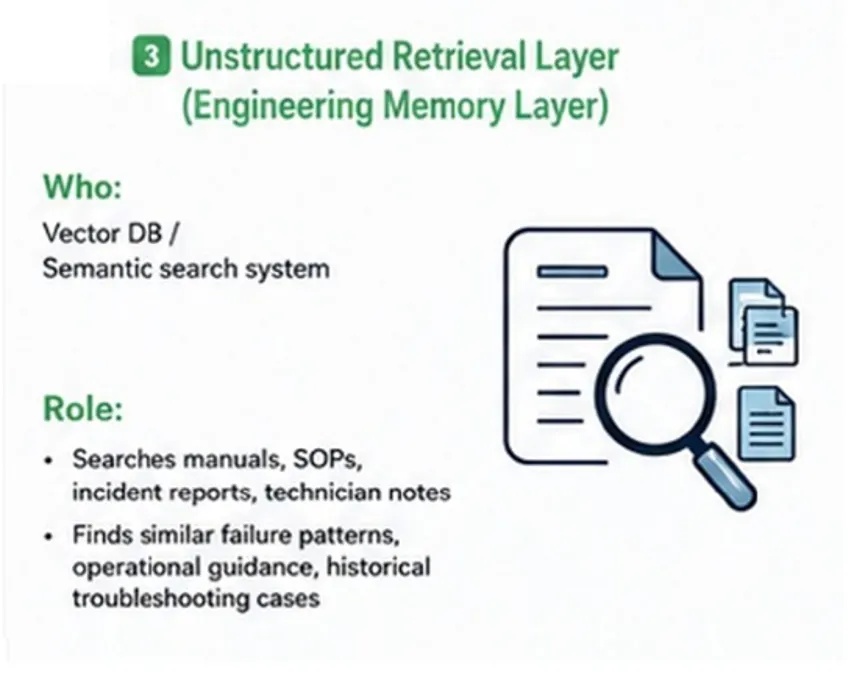
Simultaneously, the RAG framework must access a vast repository of non-relational engineering knowledge, including original equipment manufacturer (OEM) technical manuals, standard operating procedures (SOPs), legacy incident reports, and field annotations. Because these information assets are not represented in relational form, they are managed via a semantic pipeline.
Unstructured text documents are segmented into contextual chunks, transformed via embedding models into vector representations, and indexed within a vector database. During an operational anomaly, this layer serves as the enterprise’s engineering memory, executing semantic proximity searches to isolate conceptually relevant historical failure modes, design tolerances, and troubleshooting procedures.
5. The Context Unification Layer: Cross-Domain Alignment and Semantic Reconciliation
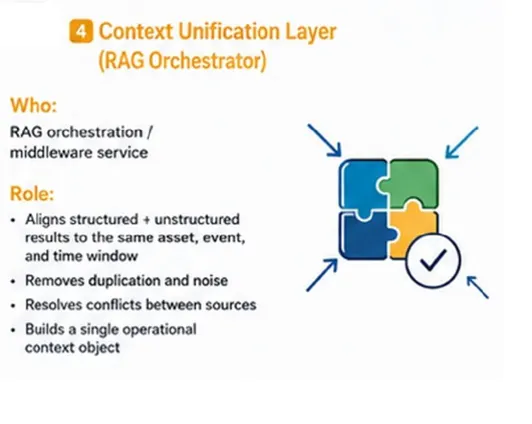
A primary challenge in utility-scale Retrieval-Augmented Generation (RAG) systems is the integration of heterogeneous data structures spanning structured operational systems and unstructured engineering knowledge repositories. The Context Unification Layer addresses this challenge by performing temporal and semantic alignment across these domains. The layer binds historical maintenance records and incident reports to operational sensor streams within a consistent analytical time window. In parallel, it aligns schema-bound identifiers from Supervisory Control and Data Acquisition (SCADA) tags and Computerized Maintenance Management Systems (CMMS) with semantic embeddings derived from the vector index. Through noise filtering, contextual prioritization, and asset-criticality-aware weighting, the layer suppresses irrelevant or conflicting information across heterogeneous sources and integrates the remaining information into a unified operational context representation for downstream reasoning.
6. LLM Reasoning Layer
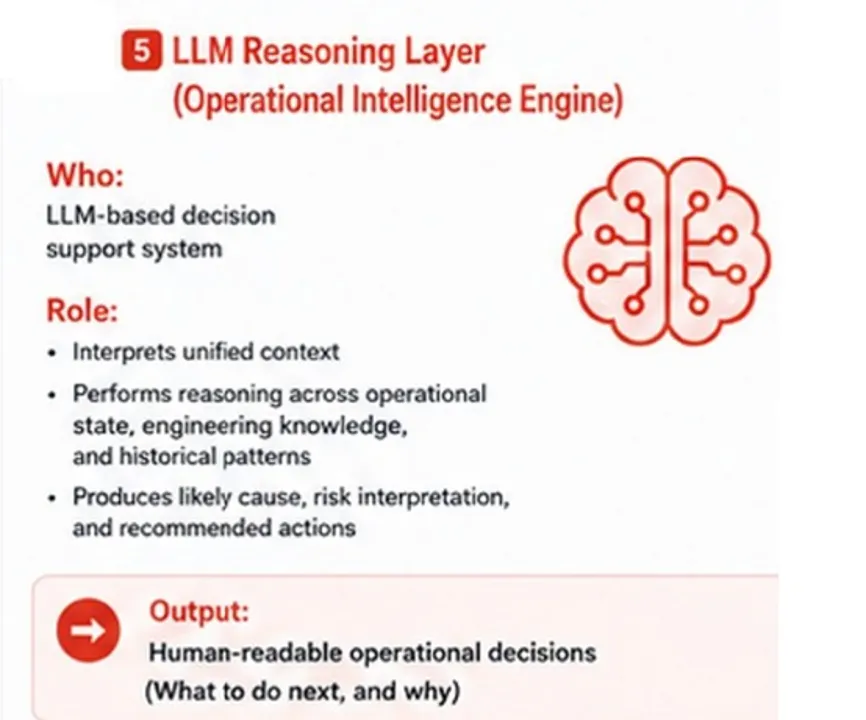
The unified operational context representation is encoded within the token budget constraints of a domain-optimized foundation model. This operation transforms the model from a general-purpose language model into a domain-constrained operational reasoning capability.
Conditioned on the retrieved and aligned context, the model performs retrieval-grounded reasoning over fused operational and engineering information. It interprets operational telemetry in conjunction with structured asset states and unstructured engineering knowledge to generate context-aware decision-support outputs that assist grid operators in operational assessment, diagnosis, planning, and response activities, and related operational functions.
7. Operational Walkthrough: Transformer Thermal Anomaly Scenario
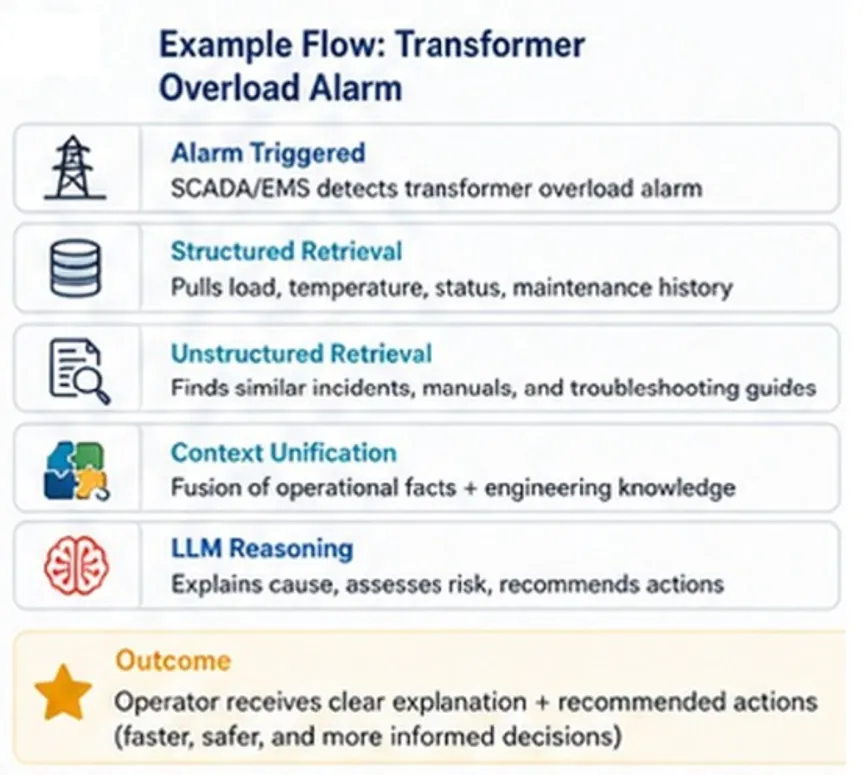
To illustrate the operational flow of the proposed cross-domain orchestration framework, consider its execution during a localized grid anomaly. When Supervisory Control and Data Acquisition (SCADA) telemetry registers an elevated temperature condition on Transformer T-204 during a peak loading interval, the structured and unstructured retrieval pipelines are activated in parallel.
The Structured Data Retrieval Pipeline maps the event to the corresponding asset and enriches the operational state by retrieving real-time electrical measurements and recent Computerized Maintenance Management Systems (CMMS) records indicating cooling fan degradation. In parallel, the Unstructured Data Retrieval Pipeline retrieves semantically relevant engineering knowledge, including OEM thermal limits and historical troubleshooting cases from the vector-indexed knowledge repository.
The Context Unification Layer then aligns these heterogeneous inputs across temporal and semantic dimensions, producing a unified operational context representation that integrates current sensor states, maintenance history, and engineering constraints. Conditioned on this unified context, the reasoning layer identifies a persistent structural risk associated with cooling system degradation under sustained high-load conditions.
The system subsequently generates a structured decision-support output, providing root-cause hypotheses, localized risk interpretation, and recommended operational actions, including load redistribution considerations and targeted field inspection guidance.
8. Conclusion
This article introduces a mission-critical decision-support layered architecture for digital grid operations based on Retrieval-Augmented Generation (RAG). The proposed architecture integrates state capture, structured and unstructured knowledge retrieval, temporal and semantic alignment, context unification, and constrained LLM-based reasoning into a unified framework for grid operational decision support.
Through this layered design, heterogeneous operational telemetry and engineering knowledge are mapped, enriched, aligned, and unified into a consistent operational context representation. This enables retrieval-grounded decision support for grid operators, supporting operational assessment, diagnosis, planning, and response activities within critical infrastructure, while maintaining safety and reliability constraints.

Alaa Mahjoub is an independent digital business advisor based in Abu Dhabi, UAE. He has collaborated with organizations in the utilities, transportation, petroleum, and defense sectors across multiple countries. He has led digital transformation, data management, operational technology and enterprise architecture programs, as well as training initiatives, across the UAE, Kuwait, Egypt, Malaysia, Singapore, the UK, and the US. His work included driving the Digital Grid transformation as part of the restructuring of the water and electricity sectors in the Emirate of Abu Dhabi.
Alaa has published and served as a reviewer for the IEEE, CIGRE, SPE, the Arab Union of Electricity, and the World Utilities Congress. He holds B.Sc.. and M.Sc. degrees in Computer Engineering from the Military Technical College (MTC) and Cairo University.
Alaa Mahjoub is an independent digital business advisor based in Abu Dhabi, UAE. He has collaborated with organizations in the utilities, transportation, petroleum, and defense sectors across multiple countries. He has led digital transformation, data management, operational technology and enterprise architecture programs, as well as training initiatives, across the UAE, Kuwait, Egypt, Malaysia, Singapore, the UK, and the US. His work included driving the Digital Grid transformation as part of the restructuring of the water and electricity sectors in the Emirate of Abu Dhabi.
Alaa has published and served as a reviewer for the IEEE, CIGRE, SPE, the Arab Union of Electricity, and the World Utilities Congress. He holds B.Sc.. and M.Sc. degrees in Computer Engineering from the Military Technical College (MTC) and Cairo University.