

Scientific and technical research is being conducted in the field of new air-generated energy sources in the atmosphere to ensure the operation of various meteorological equipment.
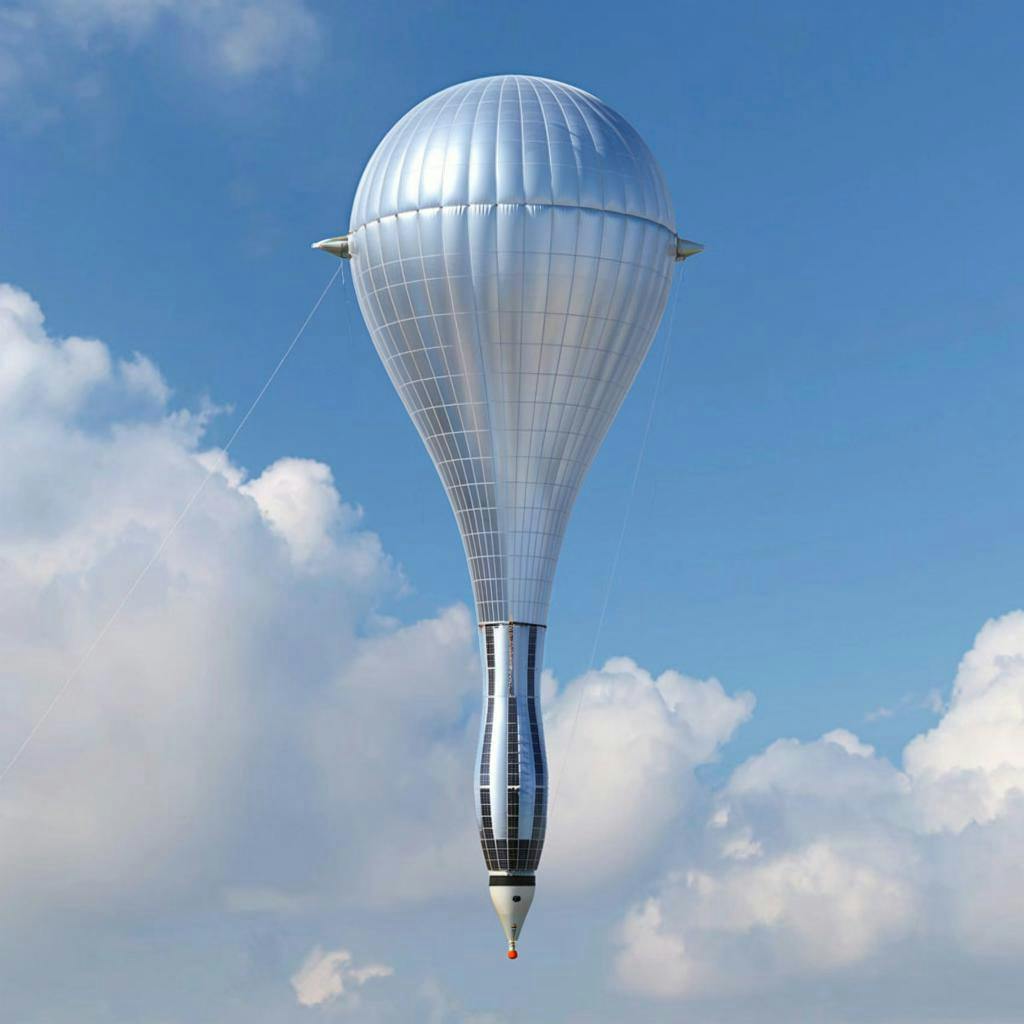
A balloon with a vertical vortex turbine generator with a capacity of up to 100 kW, operating at an altitude of more than 3,000 meters, is an innovative solution for generating electricity in conditions where traditional wind turbines are ineffective. This type of balloon uses a vertical axis of rotation and a vortex effect to generate energy, which allows it to operate efficiently at high altitudes where wind speeds are higher and more stable.
Main characteristics of a vertical vortex turbogenerator balloon:
Altitude: The balloon can operate at an altitude of more than 3,000 meters, which allows it to use stronger and more stable winds that are inaccessible to onshore wind turbines.
Power: The turbo generator is capable of generating up to 100 kW of electricity, making it suitable for a variety of applications, including providing energy to remote sites and small communities.
Vortex effect: The vertical axis of rotation and the special design of the blades create a vortex effect that increases the efficiency of capturing wind energy.
Materials: The balloon is made of lightweight and durable materials, which ensures its durability and resistance to extreme weather conditions.
Control: The control system allows the balloon to automatically adjust its orientation to maximize wind usage.
Advantages of a vertical vortex turbogenerator balloon:
High efficiency: Working at higher altitudes allows for stronger and more stable winds, which increases power generation.
Low noise: The vertical axis of rotation and the vortex effect reduce the noise level compared to traditional horizontal wind turbines.
Ecological cleanliness: The balloon does not require the use of fossil fuels and does not emit greenhouse gases.
Flexible application: The balloon can be used in a variety of conditions, including remote and hard-to-reach areas.
Application of a balloon with a vertical vortex turbogenerator:
Energy supply to remote facilities: The balloon can provide energy to remote facilities such as weather stations, telecommunication towers.
Agricultural industry: The balloon can be used to provide energy to farms and irrigation systems.
Environmental projects: The balloon can be used in energy conservation and carbon footprint reduction projects.
Conclusion
A balloon with a vertical vortex turbine generator with a capacity of up to 100 kW, operating at an altitude of more than 3,000 meters, is a promising solution for generating electricity in conditions where traditional wind turbines are ineffective. Its high efficiency, environmental friendliness and flexible application make it attractive for various industries and projects.
What is the optimal rotor diameter for maximum efficiency of a vortex turbine at high altitude?
The optimal rotor diameter for maximum efficiency of a vortex turbine at high altitude depends on several factors, including wind speed, air density, and turbine design. Let's consider these factors in detail.
At high altitudes, wind speed is usually higher than at ground level. This means that the turbine must be able to efficiently utilize this energy. The optimal rotor diameter should be such that it maximally captures the airflow and converts it into energy.
At high altitudes, air density is lower, which reduces the power that the turbine can generate. This requires an increase in rotor diameter to compensate for the reduced air density.
A vortex turbine works by creating vortices in the airflow. The optimal rotor diameter should be such that the vortices are effectively formed and transfer their energy to the turbine blades.
The power of a wind turbine is determined by the formula:
P=12⋅ρ⋅A⋅v3⋅Cp
where:
P is the power (W),
ρ is the air density (kg/m³),
A is the rotor area (m²),
v is the wind speed (m/s),
Cp is the power coefficient (usually around 0.4 for modern wind turbines).
For maximum efficiency of a vortex turbine at high altitude, the rotor diameter should be such that:
Maximally captures airflow: The larger the rotor diameter, the more air it can capture.
Effectively forms vortices: The rotor diameter should be such that vortices are formed and transfer their energy to the turbine blades.
Accounts for air density: At high altitudes, air density is lower, which requires an increase in rotor diameter to compensate for the reduced air density.
Let's assume that the wind speed at an altitude of 3000 meters is 30 m/s, and the air density is 0.76 kg/m³. For maximum efficiency of a vortex turbine, the rotor diameter should be such that:
Maximally captures airflow: The rotor diameter should be at least 10 meters.
Effectively forms vortices: The rotor diameter should be such that vortices are formed and transfer their energy to the turbine blades.
Accounts for air density: The rotor diameter should be increased to compensate for the reduced air density.
The optimal rotor diameter for maximum efficiency of a vortex turbine at high altitude is approximately 10-15 meters. This value may vary depending on specific conditions and turbine design.
The operation of a vortex turbine is based on several key physical principles, which allow it to efficiently convert wind energy into mechanical and then electrical energy. Here are the main principles:
Principle: Vortex turbines utilize the phenomenon of vortex shedding, where vortices are created in the wake of an object as air flows past it.
Explanation: As wind flows past the turbine's blades, it creates vortices that oscillate and transfer energy to the blades. This oscillation is then converted into rotational motion, which drives the turbine.
Principle: Bernoulli's principle states that an increase in the speed of a fluid (in this case, air) occurs simultaneously with a decrease in pressure or a decrease in the fluid's potential energy.
Explanation: As air flows past the turbine blades, it speeds up, creating a pressure difference that helps to drive the blades and generate rotational motion.
Principle: The transfer of momentum from the wind to the turbine blades is a key aspect of energy conversion.
Explanation: The wind transfers its momentum to the blades, causing them to rotate. This rotational motion is then used to drive a generator, which converts the mechanical energy into electrical energy.
Principle: Aerodynamic lift is the force that acts perpendicular to the direction of the wind flow.
Explanation: The shape of the turbine blades is designed to create lift, which helps to increase the efficiency of energy conversion. The lift force helps to drive the blades and generate more power.
Principle: The conversion of wind energy into mechanical energy and then into electrical energy.
Explanation: The rotational motion of the turbine blades is used to drive a generator, which converts the mechanical energy into electrical energy. This process involves the use of electromagnetic induction to generate electricity.
Principle: The efficiency of a wind turbine is determined by its power coefficient (CpCp).
Explanation: The power coefficient is a measure of how efficiently the turbine converts wind energy into mechanical energy. Modern wind turbines typically have a power coefficient of around 0.4, which means they can convert about 40% of the available wind energy into usable power.
Principle: The size and design of the turbine are optimized to maximize energy capture and efficiency.
Explanation: The diameter of the rotor and the shape of the blades are carefully designed to ensure that the turbine can efficiently capture the wind energy and convert it into usable power. Larger rotors can capture more energy, but they also require more material and may be more expensive to build.
The operation of a vortex turbine is based on a combination of aerodynamic principles, energy conversion, and optimization of design parameters. By understanding these principles, engineers can design turbines that are efficient and effective at converting wind energy into usable power.
Analysis of Vortex Turbines
1. Introduction
Vortex turbines represent a special class of hydraulic turbines that utilize the effect of vortex formation to convert kinetic energy from the medium into useful mechanical work. These devices find wide application in various fields including power generation, water supply, and industrial production. This report is dedicated to a detailed analysis of the functioning characteristics, advantages, disadvantages, and recent developments in the field of vortex turbines.
2. Operating Principle of Vortex Turbines
The operation of vortex turbines is based on the formation of vortices in moving media (liquids or gases) which interact with turbine components creating rotational torque. This process differs from traditional designs where energy is extracted directly from directed flow. Vortex turbines use more complex interaction mechanisms making them efficient under certain conditions.
According to research results, key factors affecting vortex turbine performance include vortex formation characteristics, flow structure, and geometry of the working area.
There are several main types of vortex turbines:
Single-flow: Simple design with one incoming stream.
Multi-flow: Turbines with multiple incoming streams providing greater power output.
Counterflow: Design allowing increased efficiency by organizing opposing flows.
Each type has its specific features and application areas depending on task requirements.
3. Advantages and Disadvantages of Vortex Turbines
3.1.1 High Efficiency
With proper selection of geometry and operating modes, vortex turbines can achieve high levels of energy extraction from the flow. For example, according to patent documentation, multi-flow vortex turbines can significantly increase overall efficiency due to optimized fluid path and reduced hydraulic losses.
3.1.2 Low Maintenance Requirements
Simple construction and minimal number of moving parts make vortex turbines reliable and durable devices requiring minimum maintenance and repair reducing operational costs.
3.1.3 Wide Range of Applications
Vortex turbines suit a broad spectrum of environments and operating conditions such as water, air, and other fluids. Their ability to operate effectively in challenging environments expands their potential applications.
Despite obvious benefits, vortex turbines have some limitations:
High sensitivity to flow parameters: Performance depends heavily on precise tuning and matching to operational conditions.
Noise issues: Some types of vortex turbines may produce significant noise especially at higher loads.
Special material needs: To ensure reliability, wear-resistant and corrosion-proof materials must be used increasing manufacturing cost.
4. Current Trends and Developments
Modern research focuses on improving vortex turbine designs for enhanced productivity and lower costs. One example is the patent for multi-flow vortex turbine featuring nozzles arranged at specific angles ensuring uniform load distribution and improved overall efficiency.
4.2 Use of New Materials
Innovative materials like composites and ceramics improve durability and resistance of vortex turbines against aggressive environments. Such materials reduce risks associated with corrosion and wear extending device lifespan.
Current trends involve implementation of automated monitoring systems managing vortex turbine operations. This allows quick response to changes in operating conditions maintaining optimal performance thus enhancing total efficiency.
Future development of vortex turbines will focus on refining designs, introducing new materials, and automation technologies. Special attention will be given to improving energy efficiency while minimizing environmental impact. Expansion into alternative energy sources and eco-friendly processes is also anticipated.
To conclude, vortex turbines offer promising prospects in the evolution of energy installations. With unique designs they efficiently extract energy from diverse media delivering high productivity and reliability. However, further research and development efforts aimed at addressing existing shortcomings and boosting overall efficiency remain essential for achieving maximum potential.

