

The design and equipment of a kinetic hydroelectric power plant using HYPOT II technology involves several stages, starting from preparation and ending with commissioning. Here are the main stages:
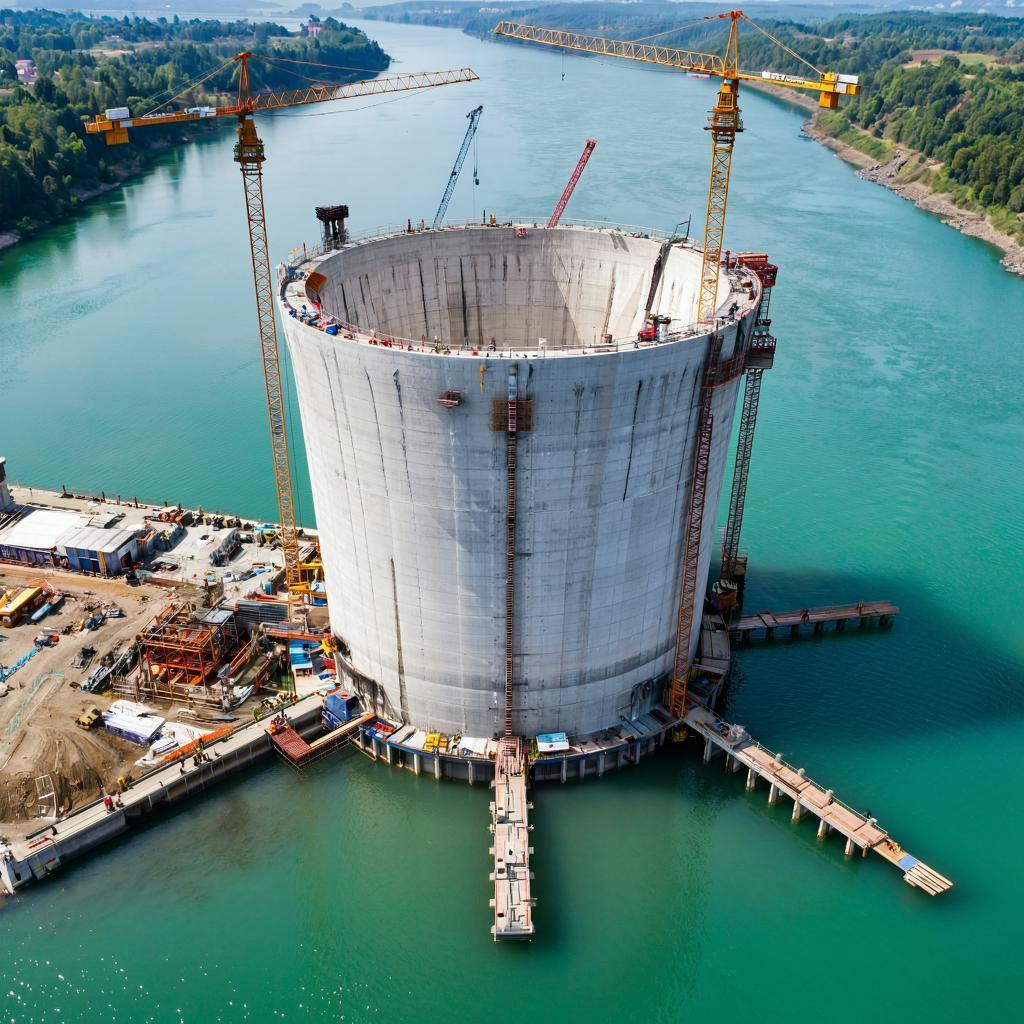
1. Preparation
Site Selection: Choosing a location for the HYPOT II installation, considering water availability, terrain, and environmental requirements.
Geological Surveys: Conducting geological surveys to determine soil and water characteristics.
Environmental Studies: Assessing the environmental impact and developing measures to minimize negative effects.
Project Development: Creating a detailed project, including power calculation, material selection, and equipment.
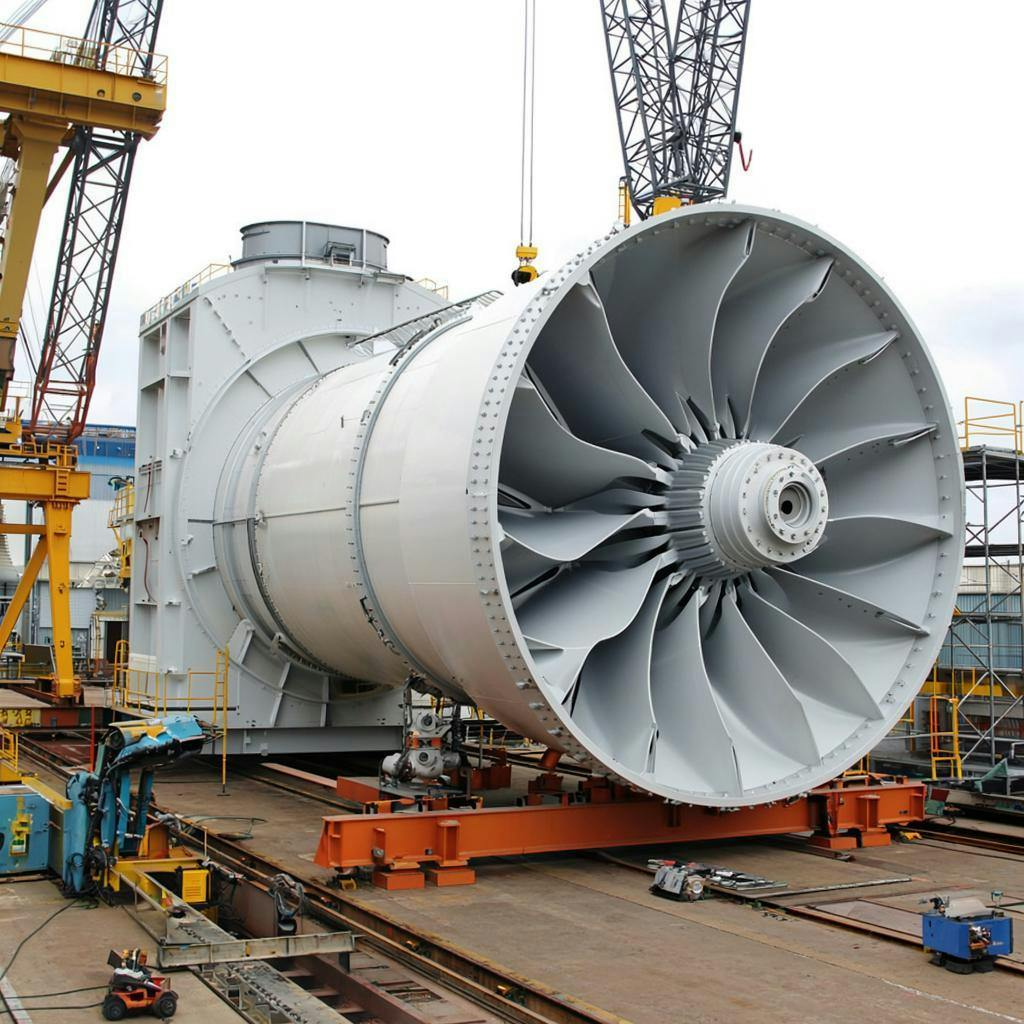
2. Construction
Site Preparation: Clearing and preparing the site for construction.
Foundation Work: Building the foundation for the HYPOT tower.
Tower Installation: Installing the hyperboloid tower, including spiral channels and collector.
Turbine Installation: Mounting turbines at the top of the tower.
Connection to the Grid: Connecting the power plant to the electrical grid.
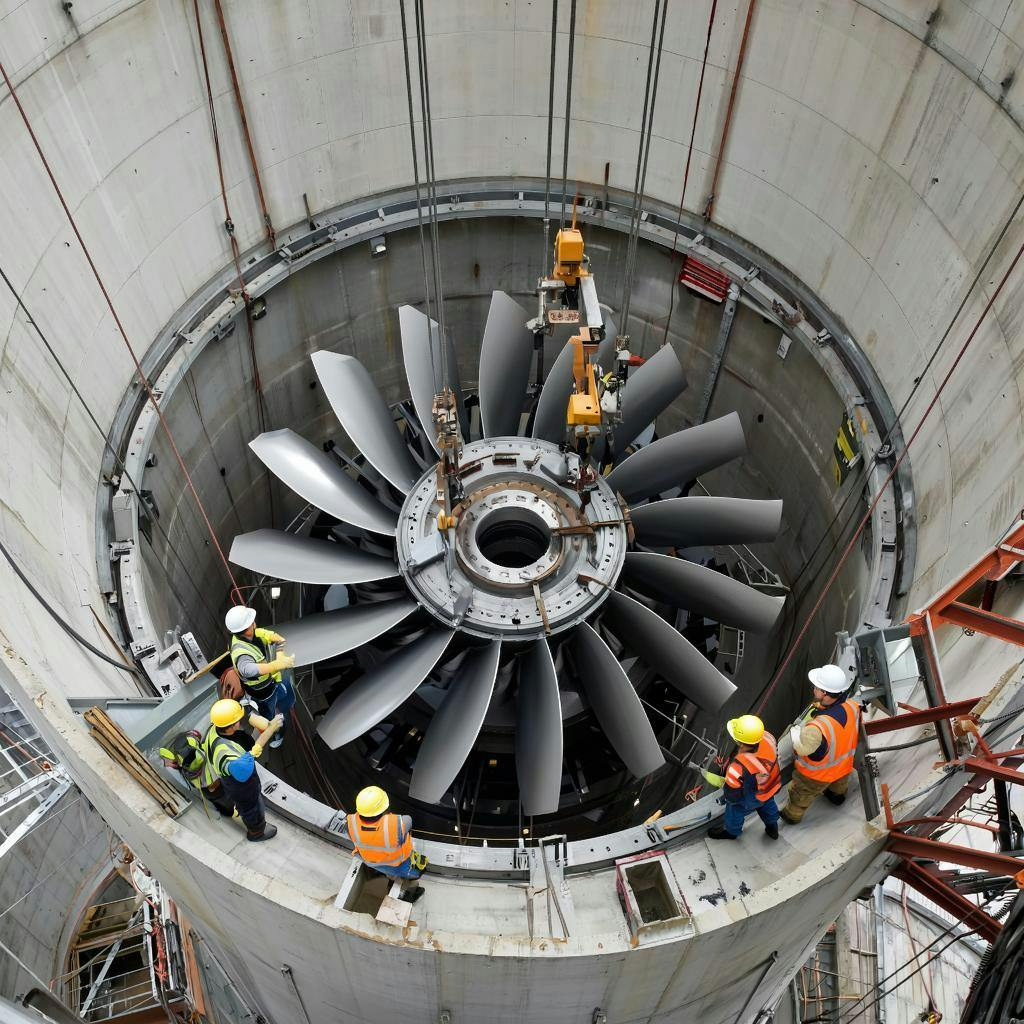
3. Equipment
Equipment Installation: Installing additional equipment such as generators, transformers, and control systems.
Testing: Conducting test runs and checking the functionality of all systems.
Commissioning: Official commissioning of the power plant.
To describe the flow path of water entering the collector and calculate its velocity and pressure as it rises in the outer hyperboloid tower, we need to consider several key parameters. Let's go through the calculation step by step.
Entering the Collector: Water enters the collector through inlet openings located around the perimeter.
Spiral Collector: Water passes through spiral channels, creating vortices that facilitate the lifting of water.
Outer Hyperboloid Tower: Water rises through spiral channels between the outer and inner hyperboloid shells.
Vortex Turbine: Water reaches the vortex turbine installed inside the inner hyperboloid shell.
To calculate the velocity of the water flow in the spiral channels, we use Bernoulli's equation:
pρ+v22+gz=constρp+2v2+gz=const
where:
p — pressure,
ρ — fluid density,
v — flow velocity,
g — acceleration due to gravity,
z — height.
Let's assume the flow velocity at the collector inlet is 2 m/s. As the water rises to a height of 50 meters, the flow velocity will change.
To calculate the pressure, we use Bernoulli's equation:
p=ρ⋅g⋅z
where:
ρ — water density (1000 kg/m³),
g — acceleration due to gravity (9.8 m/s²),
z — height (50 m).
Substituting the values:
p=1000⋅9.8⋅50=490,000 Pa
The velocity of the water flow in the spiral channels changes as it rises, and the pressure increases with height. This ensures a more stable and efficient operation of the station.
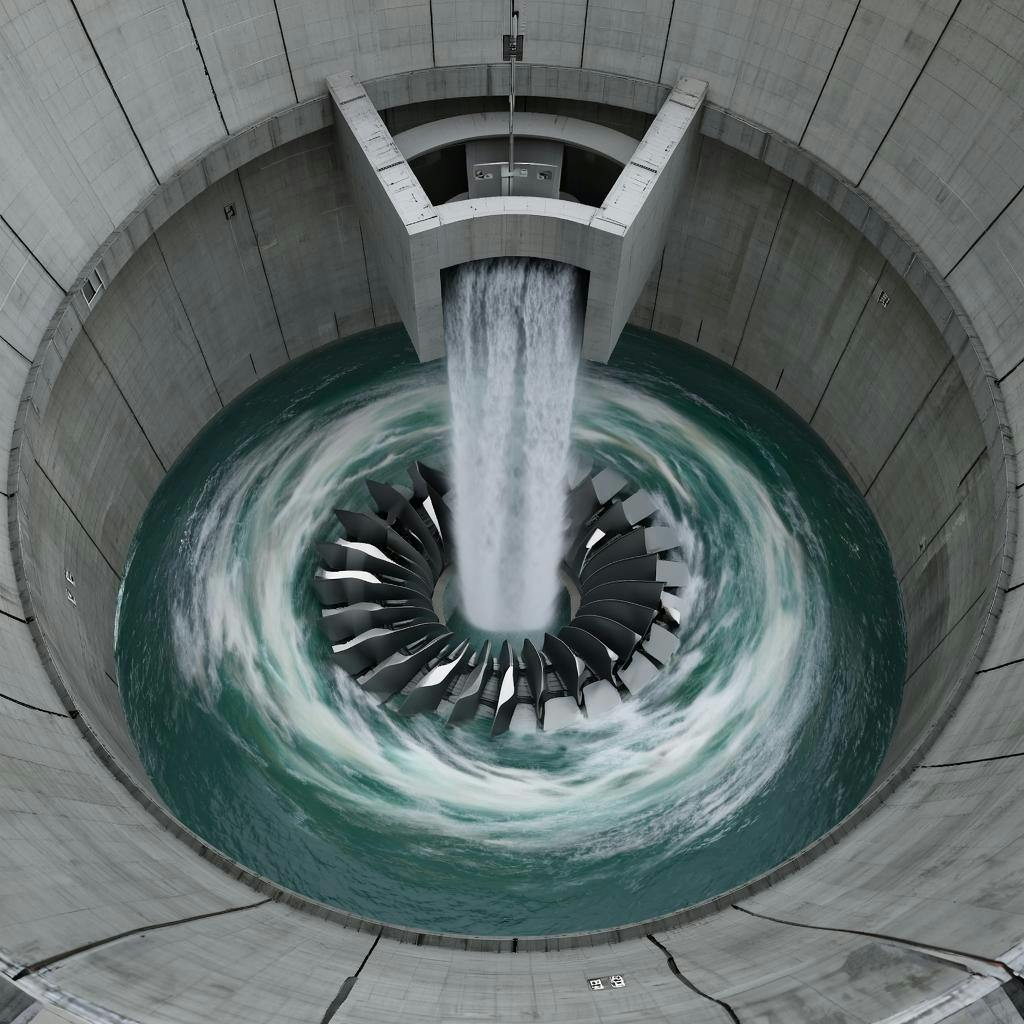
To calculate the optimal diameter of the openings for discharging water onto the vortex turbine in HYPOT II, we need to consider several key parameters. Let's go through the calculation step by step.
Water Lift Height: 50 meters (height of the tower).
Depth of Immersion: 20 meters.
Flow Velocity: 2 m/s.
Efficiency: Assume 80%.
To calculate the water flow rate, we need to consider the flow velocity and the cross-sectional area of the flow. Let's assume the cross-sectional area of the flow is 100 m² (this value may vary depending on specific conditions).
Q=v⋅A
where:
v — flow velocity (2 m/s),
A — cross-sectional area of the flow (100 m²).
Substituting the values:
Q=2⋅100=200 m3/s
To calculate the optimal diameter of the openings for discharging water onto the vortex turbine, we use the following formula:
d=πv4Q
where:
d — diameter of the opening,
Q — water flow rate (200 m³/s),
v — flow velocity (2 m/s).
Substituting the values:
d=π⋅24⋅200≈6.28800≈127.32≈11.3 m
The optimal diameter of the openings for discharging water onto the vortex turbine in HYPOT II is approximately 11.3 meters. This value may vary depending on specific conditions and project requirements.
4. Operation and Maintenance
Regular Maintenance: Conducting regular inspections and maintenance of equipment.
Repairs: Performing repairs when necessary.
Monitoring: Continuous monitoring of the power plant's operation and performance.
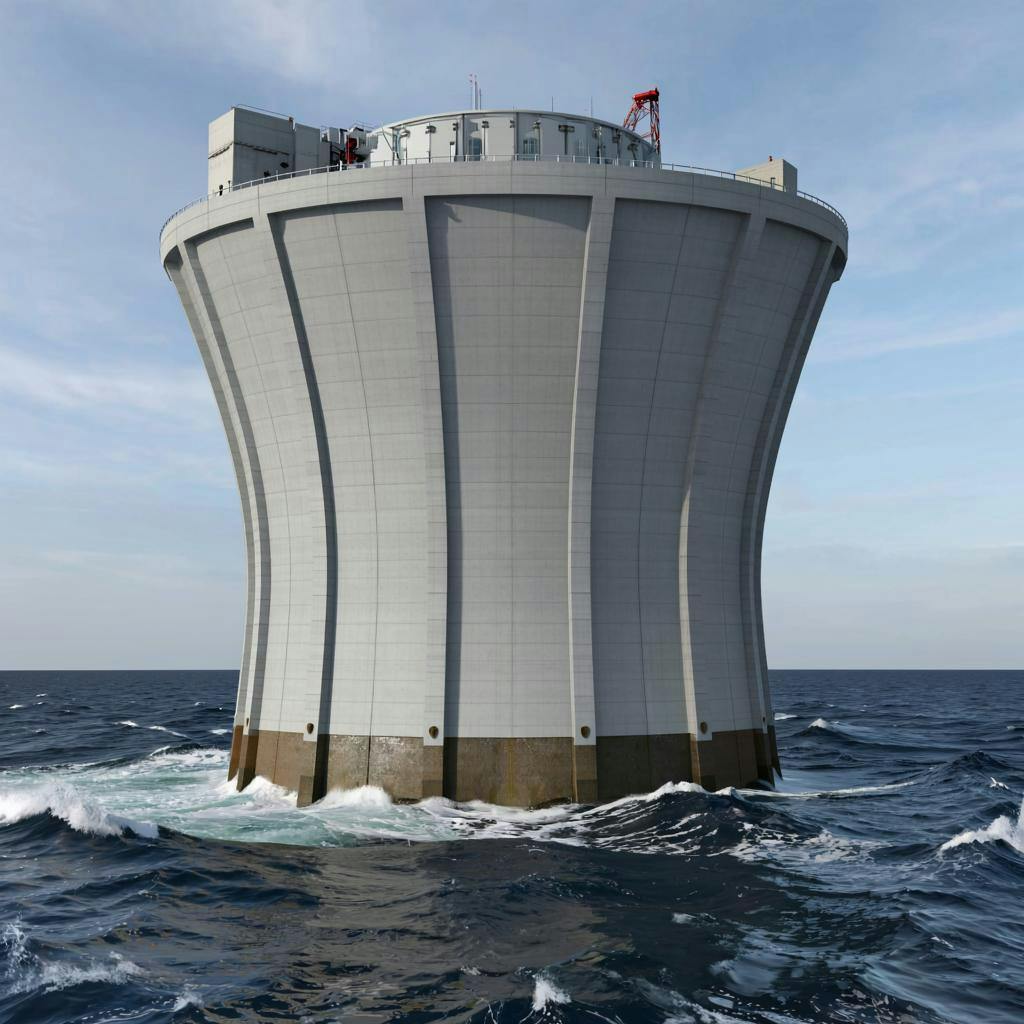
Description of HYPOT II Technology
The spiral collector in the vertical vortex turbine generator based on HYPOT II technology is a key component of new-generation hydroelectric power plants, ensuring the creation of powerful vortex flows within the installation. Its primary function is to form a stable water flow, which enhances the overall performance of the power plant. Let’s take a closer look at the design and operating principle of this element, including some расчётные parameters and physical processes.
Operating Principle of the Spiral Collector
The operation of the spiral collector is based on the principle of generating stable water vortices. The collector is located at the bottom of the hydroelectric plant and receives water directly from the surface of the water body or from the lower layers of the river.
As the water passes through a system of special spiral channels, rotational movements of the liquid are formed. This movement creates powerful centripetal (Fcentripetal=mRv2) and centrifugal forces, where:
m is the mass of the water,
v is the tangential velocity of the water flow,
R is the radius of the spiral channel.
These forces facilitate the lifting of water to significant heights while simultaneously increasing the kinetic energy of the incoming water flow (Ekinetic=21mv2). The height to which the water is lifted can be estimated using the principle of conservation of energy, considering the conversion of kinetic energy into potential energy (Epotential=mgh), where:
g is the acceleration due to gravity (approximately 9.81m/s2),
h is the height to which the water is lifted.
This approach significantly improves the operating conditions of the hydro turbine, increasing the overall efficiency of the plant compared to HYPOT I technology. The efficiency (η) of the system can be expressed as the ratio of useful output power (Poutput) to input power (Pinput): η=PinputPoutput×100%.
Structure of the Spiral Collector
To achieve optimal performance, the structure of the spiral collector includes several key elements:
Shape of the Collector:
The collector is designed in the form of a large spiral funnel. This shape ensures smooth passage of the water mass into the device, minimizes energy losses, and promotes the creation of directed flows. The angle of the spiral (α) and its diameter (D) are crucial parameters affecting the flow rate (Q) and pressure (P) within the collector.
Internal Channels:
Throughout the length of the collector, there are special spiral channels that perform two important functions:
form stable flows,
accelerate water circulation due to the specific arrangement of the walls.
These channels ensure the effective conversion of the mechanical energy of water movement into the useful rotational energy of the generator rotor. The energy conversion efficiency depends on the hydraulic resistance (Rh) and the flow velocity profile within the channels.
Inlet Openings:
On the periphery of the collector, inlet openings are placed through which water is drawn from the source. Their location is designed to ensure maximum water capture and create the most effective initial impulse. The number and size of the inlet openings affect the total flow rate (Q=A⋅v, where A is the cross-sectional area of the opening and v is the flow velocity).
Internal Shell:
In addition, inside the main structure, there is an additional internal hyperboloid shell with a closed lid, which acts as a diving bell. At the top of this shell, a vortex turbine is installed, onto which water is discharged from the upper mark, where the water has already passed through the initial stages of lifting in the spiral channels of the main body. The pressure within the hyperboloid shell (P=ρgh, where ρ is the density of water) contributes to the efficient delivery of water to the turbine.
Creation of Vortices and Their Significance
One of the key advantages of using a spiral collector is its ability to create highly efficient water vortices. It is precisely these vortices that allow for the stabilization of the water flow supplied to the turbine, maintaining a constant flow rate even with significant fluctuations in the water level of the source.
The vortices formed lift the water to the required mark before it is fed to the turbine blades, which significantly enhances the effect of liquid delivery and converts gravitational force into mechanical force used by the generator to produce electricity. The torque (T) generated by the turbine can be calculated as T=r×F, where:
r is the lever arm (radius of the turbine blade),
F is the force exerted by the water on the blade.
Advantages of Using a Spiral Collector
The use of a spiral collector in the designs of modern vertical vortex stations brings a number of tangible benefits:
Enhanced flow stability: The formation of stable vortices ensures high stability of water supply to the working elements of the turbine, which is especially important when the plant operates under conditions of uneven water supply. The coefficient of flow stability (Kstability) can be introduced to quantify this advantage.
Reduced risk of hydraulic shocks: The stable vortices formed by the spiral collector reduce the likelihood of hydraulic shocks in the spiral channels, thereby extending the service life of the equipment and reducing maintenance costs. The pressure fluctuations (ΔP) are significantly lower compared to conventional systems.
Efficient turbine operation: Due to the maintenance of constant and high-quality distribution of pressure and water flow velocity, the overall productivity of the turbines is improved, increasing electricity generation. The power output (P) of the turbine can be estimated as P=η⋅ρ⋅Q⋅g⋅H, where H is the head (height difference).
The main differences between HYPOT I and HYPOT II technologies
The main differences between HYPOT I and HYPOT II technologies in their design, efficiency, and operational principles. Here are the key distinctions:
HYPOT I: The first generation of HYPOT technology typically involves a simpler design with a focus on basic vertical vortex turbine principles. It may have a more straightforward structure with fewer advanced features.
HYPOT II: The second generation introduces significant improvements in design, including the incorporation of a spiral collector. This collector is a key innovation that enhances the formation of stable water vortices, which are crucial for improving the overall efficiency of the system.
HYPOT I: While effective, HYPOT I may have limitations in terms of energy conversion efficiency, especially in variable water conditions. It relies on basic principles of water lifting and turbine operation without advanced mechanisms to stabilize the flow.
HYPOT II: The introduction of the spiral collector in HYPOT II significantly enhances the efficiency of water flow stabilization. This results in a more consistent and powerful water flow to the turbine, leading to higher energy output and improved overall performance.
HYPOT I: The first generation may not have mechanisms to stabilize water flow effectively, which can lead to fluctuations in turbine performance, especially in conditions with variable water levels or turbulence.
HYPOT II: The spiral collector in HYPOT II creates stable water vortices, which help to maintain a consistent flow rate to the turbine. This stabilization is crucial for ensuring that the turbine operates at optimal efficiency, even under varying water conditions.
HYPOT I: Without advanced stabilization mechanisms, HYPOT I may be more susceptible to hydraulic shocks, which can damage the turbine and reduce its lifespan.
HYPOT II: The spiral collector in HYPOT II reduces the risk of hydraulic shocks by creating stable vortices. This not only extends the service life of the equipment but also reduces maintenance costs.
HYPOT I: The energy output of HYPOT I is limited by its basic design and lack of advanced stabilization mechanisms.
HYPOT II: With the improved design and stabilization features, HYPOT II can achieve higher energy output. The stable water flow and efficient turbine operation result in increased electricity generation.
HYPOT I: May have limitations in adapting to varying water conditions, such as changes in water levels or turbulence.
HYPOT II: The spiral collector allows HYPOT II to operate more effectively under a wider range of water conditions, making it more versatile and reliable.
Conclusion
Thus, the use of a spiral collector in the design of a vertical vortex turbine generator allows for the effective improvement of the quality of hydroelectric power plant operation, enhancing the performance and reliability of the system as a whole. This element demonstrates itself as an innovative solution that opens up new opportunities for improving the efficiency of converting water energy into electricity.
Designing, constructing, and equipping a kinetic hydroelectric power plant using HYPOT II technology requires thorough preparation and execution of all stages, from site selection to commissioning. This is a complex process that requires the involvement of specialists in various fields, including engineers, environmentalists, and construction workers.
HYPOT II represents a significant advancement over HYPOT I, with improvements in design, efficiency, and operational flexibility. The introduction of the spiral collector enhances water flow stabilization, reduces hydraulic shocks, and increases energy output, making HYPOT II a more reliable and efficient solution for hydroelectric power generation.

