


Germán Toro Ghio, Karlstad, Sweden, September 5, 2025
In 2024, a quiet revolution unfolded, one that has the potential to rewrite the global balance of power. The numbers are stark and unequivocal: for the first time in history, the vast majority of new renewable energy projects built around the world were cheaper than their fossil fuel competitors—without subsidies, without creative accounting, and without future promises.
According to the International Renewable Energy Agency (IRENA), of the new renewable capacity installed last year, outcompeted coal, oil, or natural gas on pure cost alone. Utility-scale solar farms, onshore wind turbines, and even the once-expensive offshore wind parks are now decisively undercutting fossil fuels. This is not merely a technical milestone; it is a geopolitical earthquake. The old fossil order—built on petrodollars, pipelines, and oil wars—is under existential threat. And like any threatened empire, it is striking back.
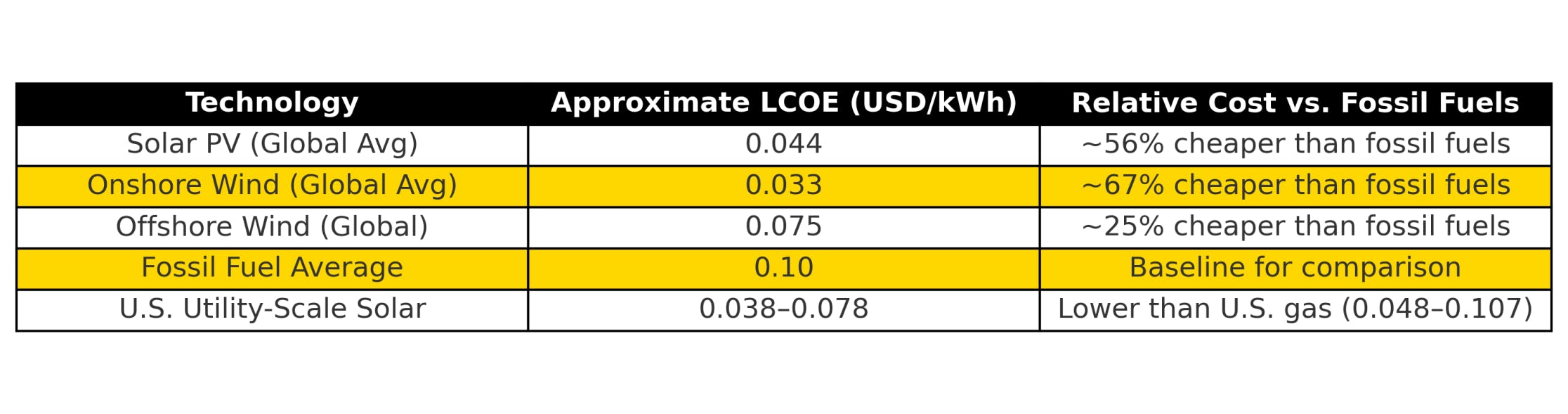
Global Cost Comparison Table
Numbers Don’t Lie: The Global Cost of Revolution
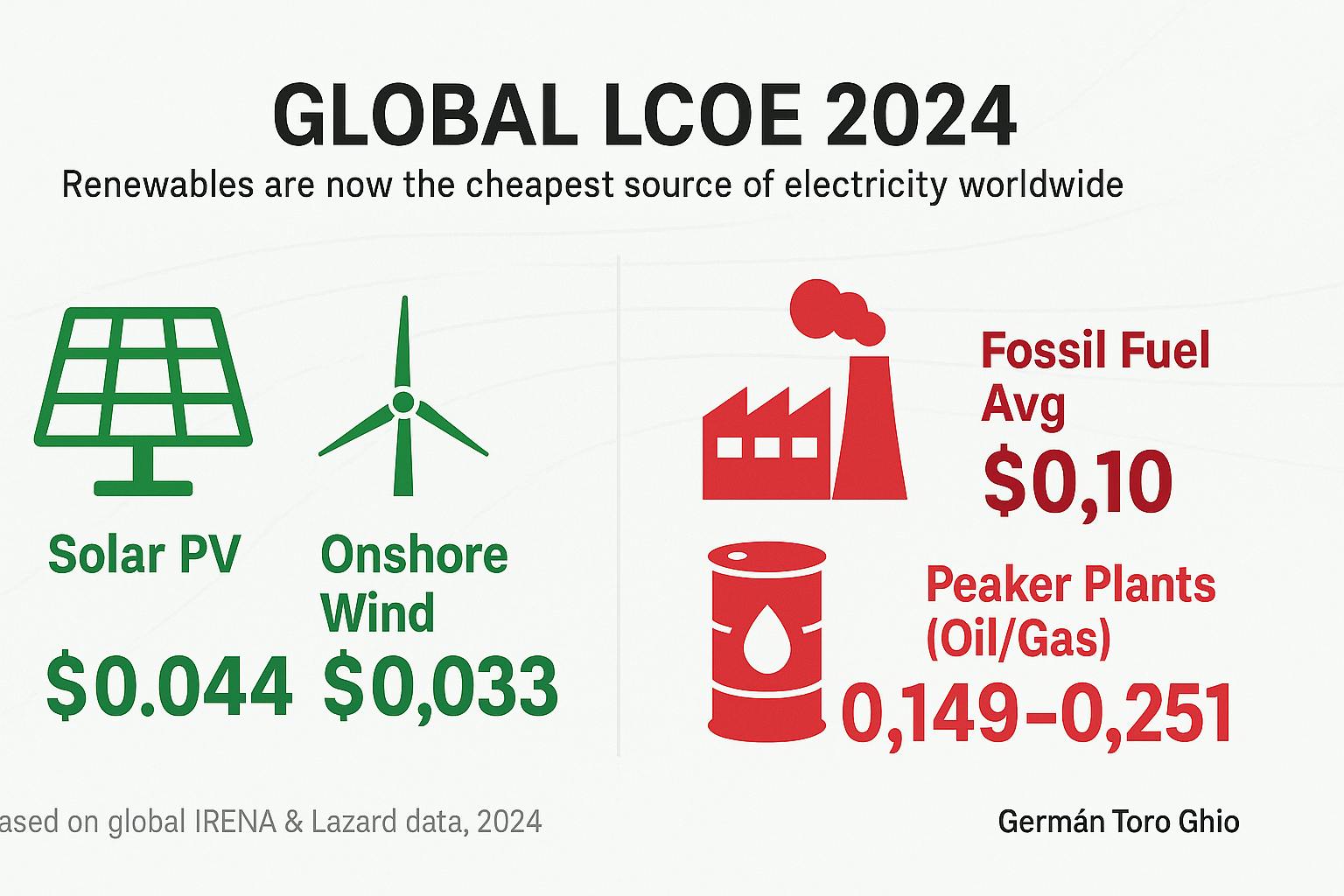
Onshore wind now averages just $0.033 per kilowatt-hour, a staggering 67% lower than the fossil fuel benchmark of $0.10. Utility-scale solar PV comes in at $0.044, making it 56% cheaper than fossil alternatives. Even offshore wind has fallen to $0.075, directly competing with gas and coal in many regional markets.
Regional Breakdown: Winners and Losers
Breakdown: Winners and Losers. In the United States, Lazard's 2025 LCOE+ shows that utility-scale solar now ranges between $38 and $78/MWh, outperforming gas plants at $48 to $107/MWh. Europe's offshore wind revolution is redefining energy independence after the Russia-Ukraine crisis, while China and India dominate renewable deployment at scale.
Fossil Pushback
Fossil fuel industries have spent years establishing political power and are not backing down easily. Trade wars are playing a major role, with U.S. tariffs on Chinese solar panels hindering progress, while European leaders discuss similar protectionist policies.
The Geopolitical Stakes
Cheap renewables shift global power. Petro-states like Russia and Saudi Arabia face existential threats as demand for oil and gas declines. Meanwhile, countries rich in sunlight and wind achieve energy independence, reducing reliance on fossil imports
Renewables have already won the cost war.
The only question is how quickly politics, finance, and public opinion will align with this reality. Each wind turbine and solar panel installed is a down payment on a more stable and just future.