

Introduction
The Silent Energy Transition Inside the Cloud
Data centres have become the physical backbone of the digital economy. From cloud computing and AI training to financial transactions, health systems, and national security, their role is now systemic rather than supportive. Yet their rapid expansion is colliding with energy realities, electricity grids under strain, decarbonisation mandates tightening, and communities increasingly resistant to new grid-intensive developments.
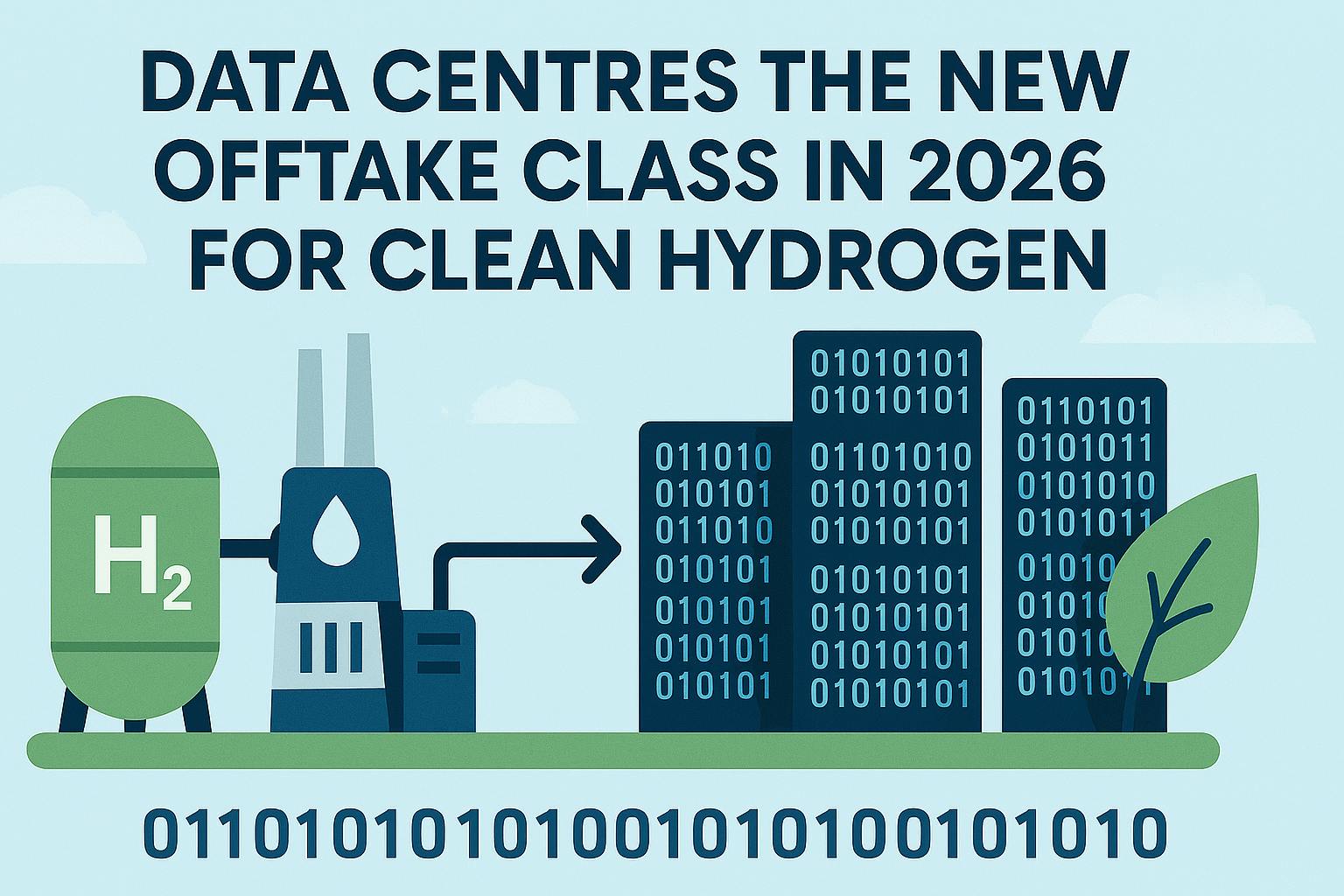
Against this backdrop, data centres are quietly emerging, and Hydrogen Ireland believes that they will top the new offtake class of '26 for clean hydrogen, not as a speculative future option, but as a pragmatic response to power, resilience, and sustainability challenges that conventional electrification alone is struggling to solve.
This article explores why data centres are uniquely positioned to become anchor customers for hydrogen, what benefits this unlocks across energy systems, and how this convergence could reshape both digital and hydrogen infrastructure.
Why Data Centres Are Different: Energy Intensity, Criticality, and Growth
Unlike most industrial loads, data centres combine three defining characteristics:
Extreme and continuous energy demand
Large hyperscale facilities now routinely exceed 100–300 MW, operating 24/7 with minimal tolerance for interruption.
Zero downtime tolerance
Power resilience is not optional; it is existential. Backup systems are mandatory and heavily over-engineered.
Explosive growth trajectories
AI, machine learning, and edge computing are driving demand curves that outpace grid reinforcement timelines.
Historically, these needs have been met through a combination of grid connections, diesel backup generators, and increasingly, power purchase agreements (PPAs) with renewable generators. But this model is fraying.
Grid congestion, long connection queues, curtailment risk, and local opposition are slowing projects. Fossil fuel, primarily, diesel backup, while reliable, is increasingly incompatible with ESG commitments and regulatory pressure. The result is a sector actively searching for dispatchable, clean, non-grid-constrained energy, a description that aligns closely with hydrogen.
Hydrogen’s Value Proposition for Data Centres
Clean hydrogen offers data centres a multi-dimensional value stack that goes far beyond simple fuel substitution.
1. Dispatchable, Grid-Independent Power
Hydrogen enables on-site or near-site power generation through fuel cells or hydrogen-ready turbines. This decouples data centre growth from grid bottlenecks, allowing capacity to be added where digital demand exists rather than where grid capacity happens to be available.
For operators facing multi-year grid connection delays, hydrogen can become a time-to-market enabler.
2. Resilience Beyond Diesel
Diesel generators dominate backup power today, but they are carbon-intensive, increasingly regulated, and politically fragile. Hydrogen fuel cells offer:
Instant start capability
Quiet operation
Zero local emissions
Longer-duration backup when paired with sufficient storage
In resilience terms, hydrogen shifts backup power from a regulatory liability to a strategic asset.
3. Heat as a Feature, not a Waste
Fuel cells produce low-grade heat as a by-product. In data centres, where cooling dominates energy consumption, this heat can be repurposed:
District heating
Absorption cooling
Industrial heat sharing
This turns data centres from isolated energy sinks into integrated energy nodes within local systems.
4. Alignment with 24/7 Carbon-Free Energy Goals
Many hyperscalers now pursue 24/7 carbon-free energy, not just annual net-zero accounting. Hydrogen enables temporal matching — storing renewable energy when abundant and dispatching it when needed — solving a problem that batteries alone struggle to address at scale and duration.
Why Data Centres Matter to the Hydrogen Economy
The hydrogen sector has long faced a structural challenge: early demand certainty. Data centres help resolve this.
· Anchor Demand at Scale
A single hyperscale data centre can consume hydrogen volumes comparable to mid-sized industrial facilities. As a fleet, they represent:
Predictable, long-term demand
Strong credit counterparties
Willingness to pay for reliability and decarbonisation
This makes them ideal anchor customers for electrolyser projects, pipelines, and storage assets.
· Accelerating Infrastructure Build-Out
Hydrogen infrastructure struggles with the chicken-and-egg problem of supply versus demand. Data centres collapse this dilemma by offering bankable offtake that justifies early investment — particularly in regions with strong renewable resources but constrained grids.
· System-Level Benefits
When integrated intelligently, hydrogen-powered data centres can:
Absorb curtailed renewable generation
Provide grid balancing services
Act as controllable loads or generators
This positions them not as grid burdens, but as grid stabilisers.
· Siting, Strategy, and the Rise of the ‘Hydrogen-First’ Data Centre
A new siting logic is emerging. Instead of asking “Where can we connect to the grid?” developers increasingly ask:
Where is renewable energy abundant?
Where is hydrogen production viable?
Where can waste heat be utilised?
This points to the rise of hydrogen-aligned data clusters, in the Hydrogen Nexus project currently been developed by Irish Company Lagan Energy Engineering they describe them as Green Data Valleys, where digital infrastructure, hydrogen production, storage, and energy reuse co-evolve.
In such models, data centres are no longer passive consumers but active participants in regional energy ecosystems.
Challenges and Realism
The opportunity is substantial, but not without hurdles:
Hydrogen cost remains higher than grid electricity in many regions
Standards for hydrogen-powered data centres are still evolving
Operators are conservative by necessity
However, these challenges mirror those faced by renewables a decade ago. As electrolyser costs fall, policy frameworks mature, and pilot projects scale, hydrogen’s competitiveness improves, particularly when resilience, speed, and system value are properly priced.
Conclusion:
Data and Energy Security - A Convergence, not a Detour
Data centres are not a niche application for hydrogen; they represent a structurally new offtake class, digital, mission-critical, capital-rich, and growing at extraordinary speed.
For data centre operators, hydrogen offers resilience, growth optionality, and credibility in a decarbonising world. For the hydrogen economy, data centres offer scale, certainty, and a bridge from ambition to deployment.
Crucially, this convergence also reframes data security and energy security as inseparable. In an era of AI acceleration, geopolitical tension, and climate volatility, secure data depends on secure, controllable, and sovereign energy supplies. Hydrogen-enabled power architectures reduce exposure to grid fragility, fuel supply shocks, and regulatory disruption, strengthening not just uptime, but national and corporate resilience.
The convergence of hydrogen and digital infrastructure is therefore not an abstract future scenario. It is already forming — quietly, pragmatically, and driven by necessity. Those who recognise data centres as hydrogen’s next anchor customers will help shape both the energy system and the cloud that increasingly defines modern life.

