


Diablo Canyon Agrees to Coastal Commission Land Use Plan
Standard Nuclear Moves Ahead with Plans for TRISO Fuel Production
Standard Nuclear Joins DOE Nuclear Fuel Line Program
Natura Resources Purchases Shepherd Power
State of New York Invests $40 Million in Nuclear Workforce Development
GE Vernova Hitachi SMR Design Clears Key UK Regulatory Review Milestone
Japan Quits Its Vietnam Nuclear Project
Environmental Groups and others opposed to the reopening of the Diablo Canyon nuclear plant thought they’d latched on to a sure thing when the California Coastal Commission told Pacific Gas & Electric (PGE) that the Diablo Canyon Plant needed to set aside 4.000 acres of its site to prevent future development for residential or commercial use.
The outcome of the decision would determine whether the U.S. Nuclear Regulatory Commission would proceed with granting 20-year extensions of the licenses of the two 1,100 MW nuclear reactors at the plant.
PG&E filed its license renewal application with the NRC in November 2023 and the NRC accepted the application for a full review in December 2023. The utility intends to keep Diablo Canyon running until 2045. The NRC is expected to approve the plant’s license renewal application in the first quarter of 2026.
The NRC’s approval depends on PG&E clearing two hurdles in California. The first is a land use plan that needs to be approved by the California Coastal Commission. The second is a certification from California Central Coast Regional Water Quality Control Board that the reactor site is in compliance with its water quality permit. The plant’s once through cooling system discharges the water back into the Pacific Ocean.
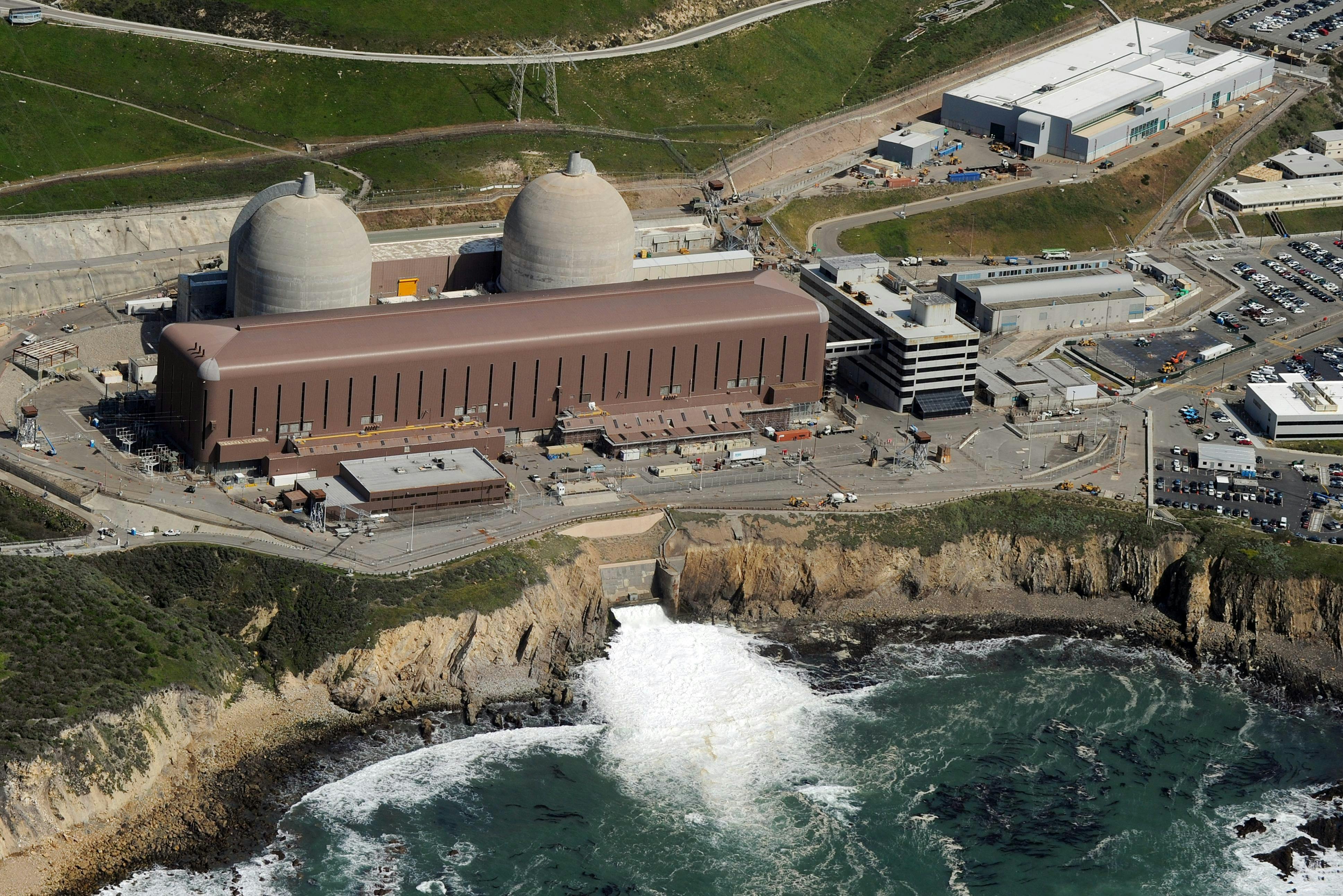
The NRC’s safety evaluation report issued in June 2025 concluded that operator Pacific Gas & Electric (PG&E) can continue to manage the site safely and within federal regulations. The report’s conclusions followed extensive technical reviews, audits, inspections, and public consultations.
First Up a Land Use Plan
Opposition groups targeted the Coastal Commission’s action calling for setting aside 4,000 acres from further development. These group have opposed extending the licenses by 20 years for the two 1,110 MW Westinghouse pressurized water reactor (PWR) units at Diablo Canyon every step of the way.
By way of background, environmental organizations thought they’d put a lid on the future of the plant in 2016 with an agreement to close the plant. In June 2016 four leading environmental groups signed on to the agreement to close the twin reactors and replace them with “greenhouse gas free resources,” e.g., solar, wind, and hydro. The groups involved included Friends of the Earth, the Natural Resources Defense Council, Environment California, and the Alliance for Nuclear Responsibility.
What happened next is that the State of California discovered that there was not enough generating capacity on the energy mix to cover the gapping hole was carved out of grid capacity once the reactors were shut down.
In response California Governor Gavin Newsome was able to convince the state legislature that the quickest way to be voted out of office was to let the nuclear plants stay dark which had already resulted in energy blackouts and skyrocketing utility costs. The two reactors had provided 10% of all the electricity generated in California.
In 2020 statewide rotating outages during a heat wave helped make his point. What green groups experienced is that you can preach the environmental values of renewable energy, but when people reach for the ‘on’ switch to their air conditioners, and all they hear are crickets, the party’s over.
California experienced an extreme heat wave in August 2020 that caused the California Independent System Operator (CAISO) to direct electric utilities in its balancing authority to shed load, or in more common terms, to initiate rolling blackouts.
As expected, popular sentiment came around quickly when faced with stark choice that needed to be made to reverse the Diablo Canyon shutdown order in to keep the lights on and to prevent the California economy from taking a nose dive. In 2022 a state law ordered the plant to stay open for at least five years. It also authorized a $1.4 billion loan to be paid back by a combination of future profits and federal funding sources.
This experience did not deter opposition groups from hitting the Coastal Commission hard in 2025 forcing it to spend months in hearings over the proposed restrictions on land around the plant. However, in the end, nine of the 12 commissioners voted to approve the new land use plan.
The utility proposed a timeline to conserve up to 6,700 acres of land, create 25 miles of trail easements and put aside $10 million for trail construction to mitigate its operations through 2030. It also committed to a prohibition on selling another 5,000 acres of land through 2040, unless the sale is for conservation.
Meeting Water Quality Standards is the Final Hurdle
The remaining step in the license renewal process is the approval of permits through the Central Coast Regional Water Quality Control Board. The plant uses two million gallons a day of water drawn from the Pacific Ocean as a non-consumptive use for cooling purposes. Once the water has done its job, it is discharged back into the bay.
The ocean salt water never comes in contact with the reactor. It is used in a condenser to cool the steam coming off the turbine to return it to the steam system that gets its heat from the fission process inside the reactor pressure vessel. (See image below. Image: DOE)

The California Central Coast Regional Water Quality Control Board is slated to vote in February 2026 on continued Diablo Canyon operations. To allow continued operation of the power plant, the Central Coast Water Board will consider two actions: renewing the National Pollutant Discharge Elimination System (NPDES) permit and issuing a Clean Water Act section 401 water quality certification.
Before the NRC’s license renewals can take effect, the Central Coast Water Board must certify that discharges to ocean waters resulting from the license renewals will comply with California’s water quality standards. (November 2025 staff presentation to the Water Board
Another issue related to regulating Diablo Canyon’s “once through” water use system is how it will protect marine organisms from being harmed by the intake systems. (Fact Sheet)
The same opposition groups will surely focus on these hearings as the decision by the Water Board is the last hurdle in the state’s review prior to the NRC decision whether to grant the license extensions. As they say in the world of Opera, “it ain’t over until the fat lady sings,” so watch this space early next year.
Energy Demand is Growing in California
Diablo Canyon’s future as a key element in the state’s energy portfolio is driven by rising energy demand from data centers. The California Energy Commission says demand from data centers could grow by 4 GW in the next 10 years. The commission anticipates its next forecast will at least double. PG&E’s August 2025 estimate says demand could rise as much as 10 GW by 2035. That equals the energy of nearly five Diablo Canyons.
Diablo Canyon’s extended operations through 2030 are expected to annually reduce greenhouse-gas emissions equivalent to carbon-dioxide emissions from 1.6 million cars.
& & &
A new prime contract with the Department of Energy provides for a significant expansion of the firm’s capacity to manufacture TRISO fuel for advanced reactors
Standard Nuclear, Inc., a reactor-agnostic producer of TRISO nuclear fuel, announced that it has executed an Other Transaction Agreement (OTA) with the U.S. Department of Energy (DOE), marking a major milestone in an effort to bring privately funded advanced nuclear-fuel production infrastructure online in support of TRISO-fueled reactor demonstrations in 2026. Standard Nuclear is focused on the large-scale production of advanced nuclear fuel and radioisotope power systems.
Under the newly executed OTA, Standard Nuclear will transition key operational elements of its TRISO fuel production operations to full DOE oversight, ensuring adherence to the agency’s contracting framework. This enhanced oversight enables a substantial increase in the company’s TRISO fuel manufacturing throughput within its existing facilities.
Standard Nuclear is drawing on expertise from across the DOE complex to support this transition. The Idaho National Laboratory (INL), operated by Battelle Energy Alliance for DOE, is providing technical assistance through a Strategic Partnership Project (SPP) agreement executed earlier this year. The company is also receiving technical support and specialized training from Oak Ridge National Laboratory (ORNL) and the Y-12 National Security Complex.
“We’re proud to be the first TRISO fuel manufacturer to execute an agreement of this kind with the Department of Energy ahead of next year’s reactor demonstrations,” said Kurt Terrani, CEO of Standard Nuclear.
“The advanced reactor and fuel technologies now moving into deployment all originate from decades of DOE research and development said Jess Gehin, Associate Laboratory Director, Idaho National Laboratory.
& & &
DOE has conditionally selected Standard Nuclear as the first company to join its newly launched nuclear fuel line pilot program. This initiative is designed to strengthen the domestic supply chain for nuclear fuel, a key component in the deployment of advanced nuclear reactor technologies. Standard Nuclear, based in Oak Ridge, TN, will lead the development and operation of a new nuclear fuel fabrication facility.
The project will also utilize infrastructure in Idaho to support production of advanced TRISO fuel – a next-generation nuclear fuel critical for high-performance reactors currently under development.
The company will be fully responsible for the construction, operation, and eventual decommissioning of the facility, while reactor developers will source uranium feedstock through DOE’s High-Assay Low-Enriched Uranium (HALEU) allocation program.
The fuel line pilot program directly supports the DOE’s Reactor Pilot Program, which aims to bring at least three advanced reactor designs to operational criticality by July 2026. These next-generation reactors are expected to use more efficient, safer nuclear fuel like TRISO. Standard Nuclear said in its press statement the dual approach fast-tracks research, licensing, and deployment of innovative reactor technologies outside of traditional government labs, opening the door for private-sector investment and commercial-scale deployment.
Expanding domestic nuclear fuel capabilities is a strategic national priority. For years, the US has depended on foreign countries, including adversarial powers, for enriched uranium and other critical materials. This reliance introduces supply chain vulnerabilities, especially during times of geopolitical tension.
Earlier this year Standard Nuclear, Inc.,announced its launch from stealth with $42 million in total funding led by Decisive Point with participation from Andreessen Horowitz, Washington Harbour Partners, Welara, Fundomo, and Crucible Capital.
& & &
The firm Also Partnered with NOV to Deploy Gigawatts of SMRs in early 2030s
Shepherd Power’s expertise in full-scale reactor deployment will accelerate Natura’s ability to provide comprehensive power options for customers, including site, build, own, and operate
Agreement will align Natura’s breakthrough reactor design with NOV’s manufacturing expertise to accelerate commercial deployment of Natura’s molten salt reactor (MSR) technology
Natura Resources LLC, a developer of advanced molten-salt nuclear reactors, has acquired Shepherd Power from NOV Inc. (NYSE: NOV) and signed an agreement with NOV to support commercialization of its small modular reactor (SMR) technology. As part of the transaction, NOV will become an investor in Natura and will appoint a representative to Natura’s Board of Directors.
The agreement will align Natura’s molten salt reactor design with NOV’s manufacturing, supply chain, and project management expertise to support delivery of multiple gigawatts of SMRs for data center and industrial applications between 2029 and 2032.
The acquisition adds Shepherd Power’s reactor deployment expertise, including regulatory and licensing experience, to the Natura team, strengthening Natura’s path to commercial deployment and enhancing the company’s ability to offer a range of industrial power options for customers.
Natura is building SMRs that use liquid fuel dissolved in a molten salt mixture. This design operates at high temperature and atmospheric pressure. It can use several fuel types, including recycled waste fuel and enables harvesting of rare medical isotopes critical for cancer treatment.
The firm said in its press statement that the design of Natura’s 100 MW reactor also will make it an option for produced water desalination, a critical issue for the Permian Basin and other areas of the U.S. with significant oil and gas production.
The Nuclear Regulatory Commission issued a construction permit in September 2024 for the deployment of Natura’s 1 MW reactor at Abilene Christian University. Natura expects to deploy this reactor in 2026.
Natura plans to file two commercial reactor applications with the NRC before the end of 2025 –one focused on medical isotope production and the other for grid-scale electricity generation. The company expects to deploy its first 100 MW commercial reactor in 2029.
& & &
(WNN) The New York Power Authority (NYPA) will partner with qualified workforce development providers, including technical high schools, community colleges, universities, labour unions, and others to use $40 million in funding to develop nuclear energy technical training, retraining, coursework and apprenticeship programmes to prepare workers for employment in the advanced nuclear energy field.
Hochul’s direction to NYPA, the state’s public electric utility, plans to develop at least 1 GW of advanced nuclear capacity in upstate New York, an area in and around Oswego, NY. The NYPA will develop a ‘Master Plan for Responsible Advanced Nuclear Development’ in New York as part of a $1 billion proposal
In addition to the $40 million, the NYPA Board has awarded $4 million to universities and organizations to develop and expand programs that prepare New Yorkers for high-demand careers in artificial intelligence, electromechanical trades, and advanced power systems to meet the evolving needs of the renewable energy sector.
Three nuclear power plants, all in upstate New York, and all operated by Constellation Energy, currently provide 21% of the state’s electricity, and 42% of its carbon-free electricity, according to information from the Nuclear Energy Institute. The state supports the continued operation of the two-unit plant at Nine Mile Point and the single-unit Ginna and Fitzpatrick plants.
& & &
(WNN) GE Vernova Hitachi announced that its BWRX300 SMR has cleared the second of three phases of the Generic Design Assessment (GDA) process at the U.K. Office of Nuclear Regulation. The GDA assess the safety, security, and environmental protection aspects of a nuclear power plant design that is intended to be deployed in Great Britain.
The GDA process is a voluntary, non-mandatory process. Successful completion of the three-step GDA culminates in the issue of a Design Acceptance Confirmation from the ONR and a Statement of Design Acceptability from the Environment Agency.
In May 2021, the UK’s Department for Business, Energy and Industrial Strategy opened the GDA process to advanced nuclear technologies, including small modular reactors (SMRs). GE Vernova Hitachi submitted a GDA entry application for its BWRX-300 SMR to the UK Department for Business, Energy and Industrial Strategy in December 2022. The BWRX-300 is a 300 MWe water-cooled, natural circulation SMR with passive safety systems that leverages the design and licensing basis of GEH’s ESBWR boiling water reactor.
Step 1 of the GDA of the BWRX-300 began in January 2024 and focused on agreeing the scope and schedule for Step 2. Step 1 was completed in December 2024. It then entered Step 2, which focused on evaluating the fundamental adequacy of the design and its safety, security, safeguards and environmental protection documentation. The regulators have now completed Step 2 of the GDA and issued their Step 2 statements and assessment reports on the GE Vernova Hitachi design.
There are currently no plans to deploy the GE Vernova Hitachi BWRX-300 design in Great Britain, and no sites have been identified for its deployment. If an organization decide to progress plans to deploy the BWRX-300 design, the regulators would need to undertake a further period of detailed design assessment before safety-significant construction could begin and environmental permits could be issued. This assessment could be conducted on a generic basis with GE Vernova Hitachi, should the company choose to return to the GDA process to complete Step 3.
“GE Vernova Hitachi opted for a shorter two-step GDA, making it the first requesting party to take advantage of the flexibility we introduced in our modernized GDA process,” said Rob Exley, ONR’s Head of the BWRX-300 GDA.
He added, “This means it is the quickest GDA engagement completed to date.”
Other Firms and the GDA Process
GDAs have previously been completed for the EDF/Areva UK EPR, the Westinghouse AP1000, the Hitachi-GE UK ABWR and China’s HPR1000 designs. A GDA Step 3 assessment is currently ongoing for Rolls-Royce SMR Limited’s small modular reactor design.
In August 2024 a Step 2 assessment began for Holtec International’s SMR-300. In August 2024, Westinghouse’s AP300 was accepted for a GDA review. Last month, TerraPower submitted its Natrium sodium-cooled fast reactor and energy storage system into the GDA process in the company’s first regulatory step to deploying the technology in an international market.
& & &
Reuters reports that Japan has pulled out of plans to build a commercial nuclear power station in Vietnam because the time frame is too tight, Japanese ambassador Naoki Ito told the wire service.
He said, “The Japanese side is not in a position to implement the Ninh Thuan 2 project.”
Japan at one time proposed to develop a nuclear power station for a location on Vietnam’s central highlands with a planned capacity of up to 4 GW composed of four 1,000 MW light water reactors.
A key focus of the power plant was to provide electricity to an aluminum smelting plant to move Vietnam up the value chain from simply exporting raw aluminum to developing a manufacturing capacity to produce finished durable goods.
In June, Bloomberg reported Vietnam was seeking discussions with Russia to accelerate its nuclear program and sign an investment cooperation agreement for a first nuclear power station. Vietnam is a global center of manufacturing operations for multinationals including Samsung and Apple. It has had major power blackouts as demand from its huge industrial sector and expanding urban populations often exceed the power available.
Vietnam, which shares a long common border with China, has long aligned itself with Russia to counter balance China’s influence on its economy and politics. Russia has proposed to build up to 4 GW of nuclear power generating capacity in Vietnam. Japan was supposed to have provided another 4 GW for a total of 8 GW. It is unclear whether Russia would commit to an 8 GW project or whether Vietnam could pay for it.
In 2016 Vietnam cancelled a proposal by Russia to build four 1,000 MW VVERs, and four more 1,000 MW reactors to be supplied by Japanese firms, due to the rising costs of the power stations and concerns about the country’s ability to safely manage the construction operations of the reactors. The start date was pushed back several times by the government on the grounds that it did not have enough trained nuclear engineers to manage the construction nor the safety regulatory programs needed for a reactor development effort of this size.
In January 2015 Hoang Anh Tuan, head of the Vietnam Atomic Energy Agency, told western news media that the reason for the delays is that the government wasn’t ready to manage the project nor does it have a mature and independent nuclear safety and regulatory oversight agency. A national nuclear safety agency was set up in 2010, but much more work is needed according to this report.
Construction of the reactors had been set to begin in the province of Ninh Thuan province in 2014. The site is about 350 km / 135 miles northeast of Ho Chi Minh city (formerly Saigon).
At the time Vietnam did not consider small nuclear reactors because neither the Russians nor the Japanese had commercial units to sell them. Fast forward to 2025, Russia is building SMRs to power mining operations in Siberia but has not, so far, offered them for export. Japan does not currently have a domestic design of an SMR that is economically viable.
# # #
