


You don’t have to look far to find a story about a wildfire that has burned significant acreage and impacted communities across the nation. The number and intensity of these fires are increasing and spreading eastward.
As threats increase, we have seen innovative uses of technology to combat the damage caused by fire. This is well-timed, as many states are also seeing new regulations that mandate proactive mitigation activities by utilities.
I recently met with Skye Perry, Vice President of Utilities at FNN, and learned about new technology that will help utilities mitigate future wildfire risk.
Pat Hohl: What is FNN doing to help address wildfire mitigation?
Skye Perry: The biggest change for utilities happened in the aftermath of the California Camp Fire that occurred in 2018. This fire resulted in 85 deaths and ~14,000 homes being destroyed. Prior to the Camp Fire, many utilities were claiming “Act of God” in court to avoid liability claims. After this fire, the courts ruled that “Act of God” was no longer an acceptable defense and then held the utility liable, leading to a $13.5 billion PG&E settlement for victims. Since then, we have seen utilities being held liable in similar fires across the US.
FNN’s AI wildfire and lightning technology can mitigate a utility’s liability in court while saving lives and protecting property. The first question after a wildfire is what caused it? Utilities care about wildfires regardless of the cause. But the cause directly drives a utility’s liability. Lightning-ignited wildfires account for over 70% of wildfire devastation, yet many of these fires are incorrectly blamed on utilities.
FNN deploys a network of high-risk-lightning (HRL) detectors that can accurately predict which lightning strikes will cause wildfire within 40 seconds of each strike. This data can be used to instantly assign liability for the fire to lightning and initiate the utility's response efforts. Whether lightning or another ignition source caused the fire, FNN’s AI live-fire model steps in to predict and mitigate the fire's damage to the utility’s infrastructure and the community.
Utilizing this technology from FNN demonstrates the utility's intent to mitigate and manage wildfires, as required by the courts to reduce liability. It also changes the response from fire investigation to suppression, allowing fires to be put out faster before they grow out of control.
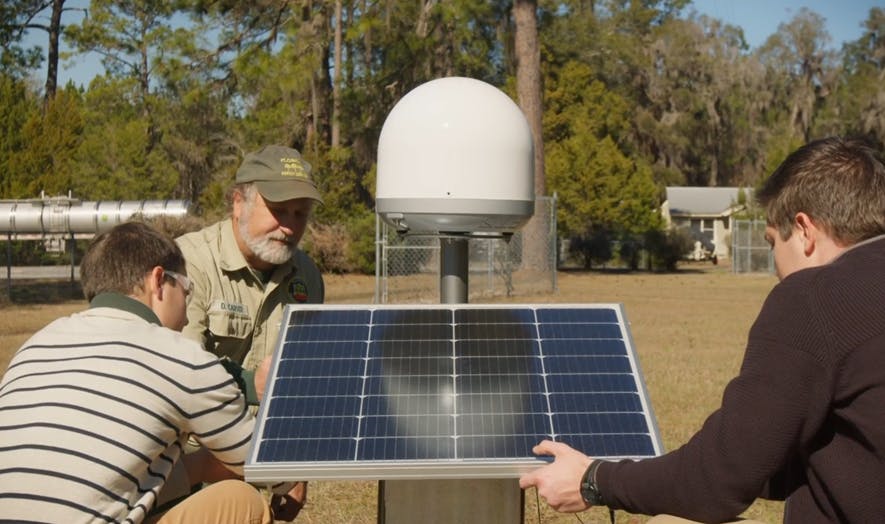
FNN and the Florida Forest Service Install an HRL Lightning Detector
Pat Hohl: Let’s bring it down to practical steps. How can utilities best focus their efforts and reduce wildfire impacts and liability?
Skye Perry: Utilities are now being regulated to establish a proactive standard of care for wildfire mitigation. This typically starts with state PUCs requiring utilities to develop and maintain wildfire mitigation plans (WMPs). The WMP must detail inspection procedures for assets, vegetation management strategy, and intended collaboration with emergency responders.
But we must go beyond an acceptable WMP to fight the fires. An impactful WMP must be tied to an investment in technology that creates a system for tracking and managing real-time wildfire risk. This system includes the WMP but also provides real-time information in three specific areas:
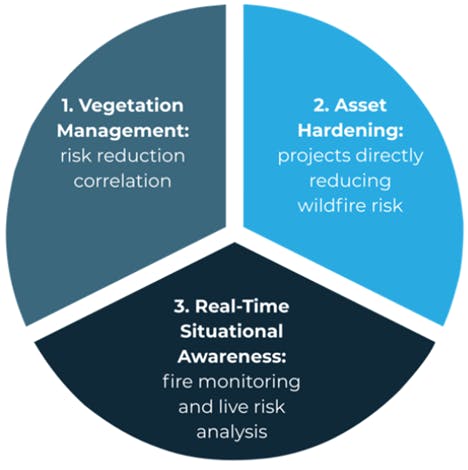
Centralizing this information and making it available to everyone at the utility are key requirements for defining the wildfire standard of care.
Pat Hohl: You’ve mentioned concepts that relate heavily to GIS. How does GIS support the enablement of a utility’s WMP?
Skye Perry: FNN offers a solution called the FNN Wildfire Hub that centralizes all information related to a utility’s wildfire standard of care. This is deployed using Esri ArcGIS Hub, which is perfectly suited for this type of information sharing.
The Hub begins by including the WMP, allowing anyone within the utility to review it. Next, each of the three key mitigation areas (vegetation management, asset hardening, and situational awareness) is included as a tab within the Hub, providing more detail on how the utility is addressing them through a wildfire lens.
Pat Hohl: Regarding vegetation management and asset hardening data, what does it look like to view them through a wildfire lens?
Skye Perry: This relates to our AI wildfire hazard model, which ingests a wide range of data sources to produce a heat map of a utility’s riskiest wildfire areas. This model includes the utility's data, as well as any proposed vegetation management or asset hardening projects.
The solution then provides a utility with two aspects of wildfire mitigation. First, a utility can review planned projects through the AI model to determine if they are focusing their dollars on the most effective locations for wildfire mitigation.
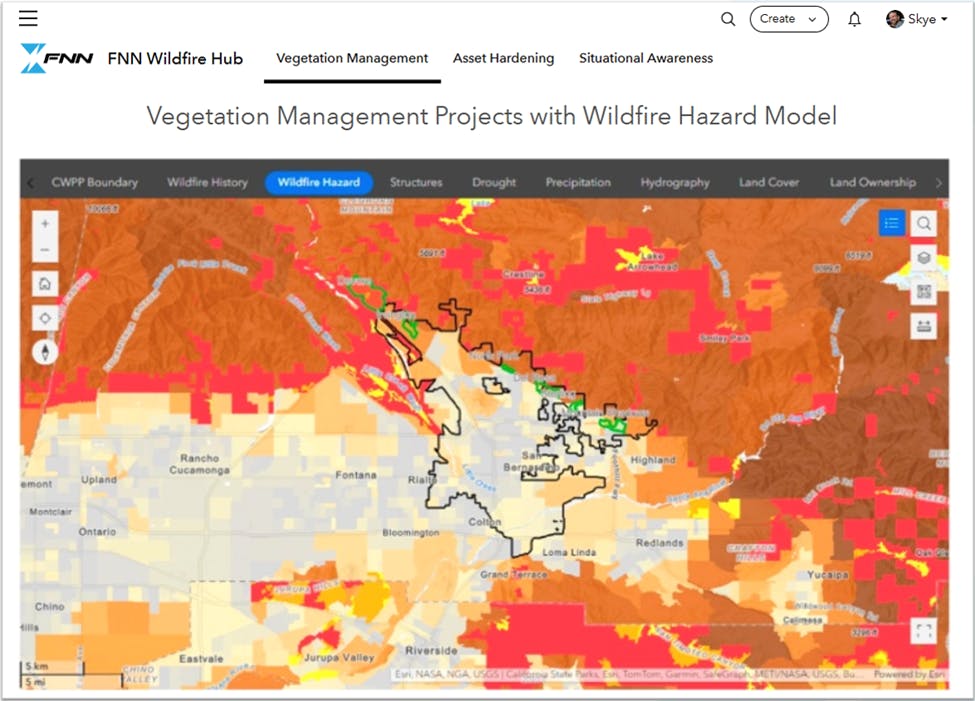
Vegetation Management Impacts via FNN’s Wildfire Hazard Model
In the map above, the small green polygons represent areas under consideration for vegetation management. This view helps a utility prioritize which projects to approve based on the targeted wildfire mitigation. Once the projects are completed, the AI wildfire hazard model can be regenerated to view the positive impacts of the completed projects.
Pat Hohl: And what about situational awareness? How does it apply in the context of FNN’s solution?
Skye Perry: Situational awareness is where the FNN Wildfire Hub provides tremendous value. The dashboards within the hub allow utilities to visualize and predict fire scenarios.
Our Hub and AI wildfire spread model uses the fire's ignition point and other sources (live weather, satellite, lightning data), to predict exactly where the fire will spread over time. The model further accounts for the terrain and integrates with firefighting agencies so we know exactly where fire crews are fighting fires on the ground.
The dashboards also allow a utility to quickly determine whether the fire was caused by the utility, lightning, or another source. While the cause of the fire will not change a utility’s emergency response, this determination can immediately relieve the utility of liability for causing the fire. Without these dashboards, it will often take days or even weeks to determine the cause of a fire.
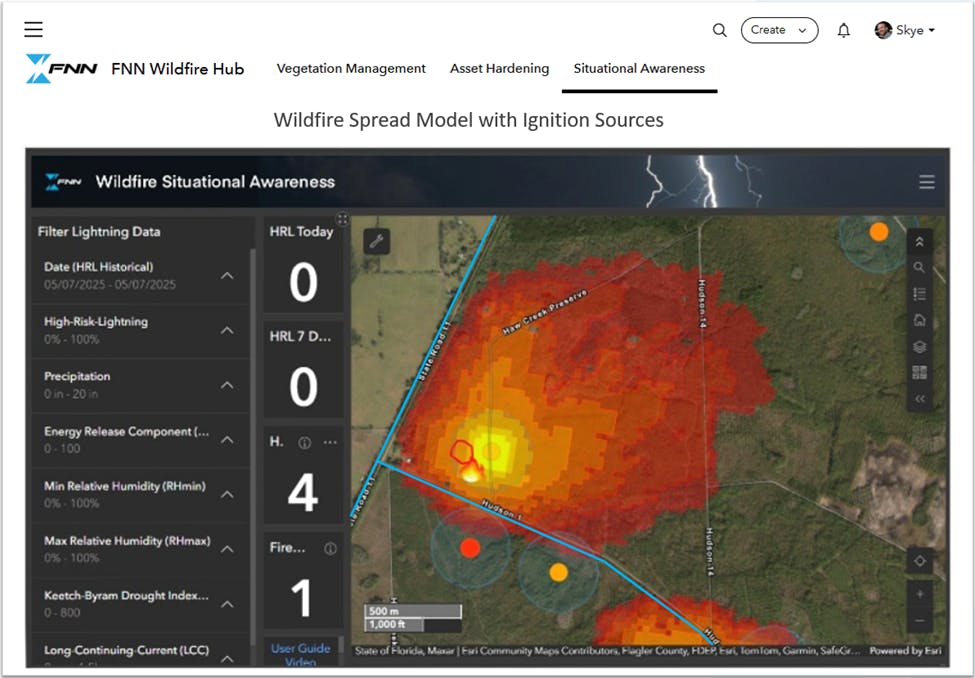
FNN Live Fire Dashboard Showing High Risk Lightning Strikes and Predictive Fire Spread
Pat Hohl: Can you explain how this type of implementation actually helps reduce liability?
Skye Perry: Implementing the FNN Wildfire Hub defines a utility’s standard of care regarding wildfire mitigation. Because the Hub stores the WMP in a well-known location, it provides companywide visibility to the plan. Then, by putting the plan into action via technology, the utility demonstrates its engagement with the plan and its intent to do everything it can to mitigate wildfires.
Nothing can guarantee that a wildfire will not occur. But the FNN Wildfire Hub clearly shows the utility’s intent in a tangible, proactive format. This solution will be accepted in court to limit a utility’s wildfire liability, with the added benefit of saving lives and property.
Pat Hohl: Thank you, Skye. This is fascinating and an outstanding use of ArcGIS Hub with big implications for our utility customers. Where can readers get more information?
Skye Perry: You can find out much more about the FNN Wildfire Hub and how it mitigates a utility’s risk at our website: https://fireneuralnetwork.com/utility
FNN provides advanced wildfire mitigation and lightning detection to utilities via the FNN Wildfire Hub and our proprietary High-Risk-Lightning Detectors. The FNN Wildfire Hub is the industry-leading centralized hub for tracking, managing, and mitigating wildfire risk and liability. FNN helps customers with their Wildfire Mitigation Plans (WMPs) to define their standard of care and provides an advanced AI enterprise platform that proves standard of care, including vegetation management, asset hardening, and real-time wildfire situational awareness.

