

Utility leaders today face a convergence of pressures that would have been difficult to imagine even a decade ago. Aging infrastructure must deliver higher reliability under rising demand. Climate-driven extremes are no longer rare events but recurring stress tests. Regulators expect defensible planning. Investors and bondholders increasingly scrutinize risk exposure. Customers, meanwhile, experience longer and more frequent outages and expect resilience, not excuses.
Despite historic infrastructure investment, including funding from the Infrastructure Investment and Jobs Act, many utilities still struggle with fragmented planning processes, siloed data, and disconnected decision-making across finance, engineering, and operations. The result is not a lack of effort, but a lack of alignment: capital that does not always flow to the highest-risk assets, wildfire mitigation plans that emphasize activity rather than outcomes, and digital tools that improve visibility without improving decisions.
Wildfire risk brings these challenges into sharp focus.
Wildfires are placing stress on communities and utility systems across regions as diverse as the Pacific Northwest, the Texas Panhandle, the Appalachians, and the Southeast. While ignition sources vary, the consequences are remarkably consistent: asset damage, prolonged outages, regulatory scrutiny, financial exposure, and erosion of public trust.
Historically, utilities have relied on Wildfire Mitigation Plans (WMPs) to demonstrate preparedness and compliance. Reviews of representative WMPs show substantial investment in measures such as undergrounding, covered conductors, enhanced inspections, vegetation management, and Public Safety Power Shutoffs (PSPS). These efforts are necessary, but they are often discussed through a single, narrow lens: reducing the probability of ignition.
Ignition reduction is critical—but it is not the full value story.
When wildfire mitigation is evaluated solely on ignition risk, some strategies appear expensive or difficult to justify under traditional benefit-cost analysis. What is frequently missing is a broader accounting of system-level benefits: improved reliability during non-fire weather events, reduced outage duration, enhanced workforce safety, lower insurance costs for utilities and communities, improved creditworthiness, and greater flexibility in capital planning.
A more holistic approach reframes wildfire mitigation as an investment in resilience, not just compliance.
Integrating grid planning with the financial assessment of wildfire risk provides a framework to evaluate mitigation not as isolated projects, but as part of a coordinated investment strategy that aligns engineering, operations, and finance.
By creating a single source of truth for asset risk, environmental conditions, and operational constraints, utilities gain optionality—the ability to compare scenarios and prioritize actions that deliver the greatest value per dollar spent. This is not about increasing budgets. It is about reallocating effort toward the highest-risk locations and decisions.
Integrated planning relies on value frameworks, scenario analysis, and continuous re-optimization to answer practical leadership questions:
Which assets present the highest combined wildfire, reliability, and financial risk today?
How does that risk change after a burn scar, a Firewise community intervention, or a vegetation treatment?
Where does incremental capital or operational effort reduce the most downstream cost—outages, claims, regulatory exposure, or reputational damage?
When wildfire risk is quantified and updated regularly, planning becomes dynamic rather than static.
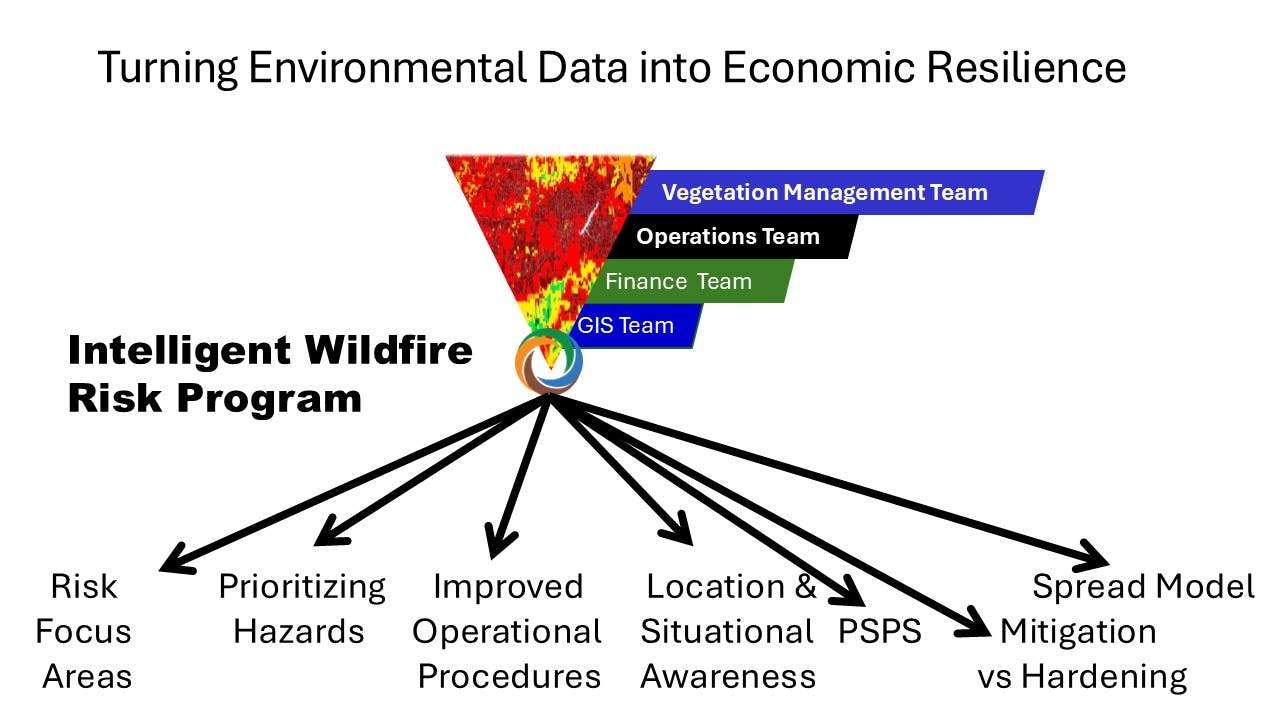
For finance leaders, wildfire risk increasingly affects far more than operating expense. Rating agencies, regulators, insurers, and bondholders are paying closer attention to how utilities identify, quantify, and manage climate-driven risk.
An integrated wildfire planning framework enables utilities to move beyond narrative justification toward measurable financial risk reduction. Continuous re-optimization of asset portfolios and operational plans—based on updated wildfire conditions—creates defensible investment decisions that can be shared with public utility commissions, financial analysts, and capital markets.
The result is not only stronger regulatory filings, but improved credibility with investors who are looking for evidence that wildfire exposure is understood, managed, and declining over time.
For engineering and operations teams, integrated wildfire planning shifts effort from reactive response to proactive risk management.
Rather than treating PSPS, inspections, and hardening measures as blanket programs, utilities increasingly define Risk Focus Areas—sometimes referred to as hazardous zones—where wildfire spread potential, asset vulnerability, and customer impact intersect. In these areas, operational procedures can be refined: earlier interventions, targeted de-energization protocols, and better coordination with emergency management agencies.
This approach improves safety and reliability without expanding scope indiscriminately.
Vegetation management is often one of the largest components of wildfire mitigation spend. Yet without dynamic prioritization, crews may be deployed based on historical cycles rather than current risk.
By incorporating updated burn scars, weather trends, and community-level mitigation actions, utilities can continuously reprioritize vegetation work—treating the highest-risk locations first without increasing budgets. Spread modeling and improved situational awareness further strengthen decision-making, helping utilities focus on where vegetation contributes most to catastrophic fire potential, not just clearance compliance.
Wildfire mitigation does not need to be more expensive to be more effective. It needs to be better integrated.
A holistic wildfire strategy—one that unifies financial planning, engineering decisions, and vegetation management—allows utilities to translate environmental volatility into actionable intelligence. The goal is not perfection, but progress: fewer surprises, clearer trade-offs, and investments that stand up to scrutiny from regulators, investors, and the communities utilities serve.
In an era where wildfire risk is no longer episodic but structural, integrated planning is not a luxury. It is the foundation of resilient, credible utility leadership.
Author Disclosure
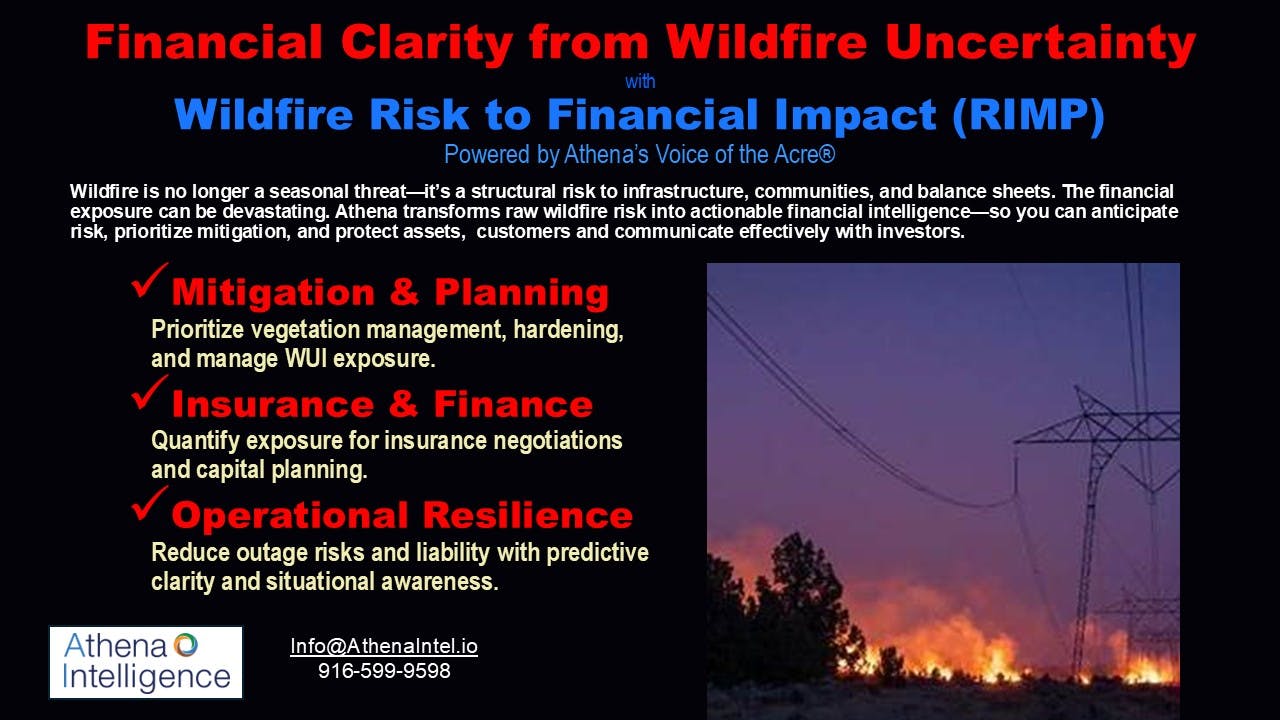
Athena Intelligence provides geospatial wildfire-risk analytics used by utilities, insurers, and public entities to support wildfire mitigation planning, PSPS programs, and risk-informed capital and operational decision-making.

