



In our previous article, Building a Decision Engine for Electric Transmission Asset Management, we covered the work plan management capabilities of an ArcGIS Utility Network transformation when the right stakeholders and data modeling attributes are in place from the onset. We answered the why for treating the Utility Network as a decision engine—rather than simply a data conversion project—by elevating condition, consequence, and cost data into the authoritative model.
This article, Implementing a Priority Index, discusses how utilities can create this decision engine through applying a priority index in the Utility Network to help rank and prioritize transmission projects. This system enables transmission utilities to effectively perform condition-based asset maintenance and plan capital investments using a structured framework backed by data. We’ve outlined the technical modeling and workflows required for electric transmission utilities to transform their siloed condition, consequence, and cost information into actionable data with a working priority index.
Three Numbers that Drive Risk-based Asset Management
Transmission utilities can use a condition-based ranking system to help drive their risk-based asset management programs (FERC/NERC) in the Utility Network. At its core, this system helps utilities prioritize transmission rebuilds, line hardening, and major maintenance projects based on risk and value rather than age or cost alone. In this context, “age” refers to the installed age of individual transmission assets—such as structures, conductors, insulators, and devices—rather than a broad infrastructure age. Using asset-level age ensures the model reflects actual deterioration patterns and supports component-specific decision-making. By turning condition, consequence, and cost into comparable scores, utilities can rank projects transparently, showing which investments deliver the highest reliability improvement or risk reduction per dollar spent.
The methodology comes down to three values.
Likelihood measures the probability of failure. Start with a condition score (good, fair, poor) and adjust for age and environment. A structure over forty years old might get an extra 0.2, while one in a wildfire zone might add 0.1. The scale runs from 0 to 1, capped at 0.95.
Consequence measures the impact of failure. It combines normalized megawatts at risk, the number of critical sites downstream, whether the line is on a key transfer path, and the degree of exposure. A weighted blend of these factors produces a score between 0 and 1.
Cost measures the investment required. Cost represents the total expected project or mitigation investment, typically expressed in millions of U.S. Dollars (MUSD). Incorporating cost ensures that decisions consider not just technical risk, but the financial efficiency of each mitigation option.
The Priority Index ties these three elements together. It divides the product of likelihood and consequence by project cost. The result is a transparent, defensible way to compare rebuilds, hardening projects, and upgrades. Higher values signal better impact per dollar.
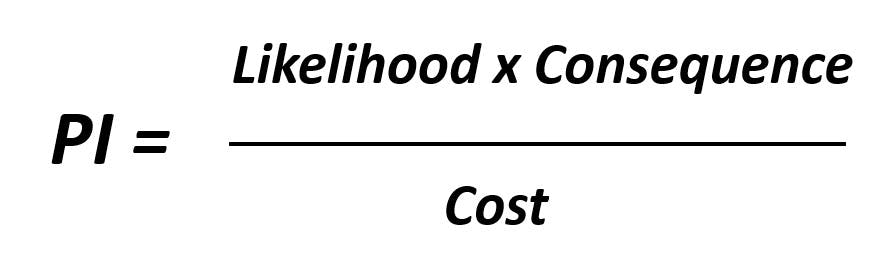
In practical terms, this means a line with high failure risk and high consequence but moderate cost will rise to the top of the list, while low-impact or high-cost projects move lower. This ranking gives asset managers a repeatable, data-driven framework for condition-based maintenance and capital planning, aligning spending with reliability and regulatory priorities.
Putting it into Practice: Example Use Case
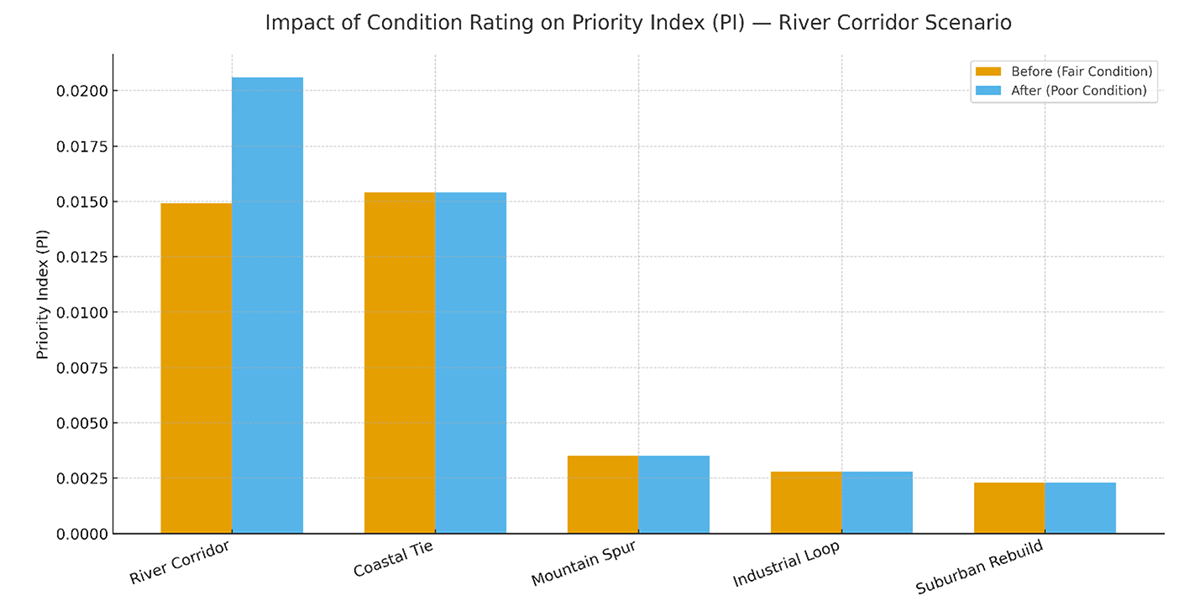
Consider a corridor that crosses a river and serves two hospitals and a data center. Structures show corrosion on inspection, and LiDAR found recent clearance issues. There is no practical alternative during peak season. An age-only method would bury this project in the middle of the list because it is not the oldest. A cost-only method would push it down because river work is expensive.
The condition-based scoring method shows significant downstream load, nontrivial critical counts, and high exposure. Likelihood rises because of age and condition, and consequence rises because of megawatts and criticality. Even with a higher price, the project moves near the top. The plan changes from “maybe next year” to “bundle adjacent spans and rebuild now,” and the reasoning is easy to see and defend under ISO 55001, the international certifiable requirements for asset management. This method clearly shows how rerating the River Corridor project from a fair to a poor condition boosts its priority index enough to push it above every other project, making it the clear top candidate even with a higher cost. Figures 2-4 show this data approach in action.


Making the Process Repeatable
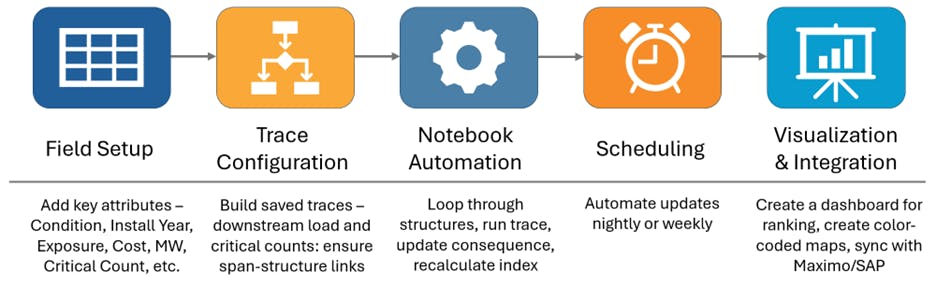
To operationalize this approach, first add the necessary fields to your structures or spans feature classes: condition, install year, exposure flags, cost estimates, downstream megawatts, critical counts, and the calculated scores. Attribute Rules in ArcGIS Arcade can handle simple calculations such as age, likelihood, and the priority index.
Next, create Saved Trace Configurations in the Utility Network (within your UN dataset in the geodatabase) that run against your transmission line and structure features to return downstream load and critical counts. Ensure structures are associated with spans; if not, use a spatial join as a fallback.
With these elements in place, build a notebook in ArcGIS Pro or ArcGIS Enterprise that loops through structures, runs the saved trace, records the downstream values, and updates consequence. Attribute rules then recalculate the priority index. Scheduling the notebook synch weekly or nightly keeps the scores current.
Finally, present the results in a way that matters to stakeholders. An ArcGIS Dashboard can display the top-ranked projects, map priorities by color and cost, and track risk reduction over time. If your organization uses Maximo or SAP, write the priority index back into those systems, so planners see the ranking where projects are scoped and approved.
Putting it to Work
One of the most common mistakes utilities can make when moving to Network Management is treating their Utility Network migration as data-conversion projects instead of decision-support projects. Collecting fields is only half the battle; you need to make the data actionable. By ranking projects with a consistent method, you give planners a defensible basis for investment decisions and give executives the evidence they need for regulators, auditors, and boards. It also satisfies the spirit of ISO 55000 by showing line of sight from policy to plan to action to results.
The Utility Network helps utilities move from “what’s where” to “who cares, and what should we do next?” When you design with the end in mind, you turn GIS into a decision engine that saves money, reduces risk, and makes your capital plan more credible.
Contact UDC for help with your asset management and read about our Utility Network services and solutions.