

The natural gas futures complex currently navigates tightening global supply-demand balance, intersecting with a fractured meteorological outlook. Domestic price action remains tethered to a restrained U.S. production profile and storage inventories that have slipped below seasonal benchmarks, exacerbated by a persistent East-West thermal divergence. This atmospheric contrast is characterized by a frigid regime entrenched across the Eastern Seaboard and Midwest against milder conditions in the Pacific Northwest. Simultaneously, aggregate U.S. LNG export loadings have strengthened toward seasonal peaks, underscoring a high-capacity utilization rate. Across the Atlantic, continental storage levels have receded into the mid-50% range, with certain member states reporting critical drawdowns below the 20% threshold. This aggressive pace of net withdrawals, driven by a pronounced winter gradient locking Northern and Eastern Europe in a deep cool zone, has pushed inventories into the lower decile of the historical envelope. Such a trajectory not only tests the resilience of the EU's minimum storage mandates but effectively removes the supply "cushion" observed in previous cycles, leaving front-month contracts acutely sensitive to any further disruption in trans-Atlantic arbitrage or a late-season arctic incursion.
According to the EIA, as of February 6, 2026, U.S. working natural gas in underground storage stood at 2,214 Bcf, . This represents a net weekly withdrawal of 249 Bcf compared with 2,463 Bcf in the prior week. Inventories are 97 Bcf lower than last year at this time and stand 130 Bcf below the five-year average, highlighting a storage position below seasonal benchmarks.
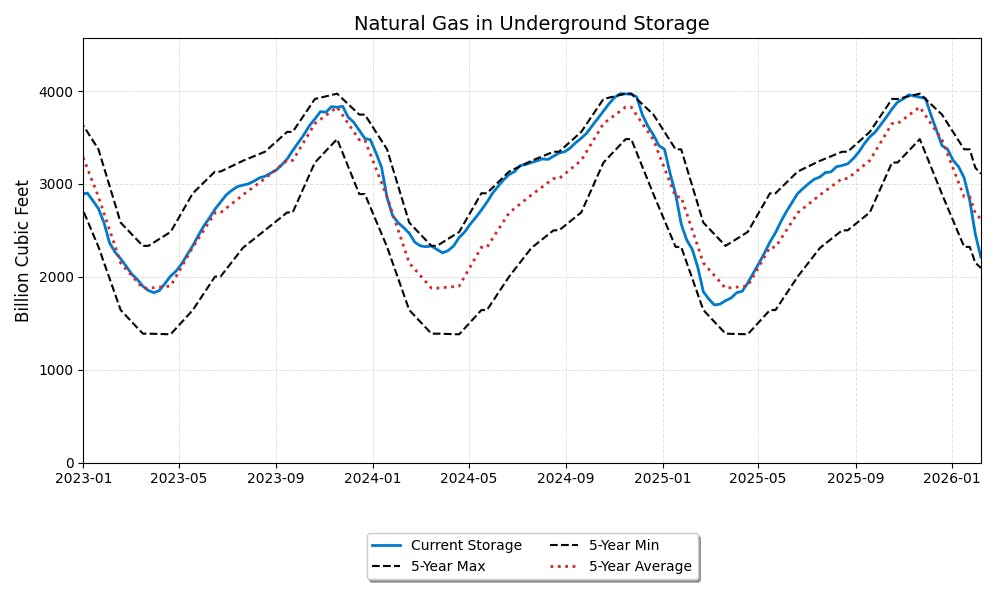
Picture 1 – Natural Gas in Underground Storage
Regionally, the Midwest (−74 Bcf) and East (−64 Bcf) registered the largest weekly declines. The Mountain region fell by 4 Bcf, while the Pacific posted a 1 Bcf increase. By contrast, the South Central region declined by 107 Bcf to 784 Bcf, reflecting a 52 Bcf draw in salt facilities alongside a 55 Bcf withdrawal from nonsalt stocks. Overall, these moves net to the 249 Bcf withdrawal across the Lower 48.
Over the past week, the United States continued to display a clear east–west temperature contrast, with colder air entrenched across much of the central and eastern portions of the country. The Midwest, Great Lakes, and Northeast registered widespread sub-freezing conditions, as many locations saw readings in the teens and 20s °F with colder pockets farther north. For early February, this places a large share of the eastern half of the nation at or below seasonal norms, reinforcing the persistence of wintertime conditions across major demand centers.
In contrast, the western United States remained noticeably milder. California, the Southwest, and parts of the southern Rockies observed temperatures largely in the 40s to 60s °F, while the Pacific Northwest and sections of the Intermountain West tracked closer to seasonal averages or modestly above them. This relative warmth stands apart from the colder regime farther east and reduces the breadth of nationwide cold exposure. Overall, the distribution of temperatures continues to concentrate heating demand across the eastern half of the country while leaving western requirements comparatively lighter.
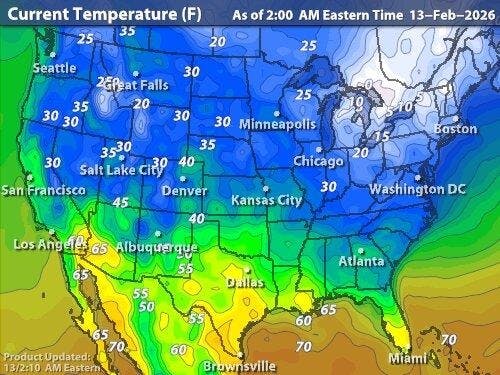
Picture 2 - United States Current Temperatures (F)
Source: https://www.wunderground.com/maps/temperature/us-current
During the period of February 20–26, 2026, the U.S. is forecast to transition toward a markedly warmer pattern across much of the Central and Eastern parts of the country. The Plains, Midwest, Ohio Valley, and Southeast show the strongest probability of above-normal temperatures, with the core of the anomaly extending from Texas and the lower Mississippi Valley northward into the Great Lakes. Portions of the Mid-Atlantic also lean warmer than average, signaling a broad erosion of the entrenched Arctic air that dominated earlier in the month.
In contrast, the Western states, particularly the Pacific Northwest and parts of the West Coast, are projected to trend below seasonal norms, while areas of the interior Southwest hover closer to average. Alaska also favors colder-than-normal conditions overall, whereas Hawaii leans warmer than average. The overall pattern indicates a redistribution of temperature anomalies rather than nationwide extremes, with warmth expanding eastward as cooler risks shift toward the West. This setup points to easing heating demand across the eastern half of the country, partly offset by firmer requirements in western markets.
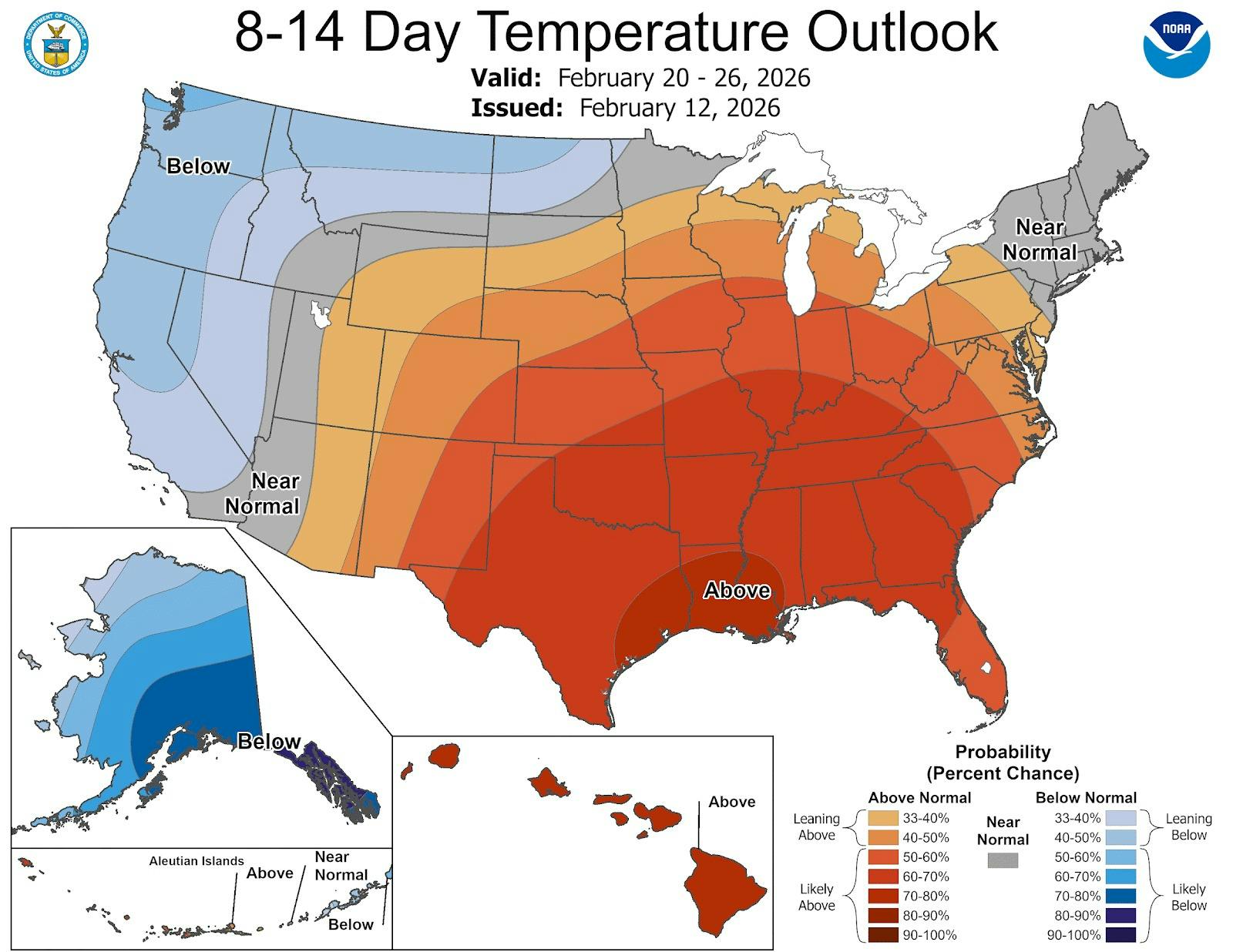
Picture 3 - Temperature outlook (F)
Source: https://www.cpc.ncep.noaa.gov/
During the most recent week, population-weighted combined cooling and heating degree days (CDD+HDD) across the United States moved sharply lower, reversing the elevated readings seen earlier in the winter. The national index declined from the upper-teens and low-20s toward roughly 12 by the latest observation. That kind of trajectory reflected a rapid contraction in aggregate weather-driven demand as milder air expanded across several key consumption regions.
At the state level, New York continued to record the highest totals, beginning the period in the 40s before easing into the low-30s. Texas and Louisiana showed a pronounced retreat, sliding from low-teens readings into the single digits and, at times, the low single digits. Florida remained minimal throughout, while California held mostly in the low-to-mid-teens, consistent with relatively temperate coastal conditions. The spread illustrated how demand intensity has narrowed geographically even as the Northeast retains a clear heating signal.
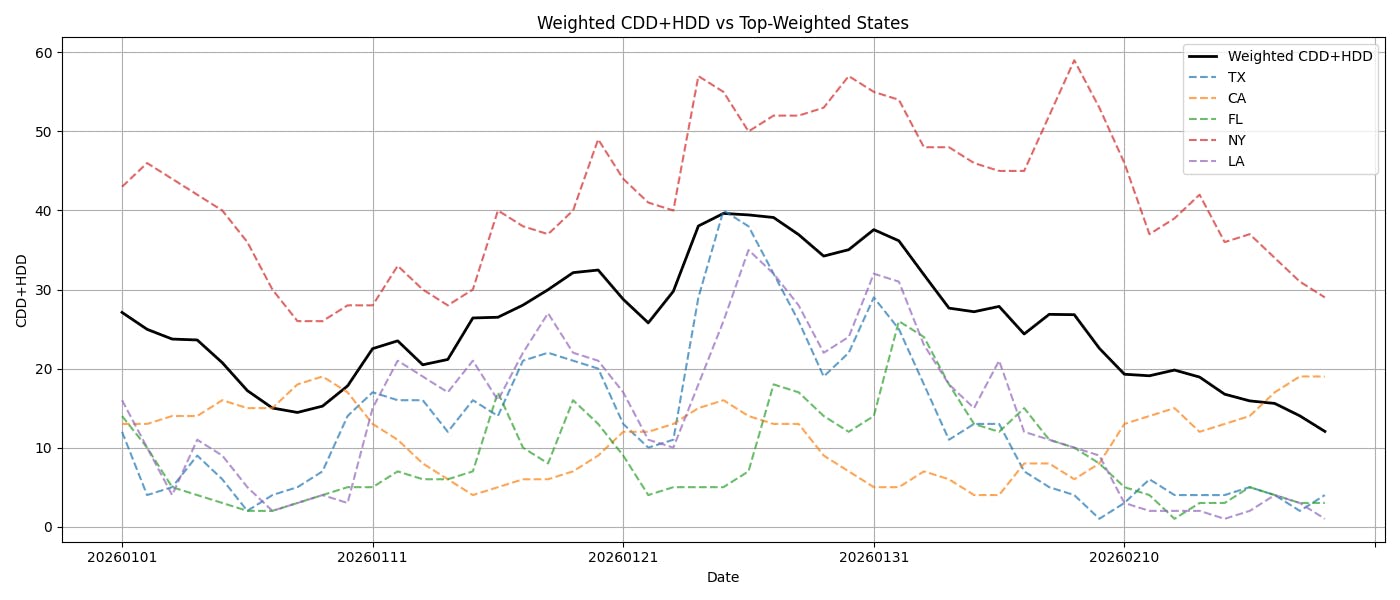
Picture 4 – Weighted CDD+HDD vs Top-Weighted States
Relative to climatological norms, actual population-weighted CDD+HDD fell decisively below the seasonal baseline. By the end of the window, daily values stood well under the lower bound of the ±2σ range rather than merely approaching it. That indicated an anomalously light level of temperature-driven demand compared with what is typical for mid-February.
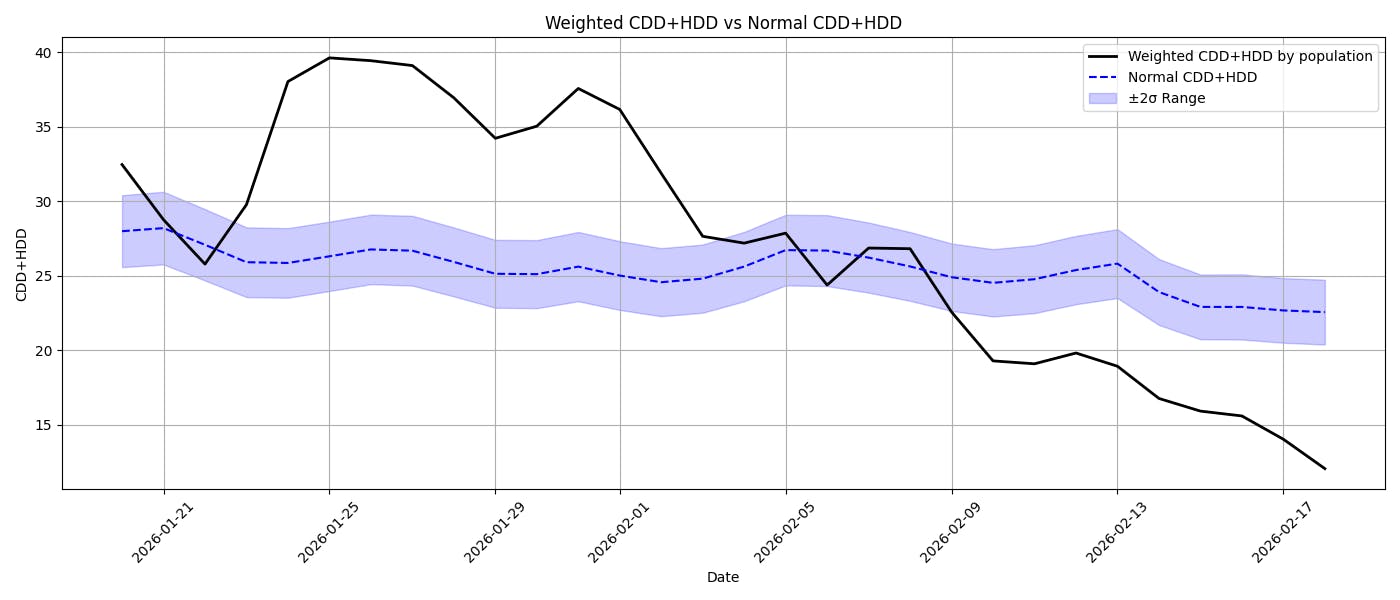
Picture 5 – Weighted CDD+HDD vs Normal CDD+HDD
Altogether, the latest decline in degree days pointed to a clear near-term weakening in natural gas consumption intensity. While heating load persisted in northern markets, it proved to be insufficient to offset softness elsewhere. The national demand profile, therefore, shifted away from extreme winter pressure toward a more moderate footing.
Across Europe, average temperatures during February 1–7, 2026, continued to reflect a pronounced winter gradient across the Old Continent. Northern and Eastern Europe, including Scandinavia, the Baltic region, Belarus, and much of Ukraine, experienced broadly cool conditions, with the lowest averages concentrated across Finland and northwestern Russia. Central Europe, including Germany and Poland, occupied a transitional zone, registering cooler readings than the west and south but less severe than those observed farther northeast.
In contrast, Western and Southern Europe remained comparatively mild. The Iberian Peninsula, France, Italy, and large portions of the Balkans reported moderate to locally warm averages for early February, with the Mediterranean rim retaining the most temperate conditions. Coastal areas of Spain, southern Italy, and Greece stood out for maintaining the highest readings within the region.
That kind of distribution pattern reinforced a persistent north–south divide in European temperatures, sustaining stronger space-heating demand across northern and eastern markets while allowing more moderate requirements across western and Mediterranean countries.
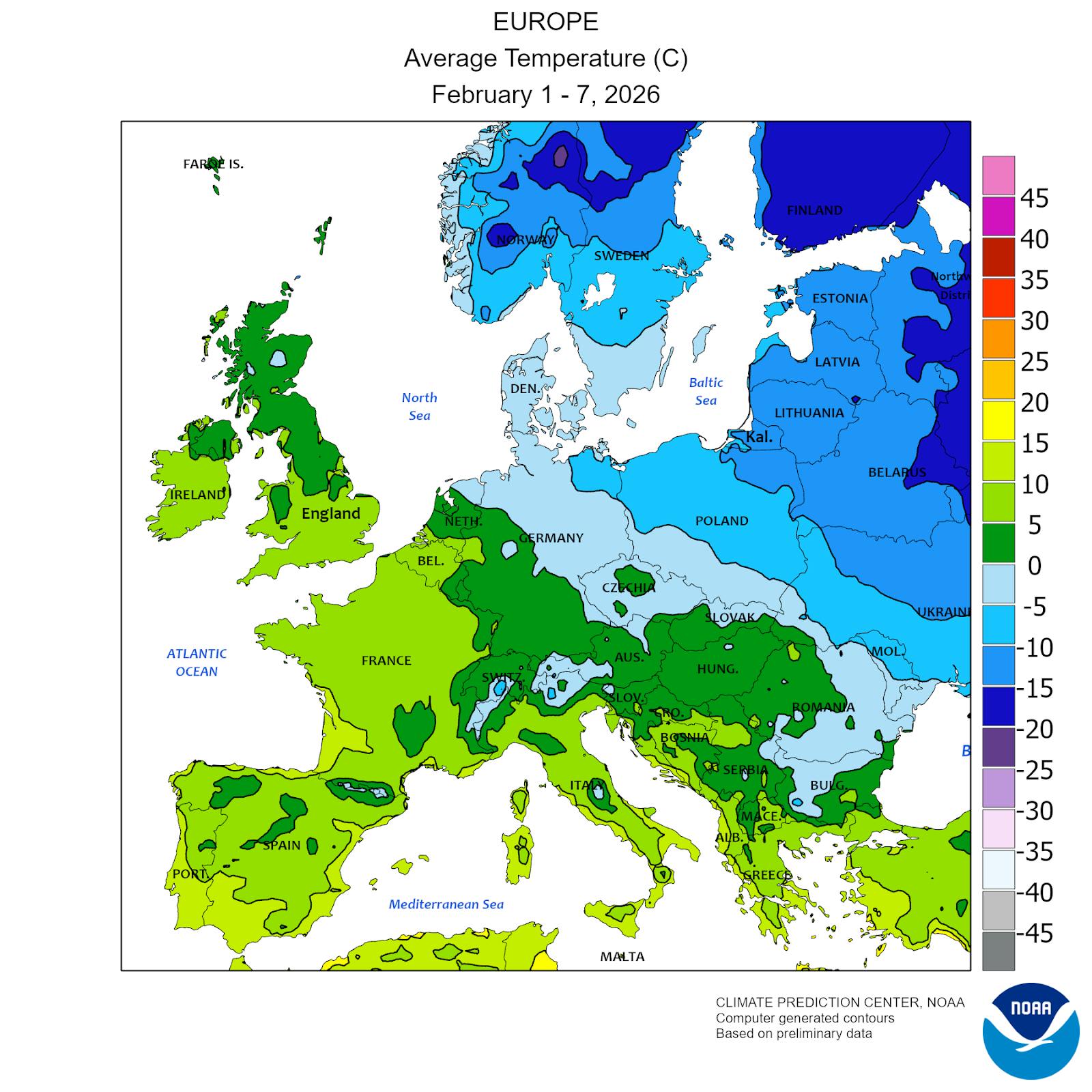
Picture 6 - Europe Average Temperature (C)
Source:https://www.cpc.ncep.noaa.gov/products/JAWF_Monitoring/Europe/temperature.shtml
U.S. Production and LNG Exports: Export Activity Generally Strengthened
According to shipping data from Vortexa Analytics, for the week ending February 11, a total of 37 LNG vessels departed U.S. ports, carrying a combined LNG-carrying capacity of 140 Bcf. This represents an increase of 6 Bcf compared with the previous week, alongside a rise of two vessel departures. Export activity strengthened across several terminals, reflecting higher aggregate loadings during the period. Despite the week-over-week increase, LNG export volumes remain broadly consistent with the elevated levels observed throughout the winter, underscoring sustained international demand for U.S. supply amid ongoing seasonal heating needs in key overseas markets.
According to Baker Hughes, the total U.S. rig count stood at 544 rigs as of late January, unchanged from the prior week. While drilling activity has stabilized in recent weeks, the overall rig count remains materially below levels recorded at the same time last year. This continues to point to a relatively restrained upstream environment, even as weather-driven demand and LNG export flows remain supportive of U.S. natural gas balances.
According to the latest data shown in Picture 7, as of early February 2026, European gas storage levels stood at roughly the mid-50% range. That figure places current inventories below the stronger positions observed in 2023 and 2024 at the same point in the winter, while tracking closer to the tighter years earlier in the decade. Relative to the broader historical envelope, stocks now sit in the lower half of the range, reflecting a faster pace of withdrawals through the core heating months. The seasonal trajectory shows a continued downward trend with no indication of stabilization, as demand remained elevated across colder parts of the Continent. That said, aggregate inventories continued to provide a functional buffer as Europe advances toward the latter stages of winter.
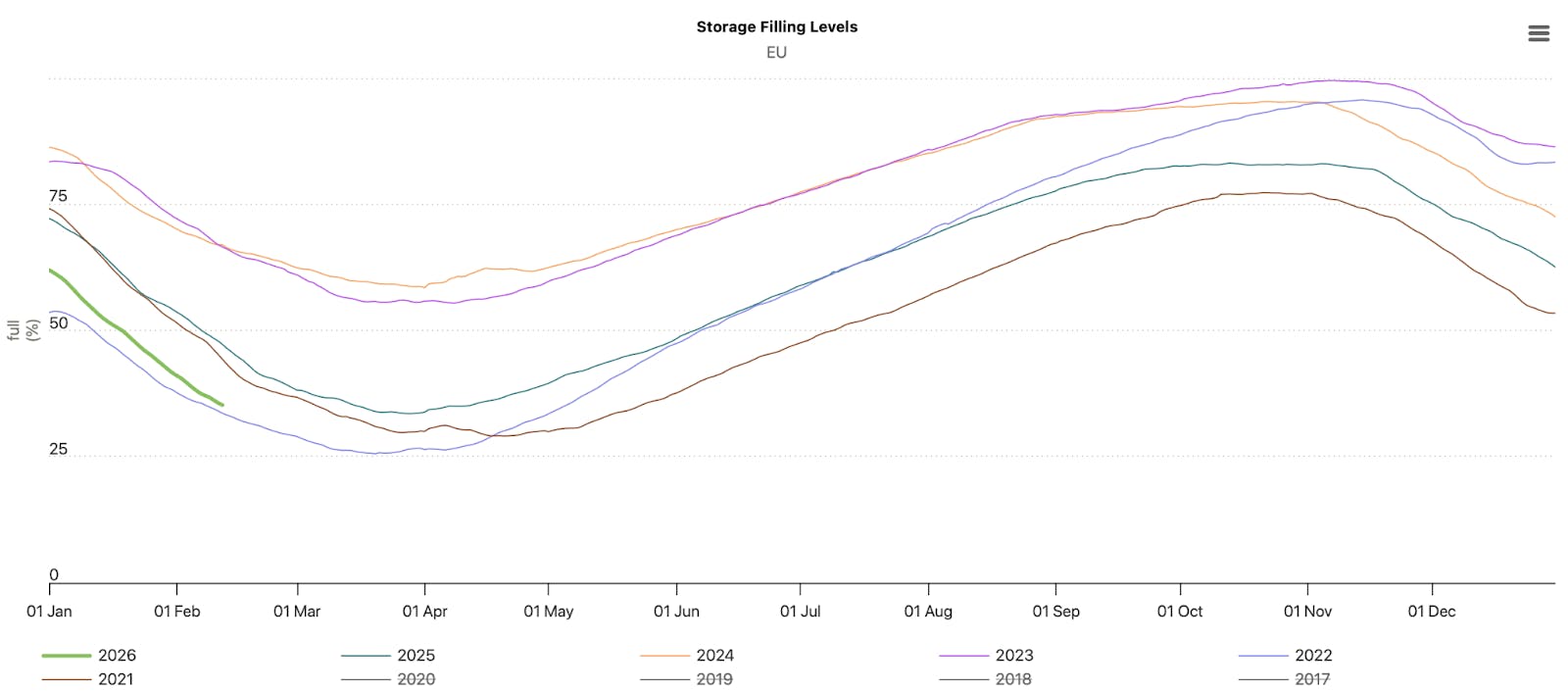
Picture 7 - Storage Filling Levels (EU)
Source: https://agsi.gie.eu/data-visualisation/filling-levels/EU
At the country level, the map in Picture 8 reveals clear regional dispersion. Western and Southern Europe are largely concentrated in the 50–60% band, with Spain and Italy around the middle of that range, while France and Belgium sit closer to the 40–50% area. Central Europe is more mixed: Germany and Austria also fall within the 40–50% band, whereas Poland stands somewhat firmer in the 50–60% range. Meanwhile, Northern and Eastern Europe appeared comparatively tighter, with several markets near the mid-40s or below, with Ukraine remaining the most pronounced low-inventory outlier. That kind of uneven distribution indicated that, despite workable volumes at the EU aggregate level, resilience for the remainder of winter will likely rely heavily upon cross-border flows and regional balancing.
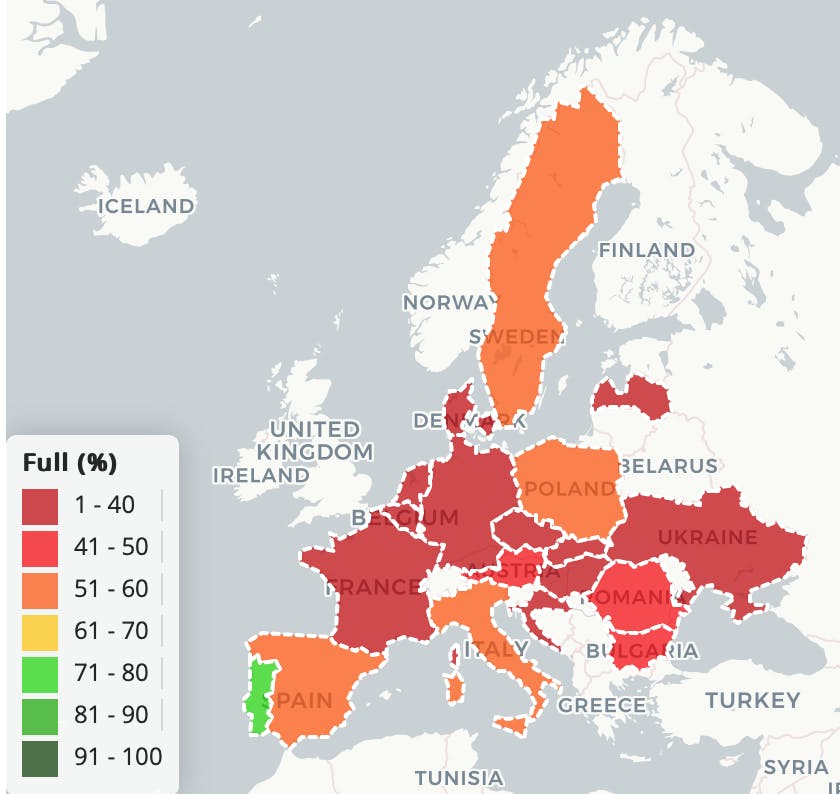
Picture 8 - Filling levels country map (EU)
Source: https://agsi.gie.eu/data-visualisation/filling-levels-country/map
Conclusion
Over the past week, Henry Hub futures declined toward $3.15/MMBtu, falling roughly 2% in the latest session as the market continued to unwind part of the weather premium built during the late-January cold period. The adjustment came even as storage withdrawals remained substantial, with traders increasingly focused on moderating national degree-day totals and the shrinking geographic footprint of extreme cold. LNG exports, while still running at robust seasonal levels, provided more of a stabilizing influence than a fresh bullish catalyst. In Europe, Dutch TTF front-month futures also softened, trading near €32/MWh (≈$11/MMBtu) and posting a similar week-over-week decline. The parallel move across both benchmarks underscores a shift away from acute winter risk toward a more balanced near-term supply picture.
Looking ahead, Henry Hub prices are expected to consolidate within a $2.9–$3.5/MMBtu range, with easing heating demand weighing on rallies while firm LNG utilization and inventories closer to historical norms help limit downside. Dutch TTF is projected to fluctuate between €30 and €35/MWh (≈$10–$12/MMBtu), as aggregate European storage remains workable but unevenly distributed across regions. Weather developments will remain the primary driver of short-term volatility, particularly any changes to the expected moderation in the eastern United States. Overall, near-term pricing reflects a balance between softer demand signals and continued structural support from export flows and winter stock uncertainty.

