


By Kennedy Maize
The Trump administration’s push to support coal, despite the costs, is “running into reality,” according to a new analysis by the Institute for Energy Economics and Financial Analysis. IEEFA analysts Dennis Wamsted and Seth Feaster conclude,”The administration’s political support for ‘clean, beautiful coal’ keeps running into economic reality. Coal-fired generation costs continue to rise, making the resource economically uncompetitive.”
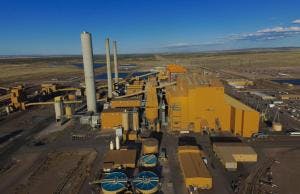
The U.S. based firm that has a global reach examines Arizona’s 1,649-MW, four-unit Springerville coal-fired plant, which the owners are planning to shut down in the near future. The report notes, “The latest example of this economic reality is occurring at the 1,649-megawatt (MW), four-unit Springerville coal-fired plant in Arizona. The plant has three owners, but they have all reached the same conclusion: It is time to stop burning coal.”
According to the IEEFA analysis, the cost of running the plant has soared since 2020. In 2020, the cost of operating the plant and supplying coal was $34.40/megawatt-hour, according to data provided to the Federal Energy Regulatory Commission. In 2024, that figure had essentially doubled to $66.70.”
The report notes, “Two of the owners, Tucson Electric Power (TEP), which owns Units 1 and 2 (381 MW and 406 MW), and the Salt River Project (SRP), which owns Unit 4 (415 MW), have decided to convert their three units to gas. Tri-State Generation and Transmission Association, which owns Unit 3 (417 MW), has decided to retire its facility.”
Coal cost problems at Springerville, despite the fuel’s “beauty” in the eyes of the White House, “are staggering.” IEEFA reports, “A key reason for the spike in generation cost is soaring fuel costs for the utility. In fact, TEP paid more for coal in 2024 than it did in 2020, even as generation at the two units declined by 43.7 percent.”
Is the rise of demand for power to supply artificial intelligence data centers changing the economics of coal? Not so, says IEEFA: “The recent rise in demand growth projections, driven in large part by forecasts for rising electricity generation to power artificial intelligence (AI)-related data centers prompted TEP to reevaluate its plans for Springerville, but not its plan to stop using coal. In July 2025, the utility said it will convert the two units to run on gas by 2030. The conversion will be cheaper than building new gas-fired resources, TEP said, and will provide more cost certainty than continuing to operate the units on coal.”
Public power system Salt River Project echoed the analysis of investor-owned TEP. Last November, SRP announced plans to convert its unit to gas by 2029, saying they had concluded converting the unit to gas was cheaper than a new gas plant or continuing to burn coal.
IEEFA says the analysis by SRP’s board missed an attractive alternative. The Phoenix-based utility failed “to look at solar-plus-battery storage combinations that could have been cheaper. The board also did not release any numbers regarding the cost of keeping Unit 4 open and running on coal even though the unit only entered commercial service in 2009, making it one of the newest operating coal generators in the U.S.”
Colorado-based rural electric generation and transmission cooperative Tri-State, Wamsted and Feaster note, “is facing a more complicated set of challenges,” as it is losing members from among the 40-some distribution cooperatives it supplies in Colorado, Nebraska, New Mexico, and Wyoming.
The departures of the members are “significantly lowering the amount of power it needs to provide. In 2024, its Springerville unit was the company’s most expensive large generation resource. The unit was so costly that it would only have been economic to use it if Tri-State’s total power demand had reached more than 3,900 MW; its peak 2024 demand was just 2,533 MW.”
Tri-State has also experienced the hammer of the Trump administration’s lust for coal at any cost. As The Quad Report has reported, on December 30, the Department of Energy ordered Tri-State to keep an elderly 446-MW coal-fired unit in Craig, Colo., on the Yampa River in the central part of the state, running. The G&T co-op announced in 2016 that it would close the plant on December 31, 2025.
DOE has been implementing a Trump policy to prevent any coal-fired plants in the nation from shutting down, using an emergency provision in the Federal Power Act as a pretext to keep coal generation running. That policy is under legal challenge.
IEEFA’s research on Tri-State has found that “six units at four plants, totaling 2,019 MW of capacity, had stopped burning coal and were in the process of being converted to gas by the end of 2025. Five of these units are in the West— Colorado, Nevada, and Wyoming—reflecting the higher cost of coal power even in areas close to the nation’s largest coal mines. At least five more units around the country are scheduled for conversion in 2026, and other longer-term conversions, like the ones at Springerville, are planned.”
How the White House and DOE will respond to these plans will develop over the next 10 months. A key milestone may be how DOE deals with Consumer Energy’s J.H. Campbell plant in Michigan, which the agency first ordered to continue running for 90 days back in May, renewing the orders now three times. DOE last week (Feb. 17) renewed the order, which will expire in May, meaning the plant will have continued generating for a full year beyond when the owners planned to take it out of service.
Consumers Energy says the extended operation is costing some $30 million per month. Those costs are being borne by consumers in the region, according to an order from the Federal Energy Regulatory Commission.
