

This week’s energy market weather map shows brighter days ahead for wind and solar power generation, but pockets of high-pressure disturbance for liquefied natural gas and LNG shipping opportunities.
During ING’s early February energy transition update, Coco Zhang, ESG research analyst with the Dutch multinational financial services company, said that despite global geopolitical and energy sector turbulence, “one thing is crystal clear: solar and wind are set for steady, sustained growth this decade.”
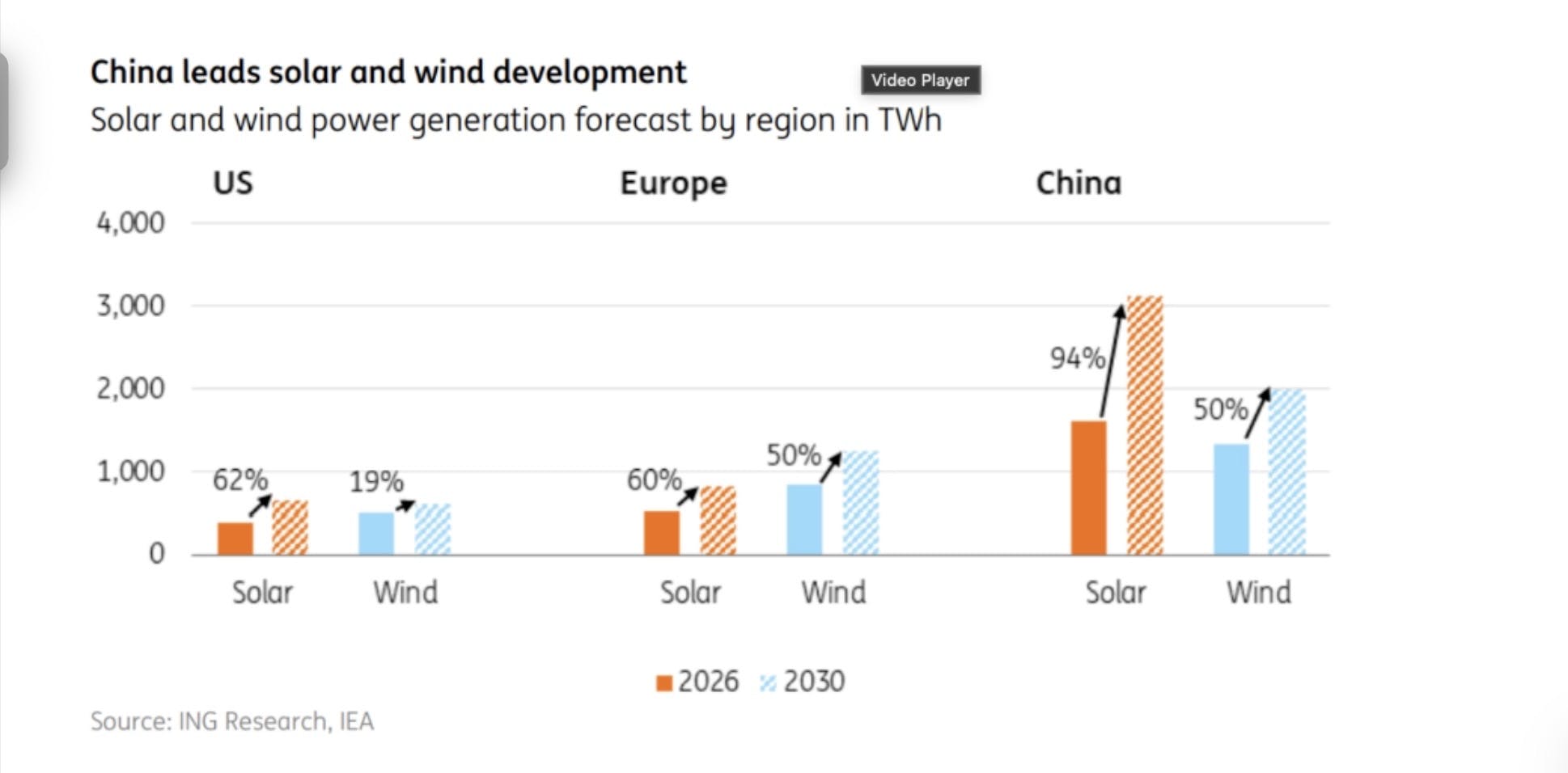
She said ING expects global solar and wind generation to grow by 20% in 2026 and to increase at an average annual pace of 15% through 2030.
Encouraging for green brigades, yes, but wind and solar still generated only 17.6% of the world’s energy in 2025’s first three quarters.
However, the resilient renewable duo is now the world’s fastest growing energy source.
Both are also fundamental drivers of green power plays in the geopolitical major leagues.
For example, the Trump administration’s push to stifle North America’s green energy growth has helped consolidate China’s standing atop the renewable energy pyramid.
As Zhang pointed out, China now controls over 80% of global energy infrastructure manufacturing capacity. It also supplies approximately 98% of the European Union's solar panel imports. As the attached ING chart illustrates, China continues to extend its lead over the West in solar and wind infrastructure manufacturing and power generation.
However, two factors are set to rewrite today’s energy equation: artificial intelligence and environmental impact.
Zhang pointed out that AI’s ability to improve industrial competitiveness coupled with its voracious energy appetite will drive renewable energy initiatives in the West, regardless of political roadblocks.
Meanwhile, environmental considerations are now bottom-line marketplace differentiators, not just corporate compliance requirements for companies operating in such arenas as energy infrastructure manufacturing, mining and metals processing.
“And I think more and more companies are aware of that,” said Zhang.
LNG shippers will also be aware of heightened global gas market volatility.
Aman Sud, Drewry’s senior manager of gas shipping, summarized the past year’s market as “muddled with many downside risks.”
Among the risks he listed during the U.K. shipping consultancy’s January LNG shipping update:
•too many LNG tankers;
•not enough demand, especially in Asia;
•mild weather in Europe and Asia; and
•chronic trade uncertainty and tariff volatility.
The good news?
Higher European imports, increased global LNG supply and record high scrapping of LNG tankers.
And more scrapping will be needed because the LNG tanker fleet is expected to expand by 8.5% in 2026.
According to the Drewry LNG update, that translates to more than 100 tankers being added to the global fleet this year.
Ocean carrier companies are also adding LNG-fuelled vessels to their fleets.
Drewry estimates that more than 1,000 will be on the water by 2027. That is encouraging considering the energy transition challenges maritime shipping faces.
So, on balance, Drewry sees business buoyancy in shipping’s LNG sector.
“We maintain a cautious outlook for the LNG trade,” said Pratiksha Negi, Drewry’s lead analyst for LNG shipping.
That outlook, she added, could be further buoyed by a surge in demand from China, “which we expect towards the end of the second quarter of 2026.”
LNG rates are also predicted to improve in 2026, driven by demand acceleration and supply expansion from Qatar, Canada and the U.S.
However, Negi cautioned that “a significant rebound is still unlikely, as fuel expansion will continue to outpace the liquefaction builder.”
So, betting lines on power play success this year will extend far beyond hockey rinks at the 2026 Winter Olympics.
www.linkedin.com/in/timothyrenshaw
@timothyrenshaw

