


Part I: From Blueprint to Reality – How ScottMadden Helped Develop a Fleetwide Model for Nuclear Generation
By Luke Martin (Partner), Brian Szews (Director), Morgan Schadegg (Director), Alex Tylecote (Manager)
ScottMadden, Inc.
From "Why Modernize?" to "How Do We Transform?"
The U.S. commercial nuclear industry has reached an inflection point. After decades of stagnation, cost pressures, aging technology, and talent attrition, the sector now faces substantial growth opportunities driven by rising power prices, increasing electricity demand, and bipartisan policy support for nuclear generation.
Yet progress remains fragmented across utility fleets. Despite pilot investments in sensors, AI, and advanced maintenance tools, few nuclear utilities have achieved progress at the enterprise level. Individual plants may have seen piecemeal improvements, but utilities struggle to scale these benefits across their fleets. This pattern reveals a fundamental truth: successful transformation requires more than deploying new technologies. It demands rethinking how nuclear utilities operate as a single integrated fleet rather than a collection of independent plants.
Why Transformation Stalls
Until recently, three interrelated challenges have constrained the nuclear industry. First, plants operate aging analog systems that have grown increasingly expensive to maintain while being unable to leverage modern digital capabilities. Second, high operating costs have historically disadvantaged nuclear plants against other generation sources (although market conditions have recently improved). Third, experienced workers have been retiring faster than the sector has been able to replace them, while competition for skilled trades has intensified across all energy sectors.
Yet the real barriers are much deeper. Nuclear operators favor proven approaches over first-of-a-kind implementations, a conservatism that supports safety and reliability but can sometimes slow innovation. Past experiences with unsuccessful technology deployments reinforce this caution. Additionally, modernization initiatives compete for limited capital against immediate operational needs, with individual plants bearing implementation risks and regulatory uncertainties. This combination of cultural resistance, resource constraints, and structural barriers creates organizational inertia that favors incremental improvements over the comprehensive transformation needed to address fundamental operational challenges.
Integrated Operations in Norwegian Oil and Gas
Even before the recent surge in demand for electricity generation, the U.S. Department of Energy's Light Water Reactor Sustainability Program (LWRS) at the Idaho National Laboratory (INL) recognized the industry's need for comprehensive transformation of the commercial nuclear industry. LWRS partnered with the energy consulting firm, ScottMadden, Inc., to develop the Integrated Operations for Nuclear (ION) framework. ION adapts proven transformation strategies from the Norwegian oil and gas sector, where operators faced remarkably similar challenges in the early 2000s: unsustainable operational costs, aging infrastructure, workforce retirements, and increasingly complex maintenance requirements.
Norwegian operators developed Integrated Operations (IO) as a radical reimagining of offshore platform management. Rather than treating each platform as an isolated asset with dedicated support functions, IO consolidated these capabilities into centralized onshore centers serving multiple platforms simultaneously. This transition required standardizing processes across the fleet, integrating real-time data systems, and fundamentally shifting from platform-centric to fleet-wide thinking. Despite significant challenges, including platform heterogeneity and organizational resistance, the approach delivered impressive results: 20-30% reduction in operations and maintenance costs, significant decreases in offshore staffing requirements, and measurable learning effects that improved with each implementation.
ION: A Pathway for Nuclear Transformation
The ION framework directly addresses the nuclear industry's transformation barriers. By adapting Norwegian oil and gas success to nuclear realities, ION provides a pathway that has been missing. Critically, ION shifts the transformation from a plant-by-plant challenge to a fleet-wide opportunity. ION enables coordinated approaches where early adopters validate solutions for subsequent sites. Centralized support functions replace duplicated efforts across plants. Standardized processes reduce complexity while respecting site-specific needs. This evolution from plant-centric to fleet-centric operations represents the same fundamental shift that enabled Norwegian operators to transform their cost structure and operational resilience.
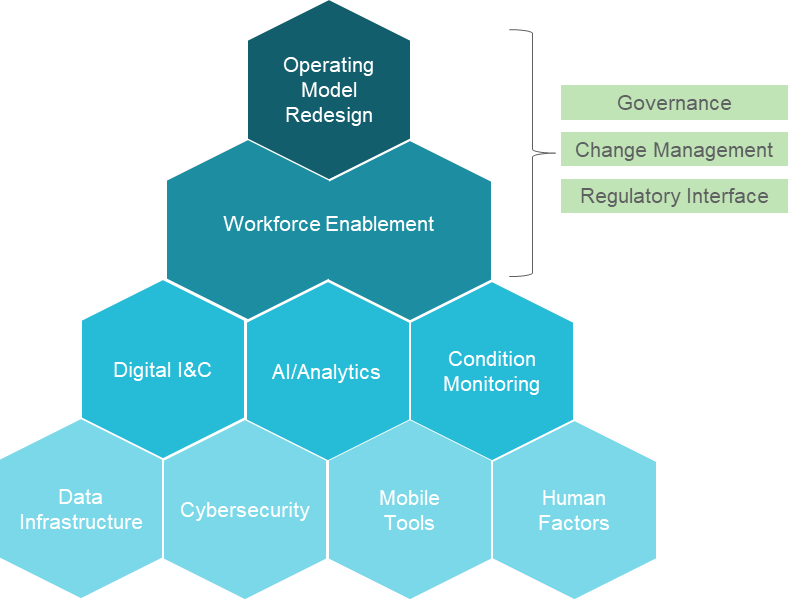
The figure above illustrates how ION translates these principles into an integrated operating model for nuclear. The framework aligns four critical domains: core technologies (digital I&C, mobile tools, advanced monitoring), data infrastructure and analytics, workforce capabilities, and governance structures. These elements work together to enable the shift from isolated plant operations to fleet-wide optimization. Technologies provide the foundation, but sustainable transformation only occurs when workforce capabilities and governance evolve in parallel. This integrated approach gives nuclear operators both the vision and practical roadmap to move beyond incremental improvements toward comprehensive modernization.
ScottMadden's Role: Making ION Work for Industry
While ION provided the proven framework nuclear operators needed, implementation required bridging the gap between Norwegian success stories and nuclear regulatory realities, ScottMadden's partnership with INL has been essential in making this translation practical and actionable for U.S. nuclear utilities.
Working directly with INL and utility partners, ScottMadden addressed the industry's risk aversion by developing concrete, field-tested implementations. We demonstrated measurable ROI from digital tools like AI-supported diagnostics and mobile-enabled maintenance, providing the proof points that conservative operators require. Our team navigated regulatory complexities by aligning ION pathways with NRC licensing requirements, cybersecurity mandates, and rate case filings, removing uncertainty from the transformation process.
Most importantly, our team helped utilities overcome the plant-by-plant implementation trap. We developed fleet-wide business case methodologies that capture shared benefits and distributed risks. Our implementation roadmaps show how to sequence deployments across sites, building momentum through early wins while managing resource constraints. By grounding every recommendation in operational realities and regulatory requirements, we give utilities confidence to move beyond incremental changes toward the comprehensive transformation that ION enables.
Stay tuned for part II, where we provide a detailed overview of how we translate ION principles into practical implementation.