

By Dr. Mani Vadari, President, Modern Grid Solutions
The Federal Energy Regulatory Commission’s (FERC) Advance Notice of Proposed Rulemaking (ANOPR) to standardize interconnection procedures for large electrical loads—particularly data centers and advanced manufacturing—is a long-overdue response to the seismic shift in energy demand. With AI, cloud computing, and industrial electrification surging, the grid must evolve to accommodate these loads swiftly, reliably, and fairly.
FERC issued this ANOPR following a Department of Energy directive to ensure that large-load projects, such as data centers, can connect in a timely, orderly, and nondiscriminatory manner. The rule is meant to address rising demand and fill a regulatory gap, since FERC has historically not overseen load interconnection.[i]
Data centers house the computing power behind everything from processing to storage. Increasingly, they have become the epicenter of artificial intelligence and machine learning. These AI Factories are purpose-built for machine learning and inference workloads. The recent surge in electricity demand is driven by these AI data centers, which are distinct in their energy profile[ii]: during training (learning mode), they consume immense computing power, requiring hundreds to thousands of megawatt-hours. Once models are deployed (operating mode), consumption drops significantly. Yes, we’re only at the dawn of the AI revolution, still only scratching the surface of the ‘art of the possible[iii]. The exponential growth of AI data centers is just beginning, with demand poised to accelerate far beyond today’s scale.
Meeting this demand requires a significant amount of power and transmission capacity to deliver it from its source to its destination. FERC is working with utilities and uses the gavel of federal legislation to improve the situation – and this ANOPR is one of the arrows in its arsenal.
The current patchwork of regional interconnection rules creates uncertainty, delays, and inefficiencies. Developers face vastly different timelines and cost structures depending on their geographical location. While many of these companies have a global footprint and accept that regulations vary from country to country, they would benefit from a unified national approach within the U.S. A standardized framework could streamline processes, reduce bottlenecks, and unlock investment in critical infrastructure. It would also support a coherent national strategy to maintain U.S. leadership in this rapidly expanding sector.
Reliability must be paramount, especially given the variability in power consumption within a single data center (see figure below). This need for speed must not come at the expense of equity or reliability. State regulators and consumer advocates rightly warn that fast-tracking, high-variability, large loads could saddle existing ratepayers with upgrade costs or compromise grid stability. The ANOPR must include safeguards to ensure that cost allocation is transparent and equitable and that reliability studies are rigorous rather than rubber-stamped.
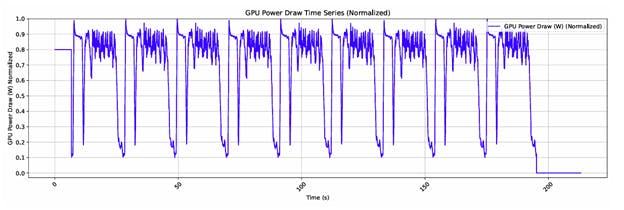
Figure 1ii: Power consumption profile from an at‑scale AI training job on DGX‑H100 racks, illustrating the extreme variability in load during machine learning training. This variability underscores the importance of rigorous reliability studies in FERC’s interconnection framework.
Large loads should not be treated as passive consumers. Many data centers are co-located with generation or storage assets. FERC should adopt hybrid interconnection models that enable these facilities to contribute flexibility and resilience to the grid, rather than just drawing from it.
Ultimately, this rulemaking presents an opportunity to reassess what constitutes a “priority.” Here are a couple of key questions we should be asking:
Should AI data centers receive expedited access over community solar or electrified transit hubs?
Should speculative crypto operations be treated the same as mission-critical public infrastructure?
FERC must define criteria that reflect societal and commercial value, not just load size[iv][v].
The ANOPR is a vital step toward modernizing interconnection policy. But it must be guided by principles of fairness, transparency, and strategic foresight. We need a grid that’s not only larger but also smarter, cleaner, affordable, and more inclusive.
[i] McGuireWoods LLP. “FERC Establishes Proceeding to Consider DOE Directive on Large Load Transmission Interconnection Rulemaking.” McGuireWoods Alerts, October 2025. https://www.mcguirewoods.com/client-resources/alerts/2025/10/ferc-establishes-proceeding-to-consider-doe-directive-on-large-load-transmission-interconnection-rulemaking/.
[ii] Numerous authors. “Power Stabilization for AI Training Datacenters.” arXiv preprint, August 2025. arXiv:2508.14318v2. https://arxiv.org/abs/2508.14318v2.
[iii] Beth Kindig. “AI Power Consumption: Rapidly Becoming Mission Critical.” Forbes, June 20, 2024. https://www.forbes.com/sites/bethkindig/2024/06/20/ai-power-consumption-rapidly-becoming-mission-critical/.
[iv] Modern Grid Solutions. “Planning for Power: What Data Center Developers Need to Know.” Watt’s On Mani’s Mind. https://moderngridsolutions.com/watt_s_on_mani_s_min/planning-for-power-what-data-center-developers-need-to-know/
[v] Modern Grid Solutions. “From Vision to Voltage: What Data Center Developers Need Utilities to Understand.” Watt’s On Mani’s Mind. https://moderngridsolutions.com/watt_s_on_mani_s_min/from-vision-to-voltage-what-data-center-developers-need-utilities-to-understand/

