


For years, the conversation around DC lighting has focused on one primary benefit: energy savings. While efficiency remains important, the industry's perspective is evolving. Today, DC lighting is increasingly being viewed as a foundational component of a broader DC building microgrid architecture.
Research from the Pacific Northwest National Laboratory (PNNL) has explored how DC lighting, photovoltaics, battery energy storage, and other DC loads can operate together on a common DC distribution system. By minimizing unnecessary AC-to-DC and DC-to-AC conversions, these architectures have the potential to reduce conversion losses, simplify power distribution, and improve overall system efficiency.
At the same time, the U.S. Department of Energy (DOE) is highlighting microgrids as a promising solution for supporting rapidly growing electrical demands—including AI-driven data centers and other high-density facilities. Among the technologies being evaluated are DC microgrids, which offer new opportunities to integrate renewable energy, battery storage, and native DC loads more effectively.
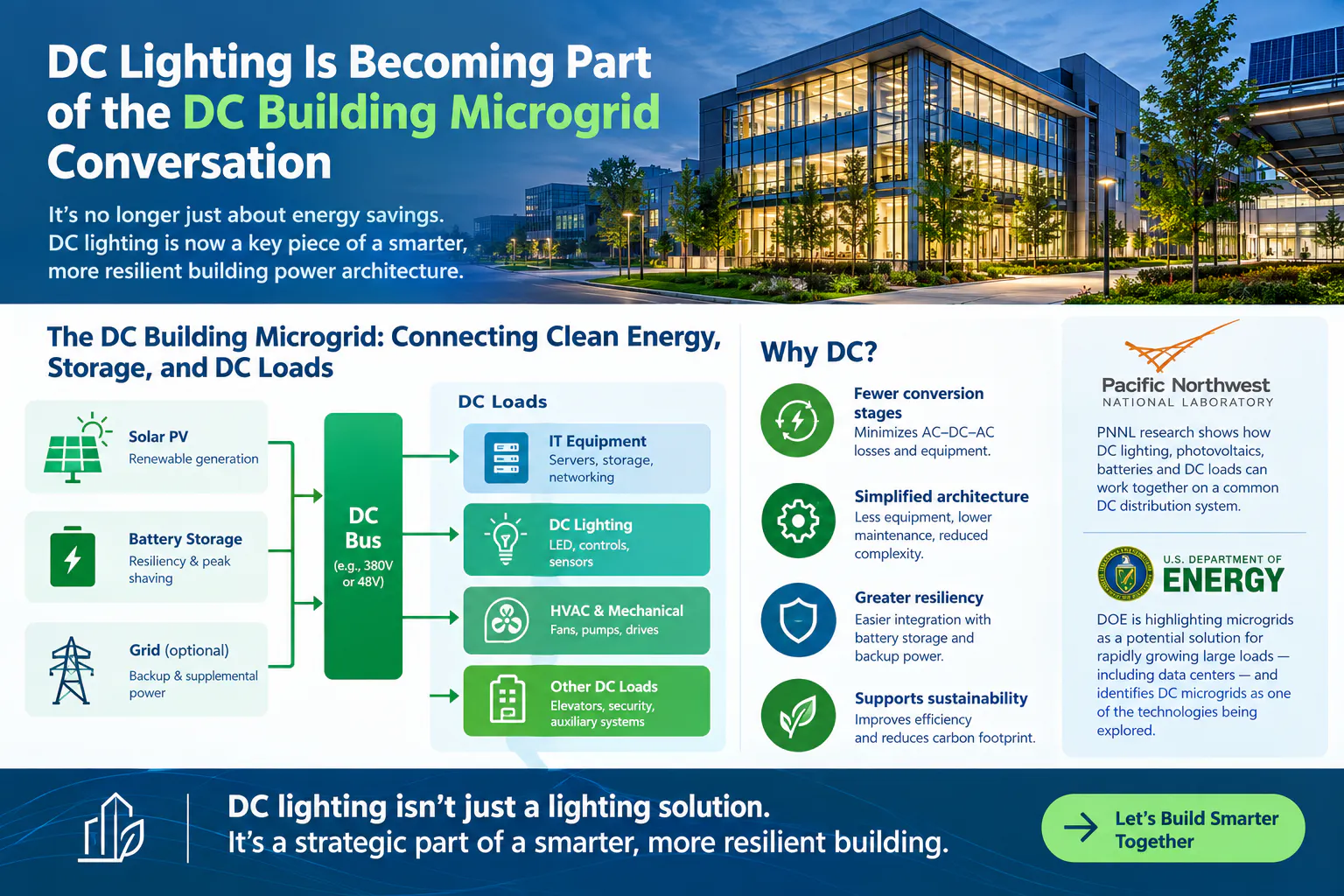
This represents an important shift in thinking. Rather than viewing lighting as an isolated electrical load, designers and facility owners can begin to see DC-powered LED lighting as part of an integrated electrical ecosystem—one that connects generation, storage, controls, and end-use devices through a more streamlined power architecture.
As buildings become smarter, more electrified, and increasingly reliant on distributed energy resources, the question is no longer whether lighting can save energy. The more strategic question is: How can lighting contribute to a more resilient, efficient, and intelligent DC-powered building? That conversation is gaining momentum—and DC lighting has an important role to play.