


By Kennedy Maize
A nine-year-old, massive utility bribery scandal in Ohio, which has so far sent a prominent Republican legislator to jail, indicted a former state utility regulator — now deceased — of accepting bribes, and sullied state politicians, utility officials, and industry lobbyists across the Buckeye State, may be coming to an end.
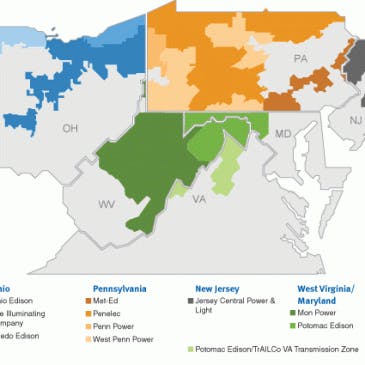
The trial of two top former FirstEnergy executives, indicted on multiple state and federal racketeering charges, began in state court in Akron last week (Feb. 3), the home of giant, multi-state electric utility FirstEnergy. Former CEO Chuck Jones and senior vice president Michael Dowling are charged with participating in what became a $60 million bribery scandal designed to keep two uneconomic Ohio nuclear plants in service.
Jones and Dowling are charged with making a $4.3 million bribe in 2019 to a private group led by long-time Ohio energy industry supporter Sam Randazzo for assistance in a plan to bail out the utility’s failing Davis and Perry nuclear plants, which were draining the company of money. Randazzo was then serving the first year of a term on the Public Utilities Commission of Ohio and as chairman of the Ohio Power Siting Board. The bribe was just one element of what became a secretive utility-financed lobbying effort to keep the plants running at the expense of its customers.
The nuclear units had been unable to win bids to supply the PJM Interconnection regional transmission organization with generating capacity because the troubled nukes were uneconomical. According to federal prosecutors, FirstEnergy began funding an effort to get ratepayers to subsidize the financially failing nuclear plants in March 2017.
As recounted by a detailed Common Cause of Ohio chronology of the scandal, the FirstEnergy subsidiary created to manage the nuclear plants declared bankruptcy in March, 2018.
In April, 2019, a bill appeared in the Ohio House, HB 6, providing for utility rate payers to bail out the nuclear plants, along with subsidies for some coal-fired plants that were also unable to win PJM capacity payments. The legislation would add some $1.3 billion annually to customer bills. Randazzo was elevated to chair the utility regulatory commission the same month.
During May through July, a series of ads appeared (surreptitiously First-Energy funded) on TV, social media, and in mailboxes promoting the legislation. Republican House Republican legislator Larry Householder had a secret $61 million fund from First Energy he used to secure the Republican votes to become House Speaker and then steered HB 6 through the legislature. The Ohio Senate passed the bill in May by 19-12. The House followed in July, 53-43. DeWine signed it into law. In August, Ohio’s Attorney General approved a referendum to overturn HB 6, putting its implementation on hold.
FirstEnergy responded by surreptitiously funding a $1 million TV ad campaign opposing the referendum. The pro-referendum forces missed an October deadline to get enough signatures to put the issue on the upcoming ballot and HB 6 went into effect. In November, at Randazzo’s direction, the PUCO ruled that FirstEnergy did not need to go through a new rate case in order to reap the benefits of HB 6.
The HB 6 financial finagle fell apart on July 21, 2020, when FBI agents arrested Householder and four prominent Republican lobbyists on federal racketeering conspiracy charges in the HB 6 drama. Householder was promptly ousted as House Speaker although not expelled from the legislature.
After a six-month trial ending in early 2023, Householder and former Ohio Republican Party chief Mathew Borges were found guilty of racketeering and wire fraud. Householder was sentenced to 20 years in prison. Borges was sentenced to five years in prison.
According to the federal prosecutors, “Team Householder spent millions of the company’s dollars to support Householder’s political bid to become Speaker, to support House candidates they believed would back Householder, and for their own personal benefit.” The statement added, “FirstEnergy Corp. signed a deferred prosecution settlement in July 2021, agreeing to pay a $230 million penalty for conspiring to bribe public officials and others.”
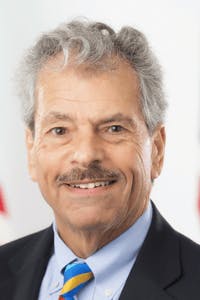
Randazzo resigned from the PUCO in November 2020 as the scandal began to unravel. The resignation came less than a day after a FirstEnergy filing at the Securities and Exchange Commission revealed that the company had fired Jones and Dowling. Randazzo was indicted in December 2023 on federal charges of bribery and embezzlement. In February 2024 he was indicted on state charges. On April 9 2024, Randazzo was found dead, hanging from a rope, in a warehouse he owned. The death was ruled a suicide. He was 74.
In September 2024, Jones and Dowling faced state bribery charges and the Securities and Exchange Commission charged Jones separately on the HB 6 scheme. Then came federal criminal charges early last year.
At the opening of the trial last week, the Cleveland Plain Dealer reported, “Jones’ and Dowling’s attorneys have said the $4.3 million was part of a settlement that FirstEnergy reached with companies that Randazzo represented as an energy attorney before he was appointed to PUCO.
“Dowling’s attorney, Steven Grimes, said FirstEnergy paid Randazzo as required by the settlement and the money ended up in Randazzo’s account, not his clients’, because Randazzo was a ‘conman’ and a ‘thief.’ Jones and Dowling and anyone at FirstEnergy had no idea he stole that money, Grimes said.”
The state trial is expected to last two months. HB 6 has been largely repealed.
Texas-based independent generation company Vistra Corp. in March 2023 announced it had bought Davis-Besse, Perry, and FirstEnergy’s two-unit Beaver Valley nuclear plant in western Pennsylvania. Vistra paid $3 billion in cash and $400 million in assumed debt.
Facebook parent Meta is buying 2,176 MW of energy and capacity from Vistra as part of its plans for AI data centers in the PJM Interconnection.
