


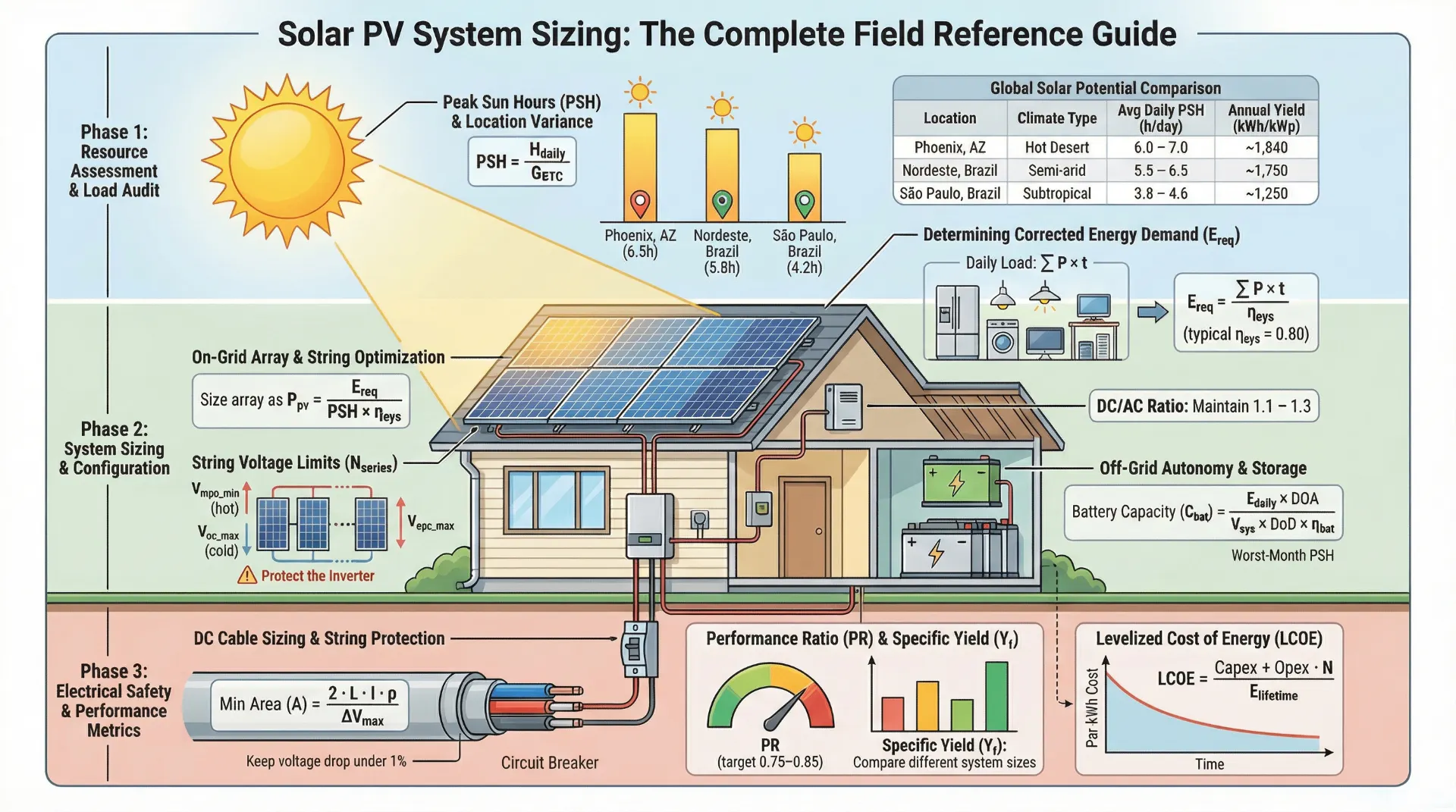
Great solar projects aren't born from rule-of-thumb estimates — they're built on a disciplined, three-phase engineering methodology that starts long before a single panel is mounted. Phase one is resource assessment and load audit: calculating Peak Sun Hours (PSH = H_daily / G_ETC) to quantify how irradiance truly varies by site — from Phoenix's hot-desert 6.0–7.0 h/day, to Nordeste Brazil's semi-arid 5.5–6.5 h/day, down to São Paulo's subtropical 3.8–4.6 h/day.
That single variable, PSH, is the foundation everything else is built on — get it wrong, and every downstream calculation inherits the error. In parallel, corrected energy demand (E_req) is derived from the sum of connected loads (ΣP×t) adjusted for system efficiency (typically η_sys = 0.80), giving a realistic — not theoretical — target for array output.
Phase two turns that demand into hardware: array capacity is sized as P_pv = E_req / (PSH × η_sys), while string configuration must respect voltage limits (V_oc_max in cold, V_mpo_min in hot) to protect the inverter across the full temperature swing the site will experience.
A DC/AC ratio held between 1.1–1.3 balances inverter clipping against economic oversizing, and for off-grid or hybrid designs, battery capacity is calculated from daily energy need, days of autonomy (DOA), depth of discharge (DoD), and worst-month PSH — ensuring the system holds up not on an average day, but on the worst one.
Phase three is where design accountability lives: DC cable sizing (A = 2·L·I·ρ / ΔV_max) to keep voltage drop under 1%, Performance Ratio (PR) targeting the 0.75–0.85 band as the clearest single indicator of real-world system health, Specific Yield (Y_f) to fairly benchmark systems of different sizes and locations, and ultimately Levelized Cost of Energy (LCOE = (Capex + Opex·N) / E_lifetime) to translate all of the above into a single, defensible cost-per-kWh figure over the project's lifetime.
This is what separates a system that simply generates electricity from one that delivers predictable, bankable, long-term performance — and it's precisely this level of technical-financial rigor that gives solar and agrivoltaic proposals credibility with municipalities, developers, and financing partners. Every well-sized system starts with respecting the physics — and ends with numbers that hold up under scrutiny.
#SolarPV #SolarEnergy #RenewableEnergy #Agrivoltaics #DistributedGeneration #EnergyStorage #PerformanceRatio #LCOE #EngineeringExcellence #CleanTech #SustainableEnergy #SolarDesign